
▶️ Answer/Explanation
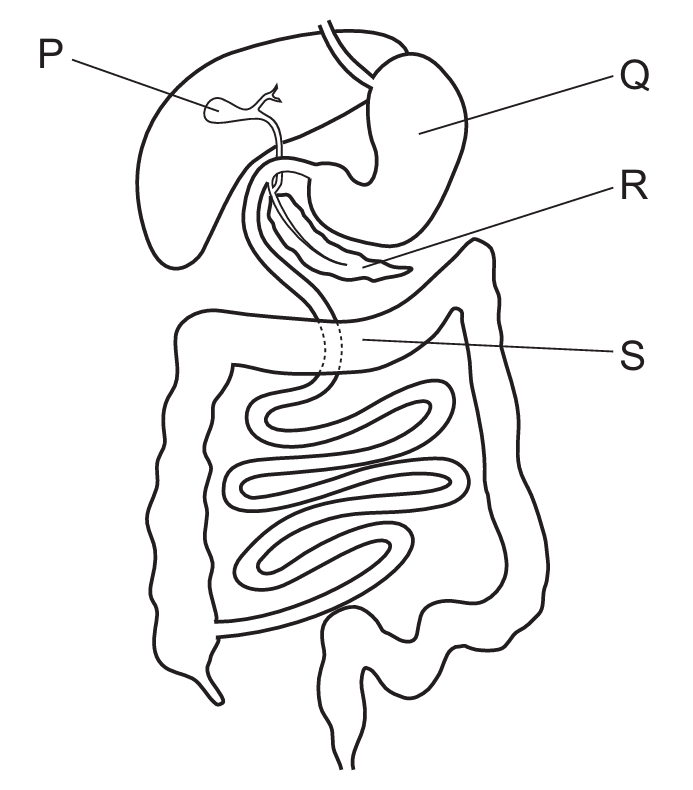
In the diagram, P is the liver (produces bile but not digestive enzymes), Q is the pancreas (produces amylase, protease and lipase), R is the small intestine (produces intestinal enzymes) and S is the stomach (produces protease). Therefore, the organs that produce digestive enzymes are Q (pancreas) and R (small intestine).
✅ Answer: (B)
✅ Answer: (B)
▶️ Answer/Explanation
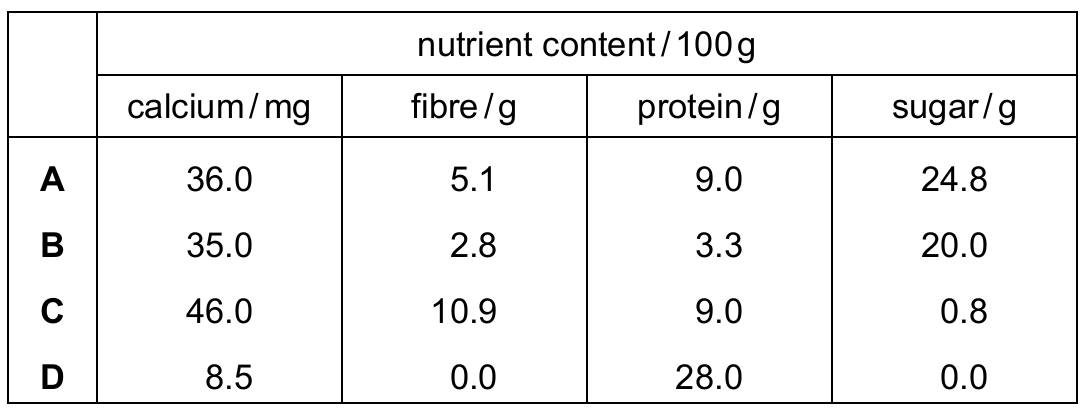
Fibre (roughage) is the nutrient that helps move food through the alimentary canal by aiding peristalsis.
Row C has the highest fibre content (10.9 g per 100 g) compared to the other rows.
✅ Answer: (C)
Row C has the highest fibre content (10.9 g per 100 g) compared to the other rows.
✅ Answer: (C)
▶️ Answer/Explanation
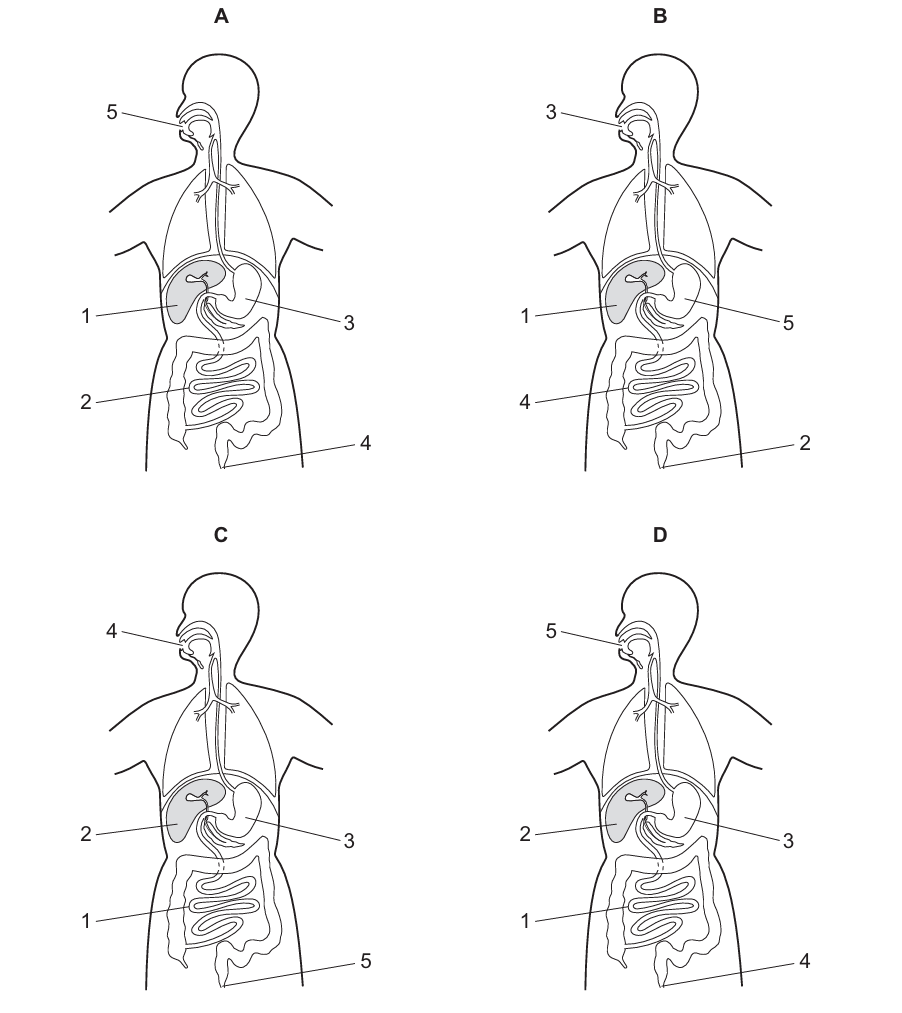
The correct sequence along the gut is \(\text{ingestion} \rightarrow \text{digestion} \rightarrow \text{absorption} \rightarrow \text{assimilation} \rightarrow \text{egestion}\).
Diagram D places processes \(5, 2, 1, 3, 4\) at the mouth, stomach/intestine, small intestine, liver/cells, and anus respectively, matching this correct anatomical order.
✅ Answer: (D)
Diagram D places processes \(5, 2, 1, 3, 4\) at the mouth, stomach/intestine, small intestine, liver/cells, and anus respectively, matching this correct anatomical order.
✅ Answer: (D)
▶️ Answer/Explanation
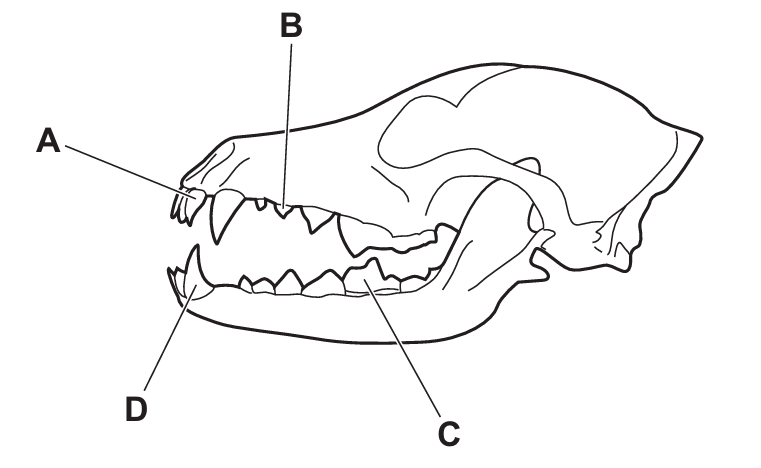
Canine teeth are pointed and cone-shaped, used mainly for gripping and tearing food, unlike the flat-edged incisors or the ridged, flatter premolars and molars.
Of the four shapes shown, the tooth with a single sharp, pointed cusp and no flat biting or grinding surface matches this description.
This distinctive pointed shape identifies option D as the canine.
✅ Answer: (D)
Of the four shapes shown, the tooth with a single sharp, pointed cusp and no flat biting or grinding surface matches this description.
This distinctive pointed shape identifies option D as the canine.
✅ Answer: (D)