
CIE iGCSE Co-Ordinated Science B7.2 Digestive system Exam Style Questions Paper 4
Question
Most-appropriate topic codes (Cambridge IGCSE Co-ordinated Sciences 0654, 2025–2027 syllabus):
• Topic B7.2 — Digestive system (Parts (a), (b))
• Topic B7.1 — Diet (Part (c)(i))
• Topic B4 — Biological molecules (Part (c)(ii))
• Topic B7.3 — Digestion (Part (d))
▶️ Answer/Explanation
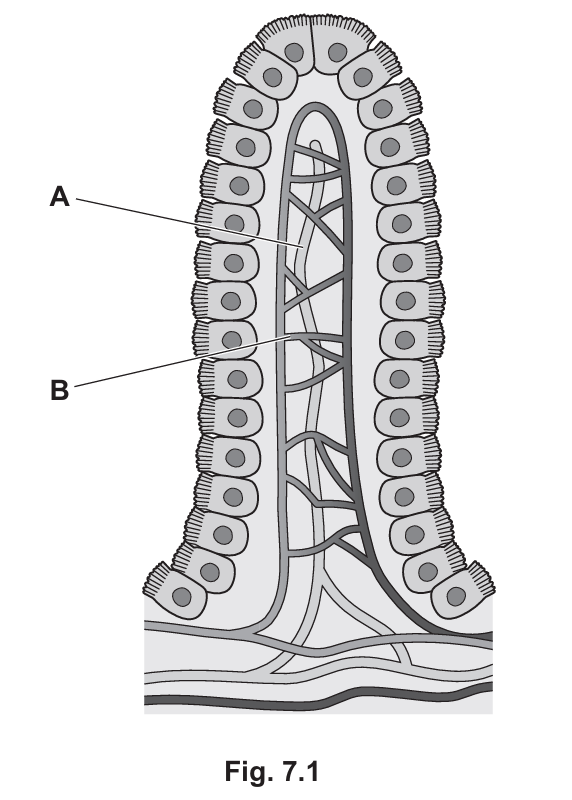
(a)(i) Lacteal — absorption/transport of fat
The structure labelled A at the centre of the villus is the lacteal.
Its function is the absorption and transport of digested fats away from the small intestine.
(a)(ii) Thin walls give a short diffusion distance
Part B, the villus surface/wall, is only one cell thick.
This gives a short diffusion distance for the transfer of digested nutrients into the bloodstream.
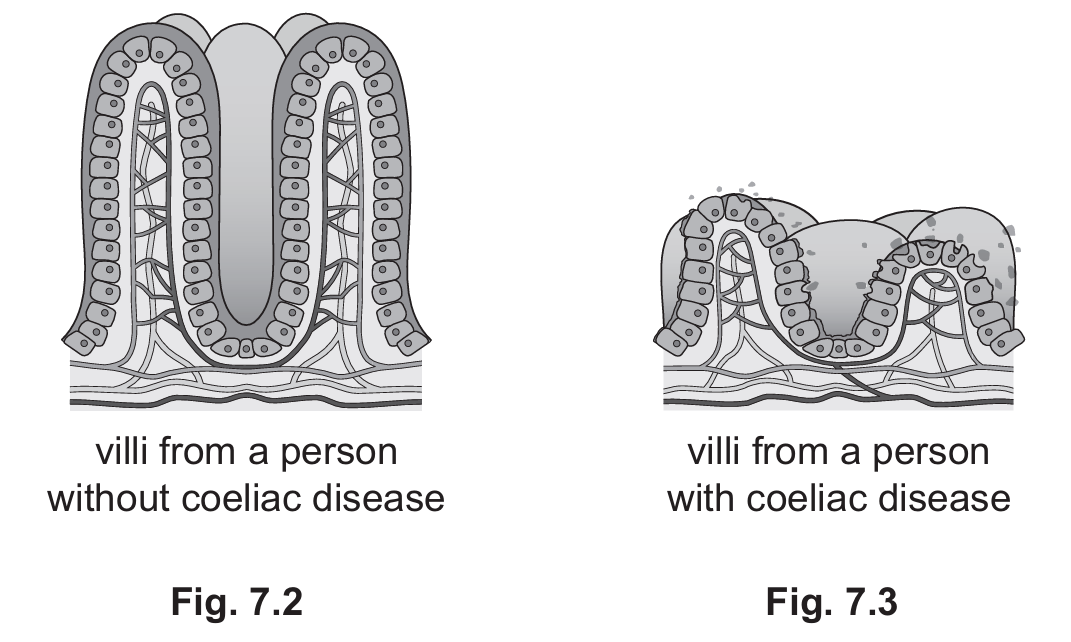
(b)(i) Shorter / flatter / smaller villi
In Fig. 7.3, the villi appear shorter, flatter, and smaller compared to the tall, finger-like villi in Fig. 7.2.
(b)(ii) Less surface area for absorption of nutrients
Flattened villi have a reduced surface area compared to healthy villi.
This decreases the rate of absorption of digested nutrients into the blood, contributing to malnutrition in coeliac disease.
(c)(i) Marasmus / kwashiorkor
Both marasmus and kwashiorkor are diseases caused by protein-energy malnutrition.
(c)(ii) Biuret solution (biuret test)
The biuret test is used to detect the presence of protein in a sample, giving a purple/lilac colour change when protein is present.
(d) 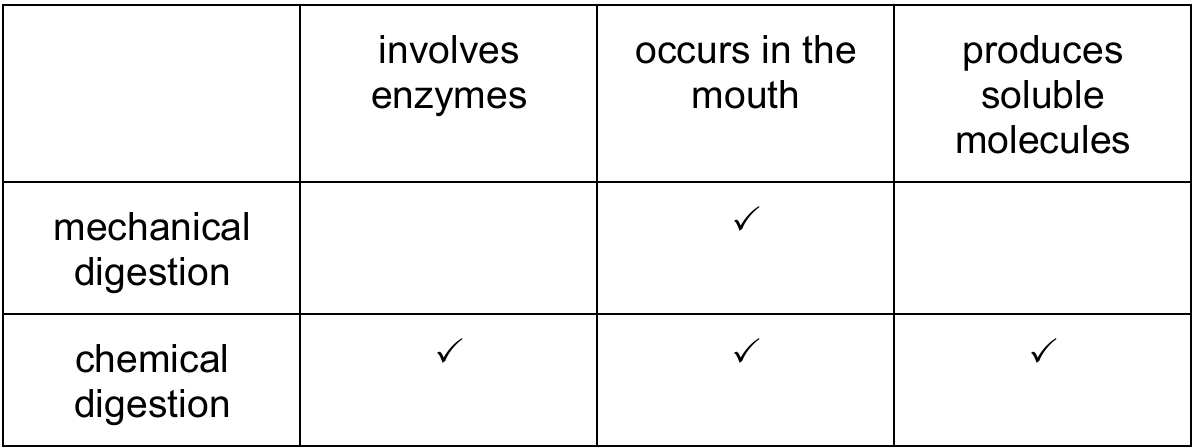
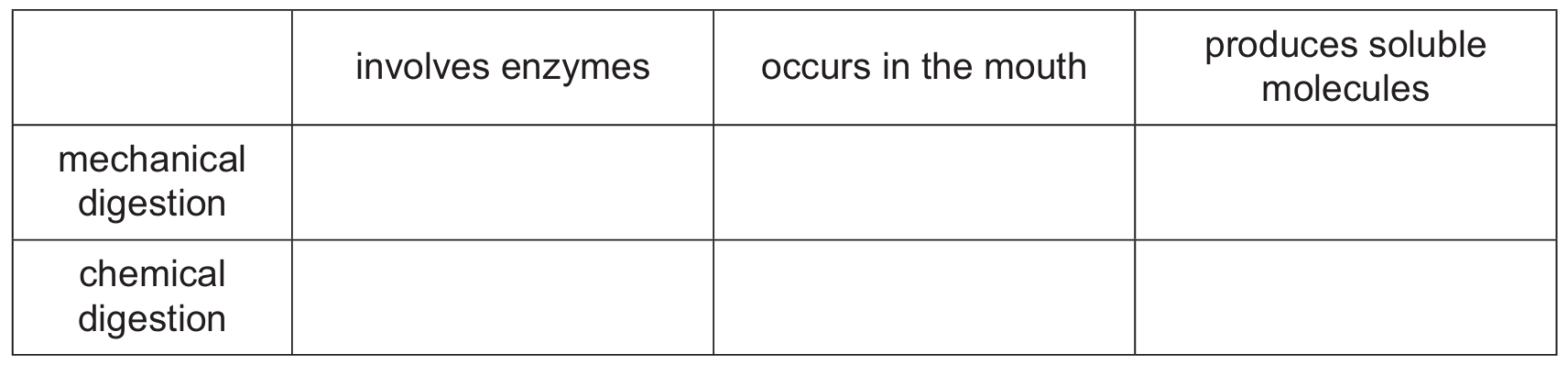
Mechanical digestion (e.g. chewing) physically breaks food into smaller pieces and occurs in the mouth, but does not involve enzymes or directly produce soluble molecules.
Chemical digestion involves enzymes which break down large insoluble molecules into smaller, soluble molecules.
Question
Most-appropriate topic codes (Cambridge IGCSE Co-ordinated Sciences 0654):
• Topic B7.2 — Digestive system (Part (a))
• Topic B5 — Enzymes (Part (b))
• Topic B7.3 — Digestion (Parts (c), (d))
▶️ Answer/Explanation
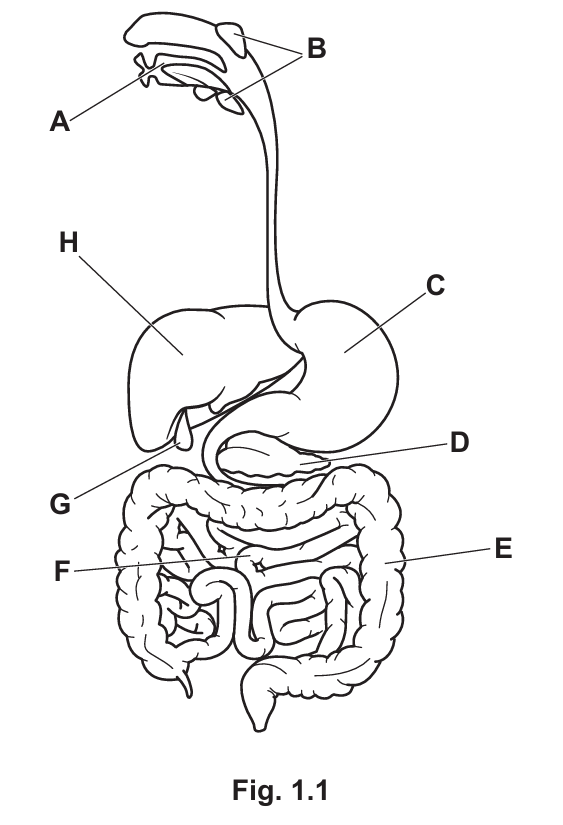
(a) villi: F bile: H insulin: D mechanical digestion: A and/or C
The small intestine (F) has a folded lining covered in villi that increase surface area for absorption.
The liver (H) produces bile, which is stored in the gall bladder and released into the duodenum.
The pancreas (D) contains islet cells that secrete the hormone insulin.
Mechanical digestion (physical breakdown without chemical change) occurs in the mouth (A), where teeth chew food, and/or the stomach (C), where muscular churning breaks food up further.
(b) Salivary amylase; breaks down starch into simpler sugars
Part B is the salivary gland, which secretes the enzyme amylase.
Amylase is a carbohydrase that catalyses the hydrolysis of starch (a carbohydrate) into maltose, a simpler/smaller sugar molecule.
This chemical digestion begins in the mouth and continues until the enzyme is denatured by stomach acid.
(c) Any two of: incisor, canine, pre-molar, molar
Humans have four types of teeth specialised for different jobs: incisors and canines for cutting/tearing, and pre-molars and molars for crushing/grinding food.
Stating any two of these four named types earns full credit.
(d) Any four of: neutralises stomach acid to give a suitable pH; emulsifies fats; increases surface area for chemical digestion; increases the rate of digestion
Bile is alkaline, so it neutralises the acidic chyme arriving from the stomach, creating the optimum pH for intestinal and pancreatic enzymes such as lipase.
Bile also emulsifies fats, breaking large fat droplets into smaller ones.
This increases the surface area of fat exposed to lipase, which speeds up (chemical) fat digestion.