
CIE iGCSE Co-Ordinated Science B7.3 Digestion Exam Style Questions Paper 3
Question
Most-appropriate topic codes (Cambridge IGCSE Co-ordinated Sciences 0654):
• Topic B7.2 — Digestive system (Part (a))
• Topic B7.3 — Digestion (Part (b))
• Topic B7.1 — Diet (Part (c))
▶️ Answer/Explanation
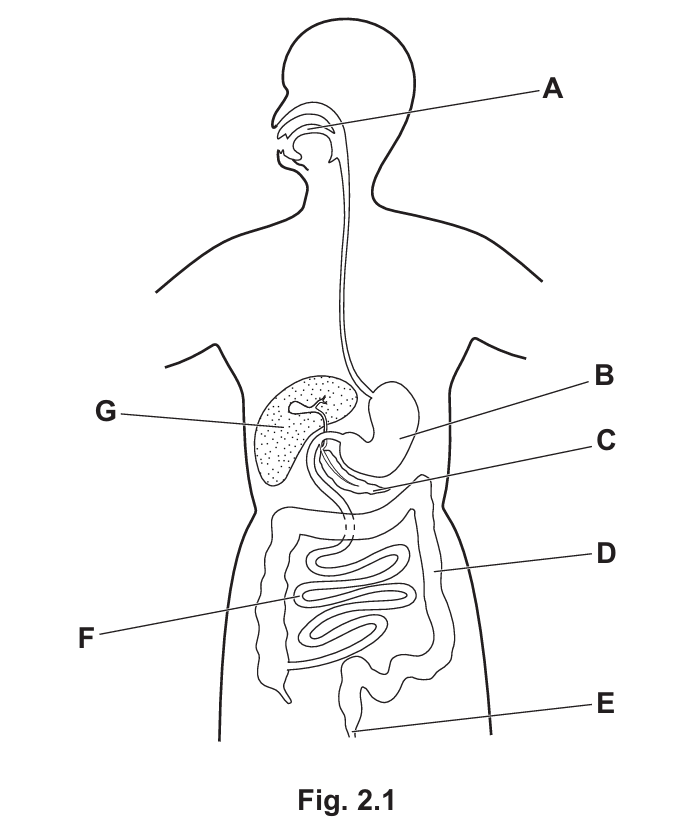
(a)(i) the anus: E ; the liver: G
The anus is the terminal opening of the alimentary canal, labelled E in the diagram. The liver is a large organ located above the stomach, labelled G.
(a)(ii) absorption: D or F ; digestion: A or B or F
Absorption of nutrients occurs mainly in the small intestine (D) and also in the large intestine (F). Digestion begins in the mouth (A), continues in the stomach and small intestine, and also occurs in the large intestine (F) where bacteria digest some material.
(b) physical / mechanical ; insoluble ; soluble ; chemical
Physical/mechanical digestion breaks food into smaller pieces, increasing surface area. Chemical digestion breaks down large insoluble molecules into small soluble molecules that can be absorbed through the intestinal wall into the blood.
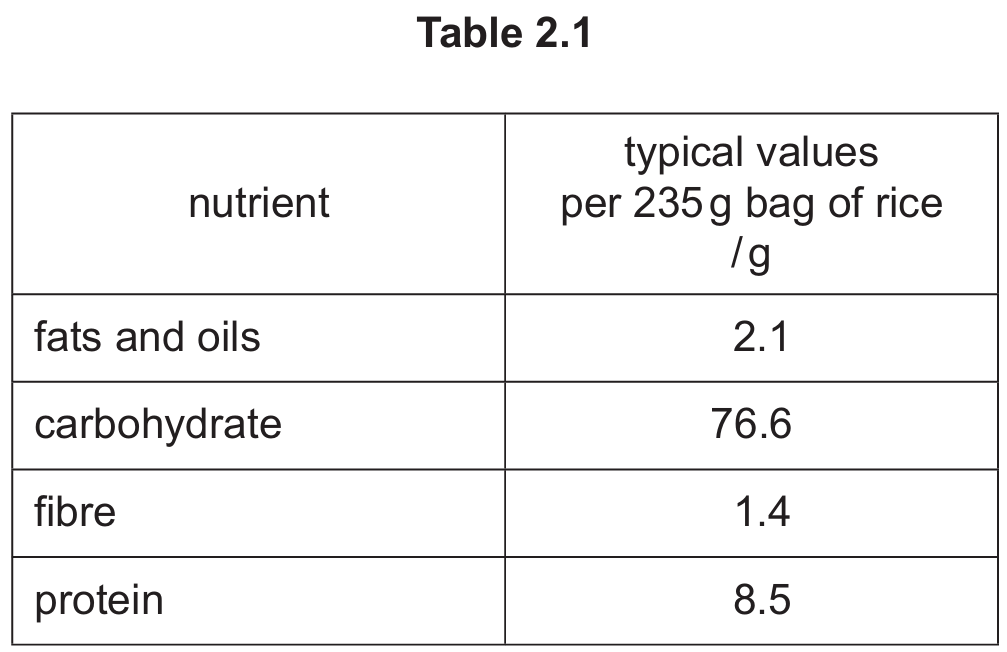
(c)(i) Percentage of protein = (8.5 ÷ 235) × 100 = 3.6%
To calculate percentage, divide the mass of protein by the total mass of the rice and multiply by 100.
(c)(ii) Vitamins / minerals / water
A balanced diet requires vitamins, minerals (such as calcium and iron), and water in addition to carbohydrates, fats, proteins and fibre.
Question
Most-appropriate topic codes (Cambridge IGCSE Co-ordinated Sciences 0654):
• Topic B7.3 — Digestion (Part (a))
• Topic B7.3 — Digestion / data interpretation skills (Part (b))
• Topic B9.4 — Blood (Part (c))
▶️ Answer/Explanation
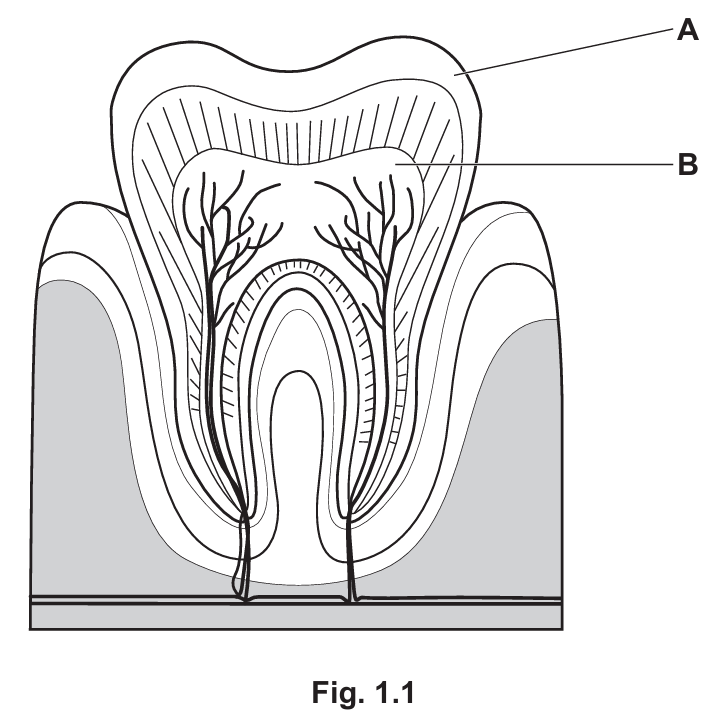
(a)(i) A — enamel; B — pulp (cavity)
Label A points to the hard white outer covering of the crown, which is enamel.
Label B points to the soft central region containing nerves and blood vessels, which is the pulp (cavity).
(a)(ii) Mechanical (physical) digestion
Teeth break food into smaller pieces by a physical/mechanical action.
No chemical change to the food molecules occurs, so this is mechanical (physical) digestion.
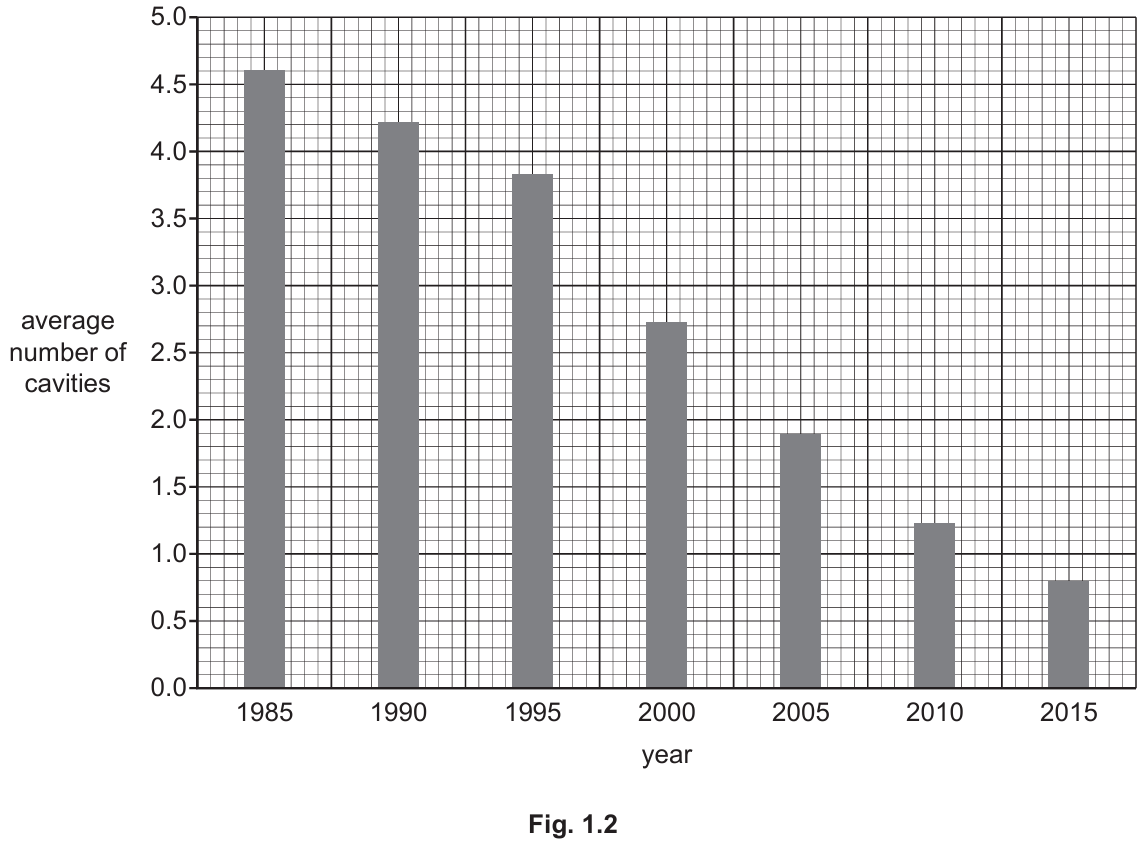
(b)(i) Average number of cavities in 1985 = 4.6; in 2015 = 0.8; percentage decrease ≈ 83%
Percentage decrease is calculated using \(\text{percentage decrease} = \dfrac{\text{decrease in value}}{\text{original value}} \times 100\).
Decrease in value \(= 4.6 – 0.8 = 3.8\).
Percentage decrease \(= \dfrac{3.8}{4.6} \times 100 \approx 83\%\).
(b)(ii) Any three from: improved dental care/technology; reduced sugar consumption / more calcium in diet; better dental health education; fluoride added to water/toothpaste
Better access to dentists and modern dental treatments reduces cavity formation.
Lower sugar intake and improved diet reduce the substrate available for cavity-causing bacteria.
Increased public health education and fluoride use (in water or toothpaste) strengthen enamel and improve oral hygiene.
(c) Any two from: red blood cells; white blood cells; plasma; platelets
Blood is made up of four main components.
These are red blood cells, white blood cells, platelets, and plasma.
Any two of these components score full marks.