
CIE iGCSE Co-Ordinated Science B8.1 Xylem and phloem Exam Style Questions Paper 3
Question
Most-appropriate topic codes (Cambridge IGCSE Co-ordinated Sciences 0654):
• Topic B9.2 — Heart (Part (a)(i), (a)(ii) & (b)(i))
• Topic B9.3 — Cardiovascular disease and risk factors (Part (b)(ii) & (b)(iii))
• Topic B8.1 — Xylem and phloem (Part (c)(i) & (c)(ii))
▶️ Answer/Explanation
(a)(i)
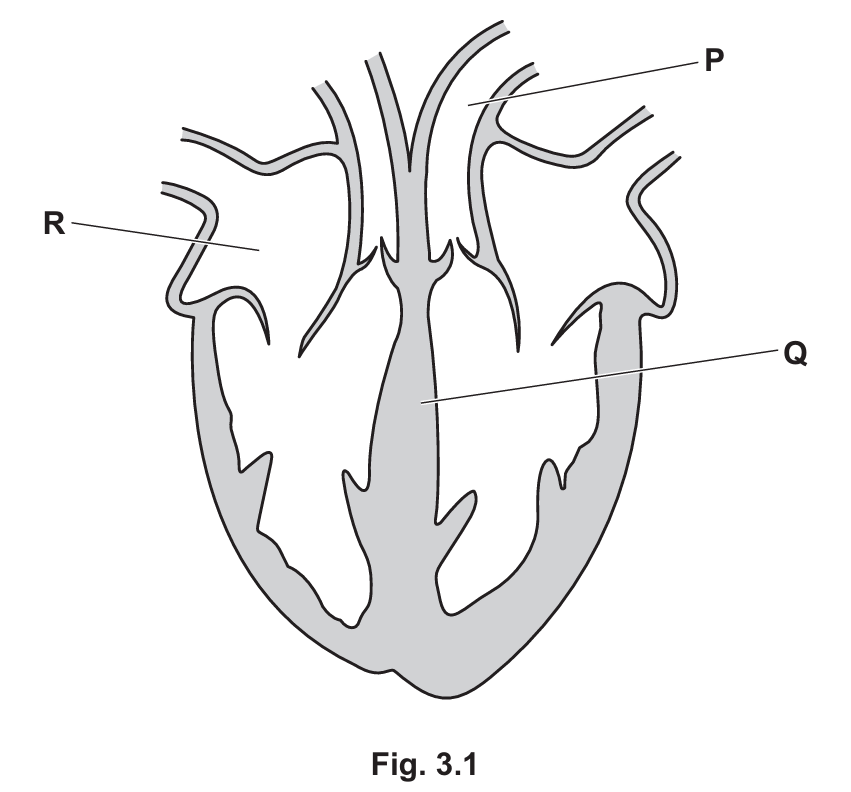
Q = septum
R = right atrium
The septum is the muscular wall dividing the heart into left and right halves, preventing mixing of oxygenated and deoxygenated blood. The right atrium is the upper-right chamber that receives deoxygenated blood returning from the body via the vena cava. Together they form the right side of the double circulatory system, directing blood toward the lungs.
(a)(ii)
1. Arteries have a thicker, more muscular wall than veins, which have thinner walls.
2. Arteries have a smaller lumen than veins, which have a wider lumen.
3. Veins contain valves to prevent backflow; arteries do not.
Arteries carry blood away from the heart under high pressure, requiring thick elastic walls to withstand and maintain that pressure. Veins return blood to the heart at much lower pressure, relying on valves and surrounding muscle contractions to keep blood flowing in the correct direction.
(b)(i)
coronary arteries
The coronary arteries branch directly from the aorta and wrap around the outer surface of the heart, delivering oxygenated blood to the cardiac muscle. Blockage of these vessels deprives the heart muscle of oxygen, causing a heart attack. They are essential because the heart cannot extract oxygen directly from the blood flowing through its chambers.
(b)(ii)
1. Smoking
2. High-fat / high-cholesterol diet (or: obesity, high blood pressure, stress, genetic predisposition)
Smoking damages arterial walls and reduces blood oxygen levels, accelerating atherosclerosis. A diet high in saturated fats raises blood cholesterol, causing fatty deposits (atheromas) to build up inside artery walls and narrowing the lumen. Both factors increase the risk of a heart attack or stroke by restricting blood flow to the heart muscle.
(b)(iii)
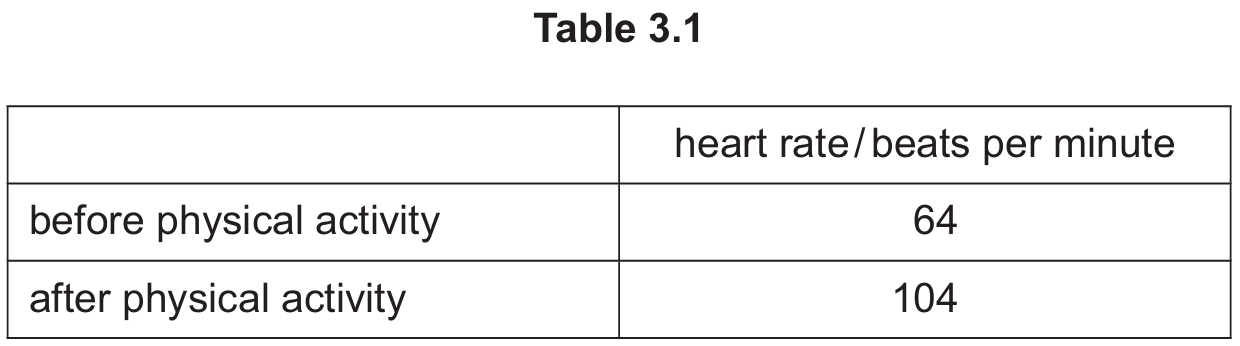
• Increase in heart rate $= 104 – 64 = 40$ beats per minute
• Percentage increase $= \dfrac{40}{64} \times 100$
• $\boxed{\text{Percentage increase} \approx 62.5\%}$
The heart rate rose by 40 bpm from its resting value of 64 bpm. Dividing the change by the original resting value and multiplying by 100 gives approximately 62.5%. This increase reflects the body’s demand for more oxygen and faster removal of carbon dioxide during physical activity.
(c)(i)
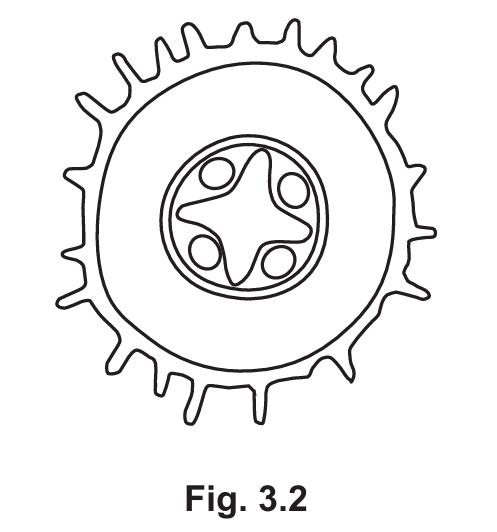
X (xylem) — labelled at the centre of the root where the tissue forms a star- or cross-shaped core.
P (phloem) — labelled in the regions between the arms of the xylem star.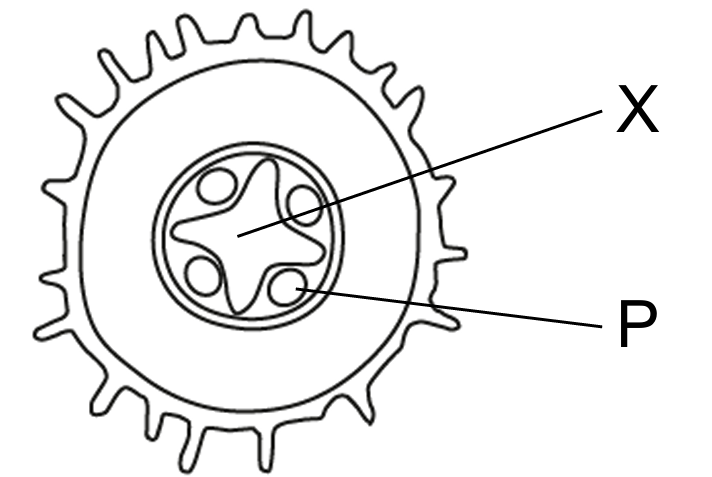
In dicotyledonous roots the vascular tissue is arranged centrally, with xylem forming the inner star and phloem nestled between its arms. This arrangement is distinct from the ring arrangement found in stems and is well-suited to withstanding the pulling forces of water uptake from soil.
(c)(ii)
The xylem transports water and mineral ions.
The phloem transports sucrose and amino acids.
Xylem consists of dead, lignified hollow tubes that move water and dissolved minerals upward from roots to leaves, driven by transpiration. Phloem is living tissue that moves the products of photosynthesis (sucrose) and nitrogen-containing compounds (amino acids) in both directions between sources and sinks — a process called translocation.
Question
Most-appropriate topic codes (Cambridge IGCSE Co-ordinated Sciences 0654):
• Topic B8.1 — Xylem and phloem (Part (a))
• Topic B6.1 — Photosynthesis (Part (b))
• Topic B8.2 — Water uptake (Part (c))
• Topic B8.3 — Transpiration (Part (d))
▶️ Answer/Explanation
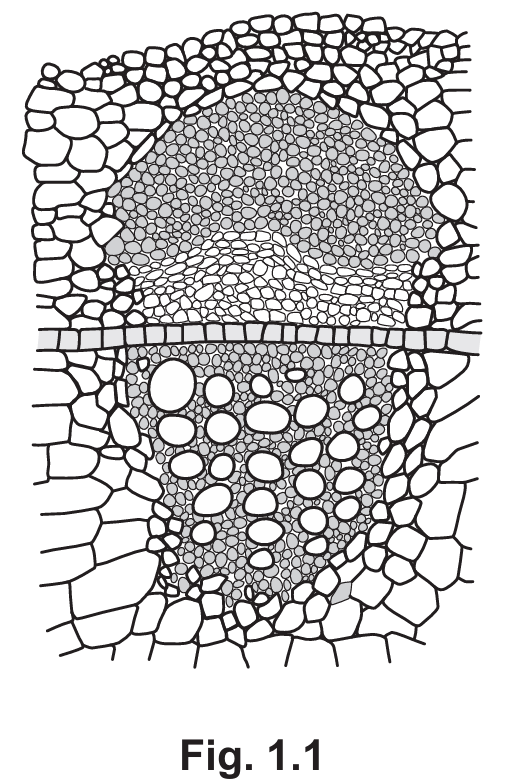
(a) Correct line drawn and labelled Y on the phloem tissue in the vascular bundle.
Sucrose is transported in the phloem, which is part of the vascular bundle in the stem. The label line should point to the phloem region.
(b) Plants make carbohydrates using the process of photosynthesis.
This process requires water and carbon dioxide in the presence of light energy and chlorophyll.
Photosynthesis is the process by which plants synthesise carbohydrates from carbon dioxide and water using light energy absorbed by chlorophyll in chloroplasts.
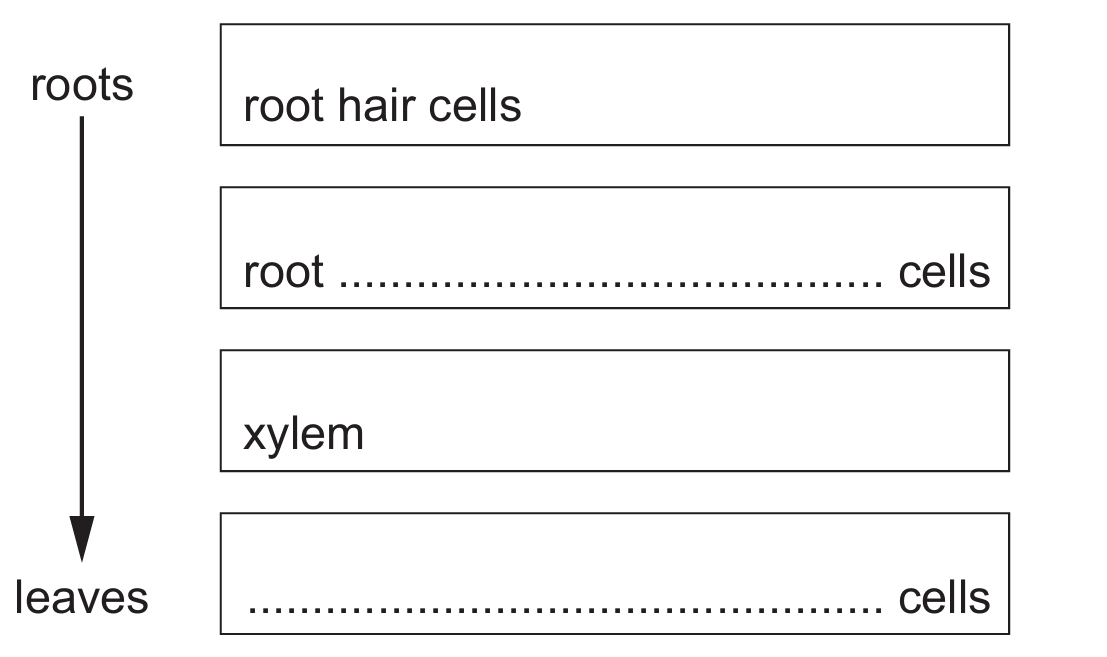
(c) roots → root hair cells → root cortex cells → xylem → leaves → mesophyll cells
Water enters through root hair cells by osmosis, passes through the cortex to the xylem, travels up the stem, and reaches the mesophyll cells in the leaves where it is used for photosynthesis or evaporates.
(d)(i) Transpiration
Transpiration is the loss of water vapour from the leaves of a plant, mainly through stomata.
(d)(ii) Stomata
Stomata are small pores on the leaf surface through which water vapour diffuses out of the leaf during transpiration.