

▶️ Answer/Explanation
A flaccid cell is one that has lost water and lacks turgor pressure.
This happens when a cell is placed in a solution with a lower water potential than the cell itself, causing net water loss by osmosis.
Cell C shows the shrunken cytoplasm typical of a flaccid cell, unlike the firm, swollen shape of a turgid cell.
✅ Answer: (C)
This happens when a cell is placed in a solution with a lower water potential than the cell itself, causing net water loss by osmosis.
Cell C shows the shrunken cytoplasm typical of a flaccid cell, unlike the firm, swollen shape of a turgid cell.
✅ Answer: (C)

▶️ Answer/Explanation
Transpiration is the loss of water vapour from the leaves, mainly through the stomata.
High temperature gives water molecules more kinetic energy, so they evaporate and diffuse out faster.
Low humidity keeps the concentration gradient of water vapour steep between the leaf and the air, speeding further water loss.
✅ Answer: (B)
High temperature gives water molecules more kinetic energy, so they evaporate and diffuse out faster.
Low humidity keeps the concentration gradient of water vapour steep between the leaf and the air, speeding further water loss.
✅ Answer: (B)
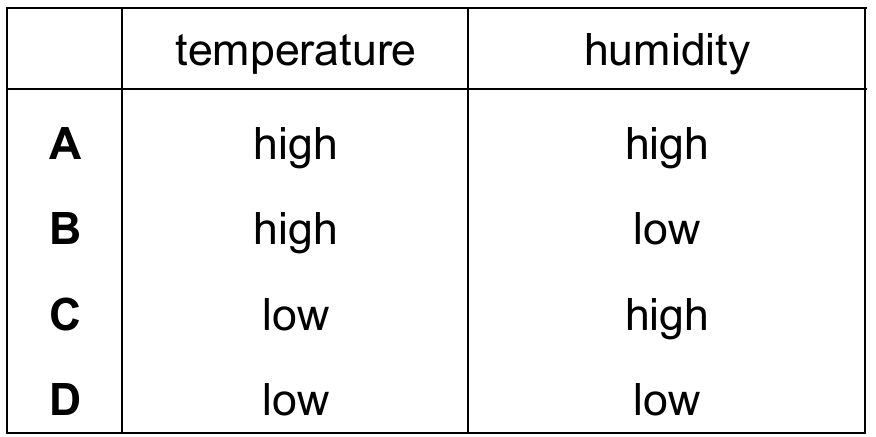
▶️ Answer/Explanation
Transpiration is the loss of water vapour from the leaves, mainly through the stomata.
High temperature gives water molecules more kinetic energy, so they evaporate and diffuse out faster.
Low humidity keeps the concentration gradient of water vapour steep between the leaf and the air, speeding further water loss.
✅ Answer: (B)
High temperature gives water molecules more kinetic energy, so they evaporate and diffuse out faster.
Low humidity keeps the concentration gradient of water vapour steep between the leaf and the air, speeding further water loss.
✅ Answer: (B)

▶️ Answer/Explanation
Potato pieces gain water and become turgid (increase in length) in dilute sucrose solutions, where water potential outside is higher than inside the cells.
In concentrated sucrose solutions, water leaves the potato cells by osmosis, so the cells lose water and become flaccid, shown as a decrease in length.
The pieces are most flaccid at the highest sucrose concentration tested, where the greatest net water loss occurs.
✅ Answer: (D)
In concentrated sucrose solutions, water leaves the potato cells by osmosis, so the cells lose water and become flaccid, shown as a decrease in length.
The pieces are most flaccid at the highest sucrose concentration tested, where the greatest net water loss occurs.
✅ Answer: (D)