
CIE iGCSE Co-Ordinated Science B8.2 Water uptake Exam Style Questions Paper 3
Question
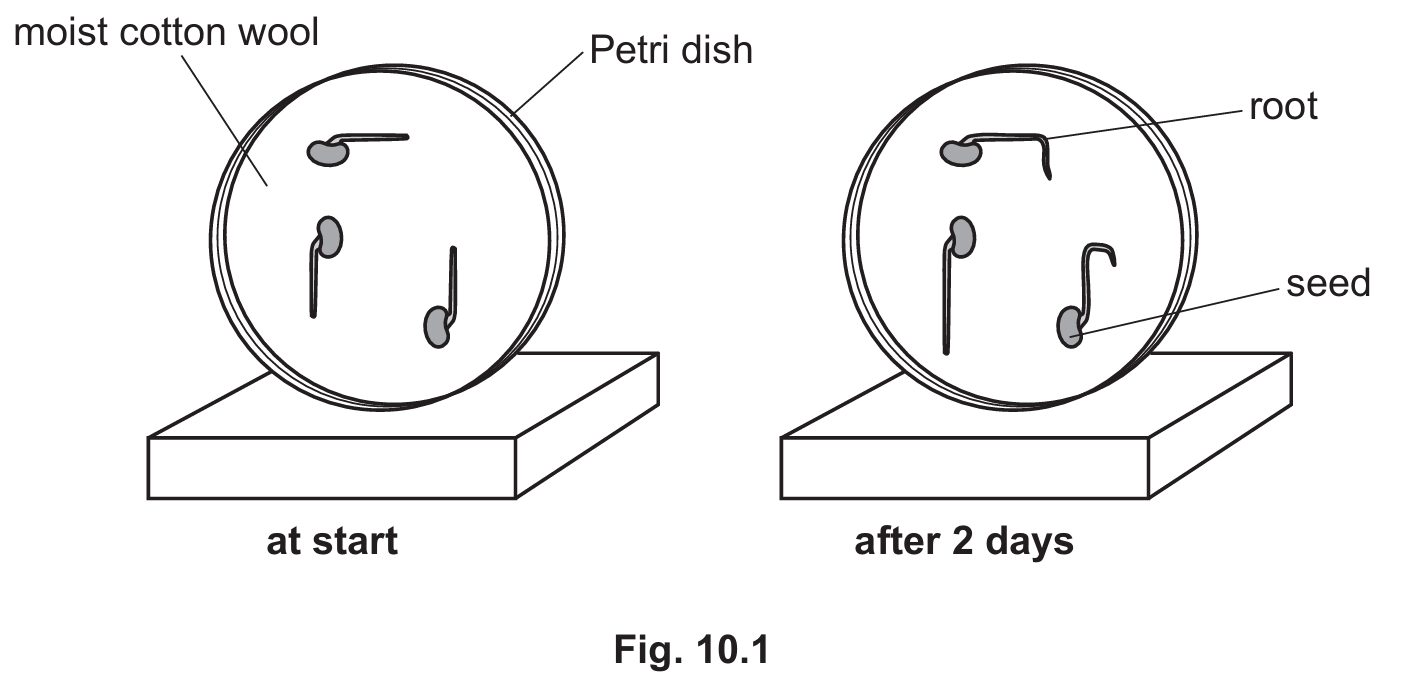
After 2 days the roots have grown downwards.
This is a tropic response called ……………………………
The roots are growing downwards towards …………………………… to receive more water from the soil.
Most-appropriate topic codes (Cambridge IGCSE Co-ordinated Sciences 0654):
• Topic B13.1 — Coordination and response (Part (a)(i))
• Topic B8.2 — Water uptake (Part (a)(ii)–(iv))
• Topic B6.1 — Photosynthesis (Part (b))
• Topic B1.1 — Characteristics of living organisms (Part (c))
▶️ Answer/Explanation
(a)(i)
This is a tropic response called gravitropism (also accepted: geotropism).
The roots are growing downwards towards gravity to receive more water from the soil.
Roots are positively gravitropic — they grow in the direction of gravitational pull, which helps them anchor the plant and absorb water.
(a)(ii) Any two from:
1. Photosynthesis — water is a raw material for making glucose using light energy.
2. Support — water provides turgor pressure to keep plant cells firm and the plant upright.
(Also accepted: as a solvent; for germination; transport of minerals.)
(a)(iii) Root hair cell
Root hair cells have a large surface area due to their long thin extensions (root hairs), maximising water absorption from the soil.
Water enters by osmosis from the soil solution into the root hair cells.
(a)(iv) Xylem (vessels)
Xylem vessels are hollow, dead cells that form continuous tubes from root to leaf.
Water moves up through the xylem by transpiration pull (the movement of water due to evaporation from leaves).
(b) magnesium
Magnesium ions (\(\text{Mg}^{2+}\)) are essential for the synthesis of chlorophyll, the green pigment used in photosynthesis.
A magnesium deficiency causes yellowing of leaves (chlorosis) because chlorophyll cannot be produced.
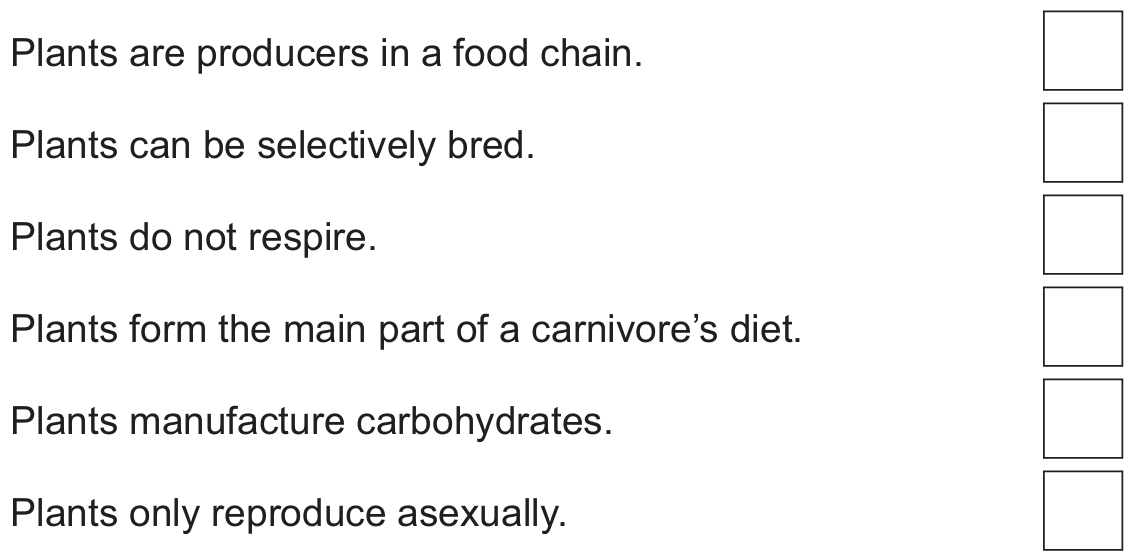
(c) Three correct statements: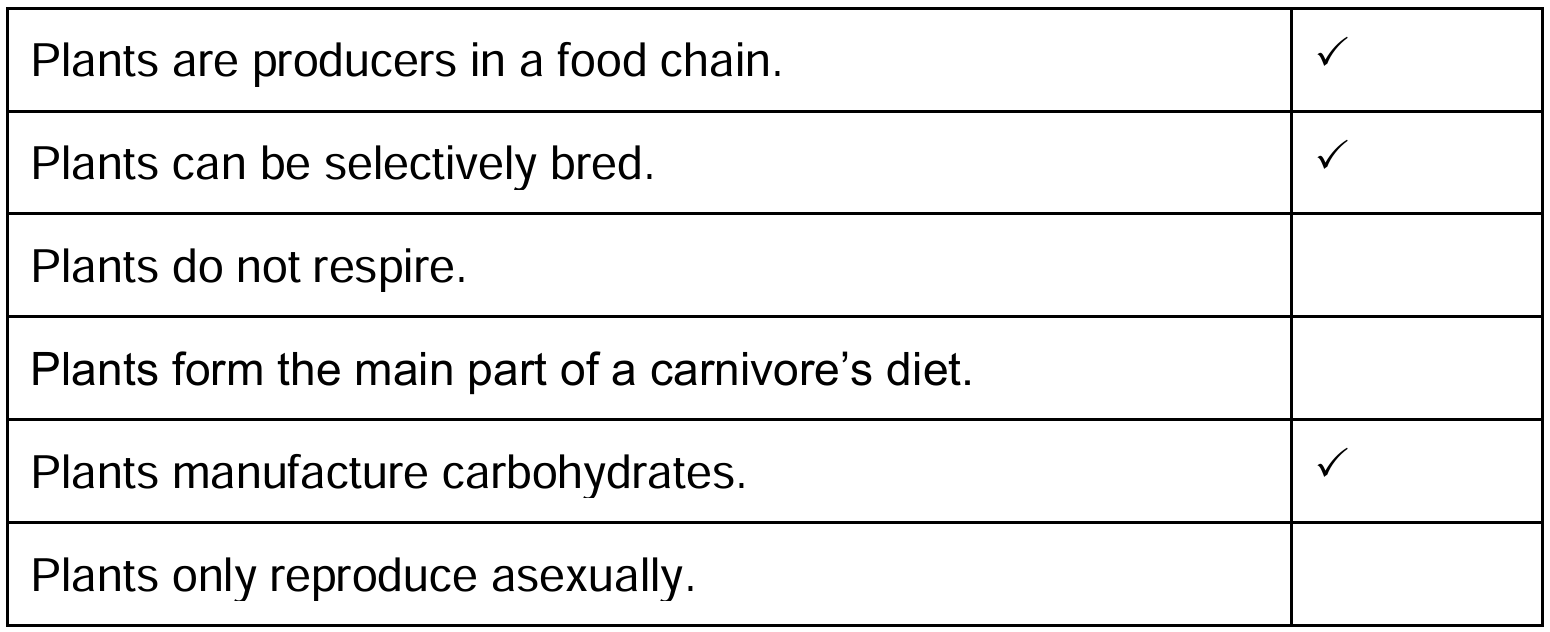
The other statements are incorrect: plants do respire; plants do not form the main part of a carnivore’s diet; and plants can reproduce both sexually and asexually.
Question
Most-appropriate topic codes (Cambridge IGCSE Co-ordinated Sciences 0654):
• Topic B8.1 — Xylem and phloem (Part (a))
• Topic B6.1 — Photosynthesis (Part (b))
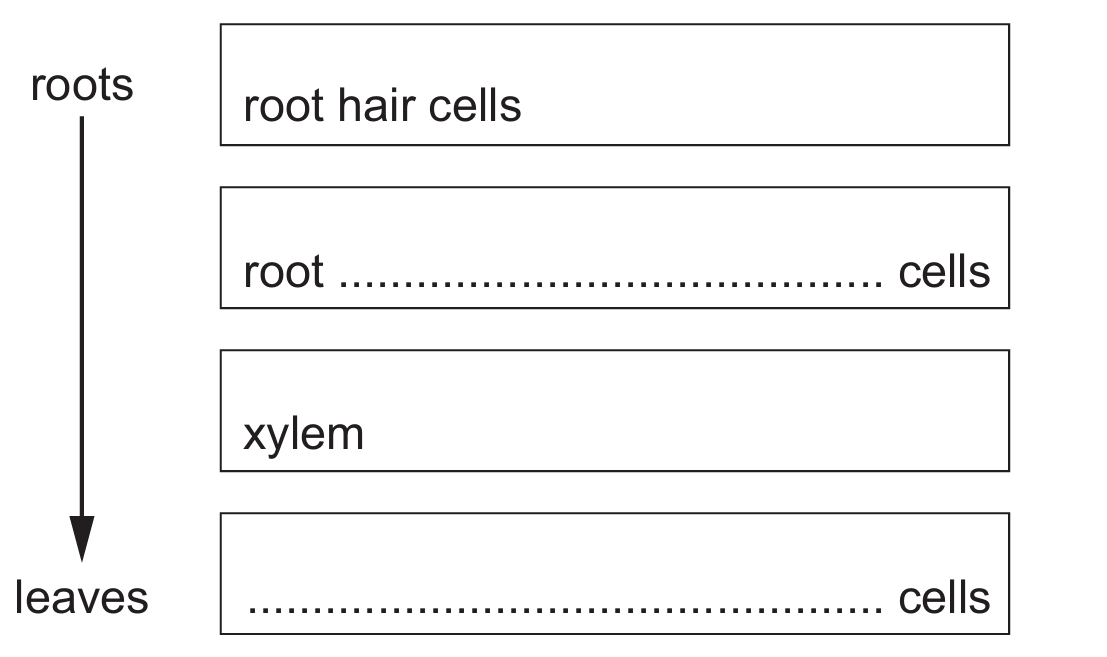
• Topic B8.2 — Water uptake (Part (c))
• Topic B8.3 — Transpiration (Part (d))
▶️ Answer/Explanation
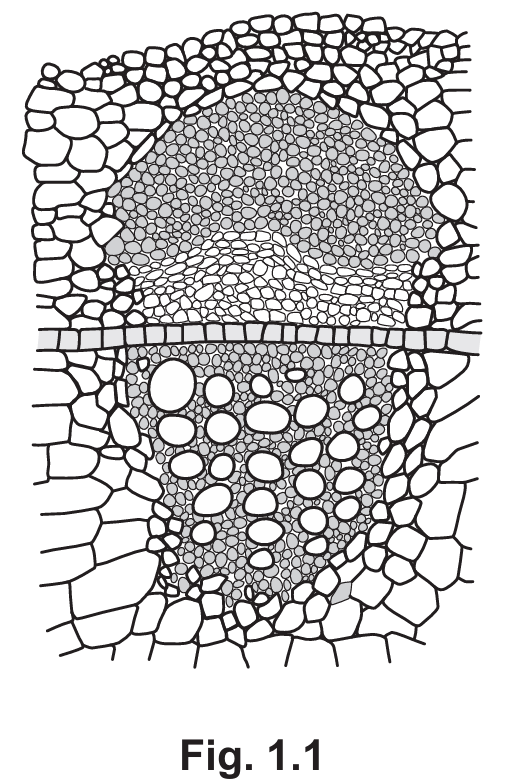
(a) Correct line drawn and labelled Y on the phloem tissue in the vascular bundle.
Sucrose is transported in the phloem, which is part of the vascular bundle in the stem. The label line should point to the phloem region.
(b) Plants make carbohydrates using the process of photosynthesis.
This process requires water and carbon dioxide in the presence of light energy and chlorophyll.
Photosynthesis is the process by which plants synthesise carbohydrates from carbon dioxide and water using light energy absorbed by chlorophyll in chloroplasts.
(c) roots → root hair cells → root cortex cells → xylem → leaves → mesophyll cells
Water enters through root hair cells by osmosis, passes through the cortex to the xylem, travels up the stem, and reaches the mesophyll cells in the leaves where it is used for photosynthesis or evaporates.
(d)(i) Transpiration
Transpiration is the loss of water vapour from the leaves of a plant, mainly through stomata.
(d)(ii) Stomata
Stomata are small pores on the leaf surface through which water vapour diffuses out of the leaf during transpiration.