
CIE iGCSE Co-Ordinated Science B8.2 Water uptake Exam Style Questions Paper 4
Question
Most-appropriate topic codes (Cambridge IGCSE Co-ordinated Sciences 0654):
• Topic B6.2 — Leaf structure (Part a)
• Topic B6.1 — Photosynthesis (Part b)
• Topic B8.4 — Translocation (Part c)
• Topic B8.2 — Water uptake (Part d)
▶️ Answer/Explanation
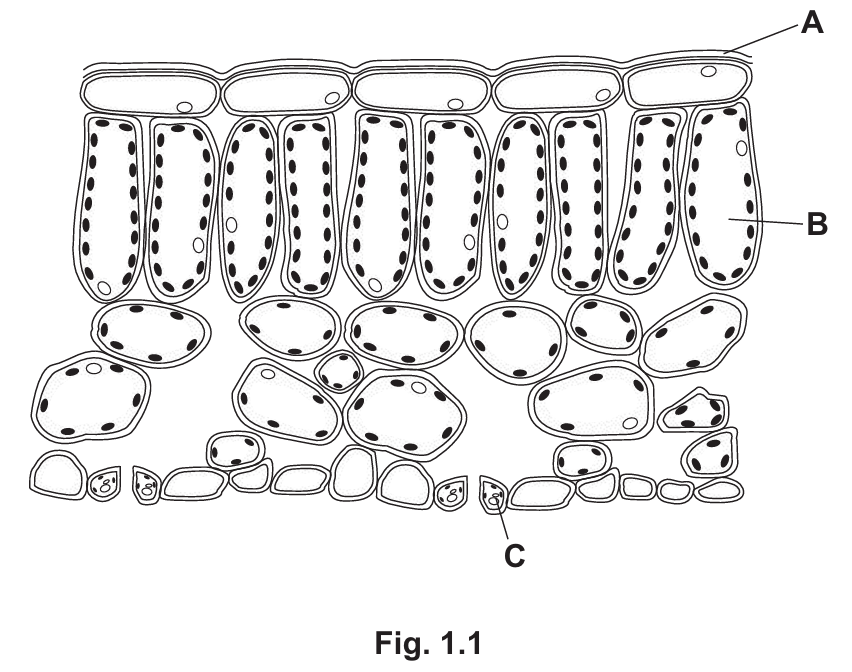
(a) Part A – Cuticle (waterproof / transparent):
The cuticle is the waxy layer covering the upper epidermis. Its waterproof nature prevents excessive water loss from the leaf surface, conserving water for photosynthesis. Its transparent property allows maximum sunlight to pass through to the photosynthetic cells beneath.
Cell B – Palisade mesophyll cells (contain many chloroplasts / located near upper surface):
These elongated, column-shaped cells are packed tightly together near the upper surface of the leaf. They contain numerous chloroplasts, which trap maximum light energy for photosynthesis. Their dense packing reduces light penetration loss and allows efficient absorption.
Cell C – Guard cells (open and close stomata):
Guard cells regulate the opening and closing of stomata (pores in the epidermis). When open, they allow carbon dioxide to diffuse into the leaf for photosynthesis and enable oxygen (a product) to diffuse out, while also controlling transpirational water loss.
(b)(i) Description of results:
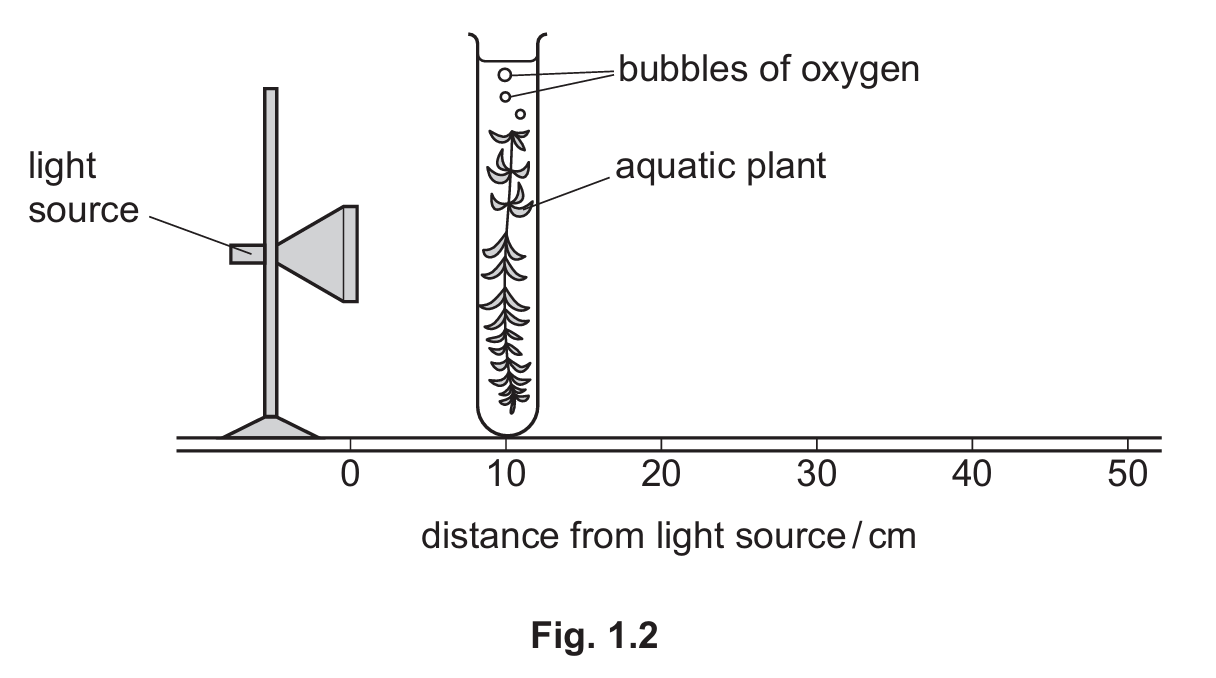
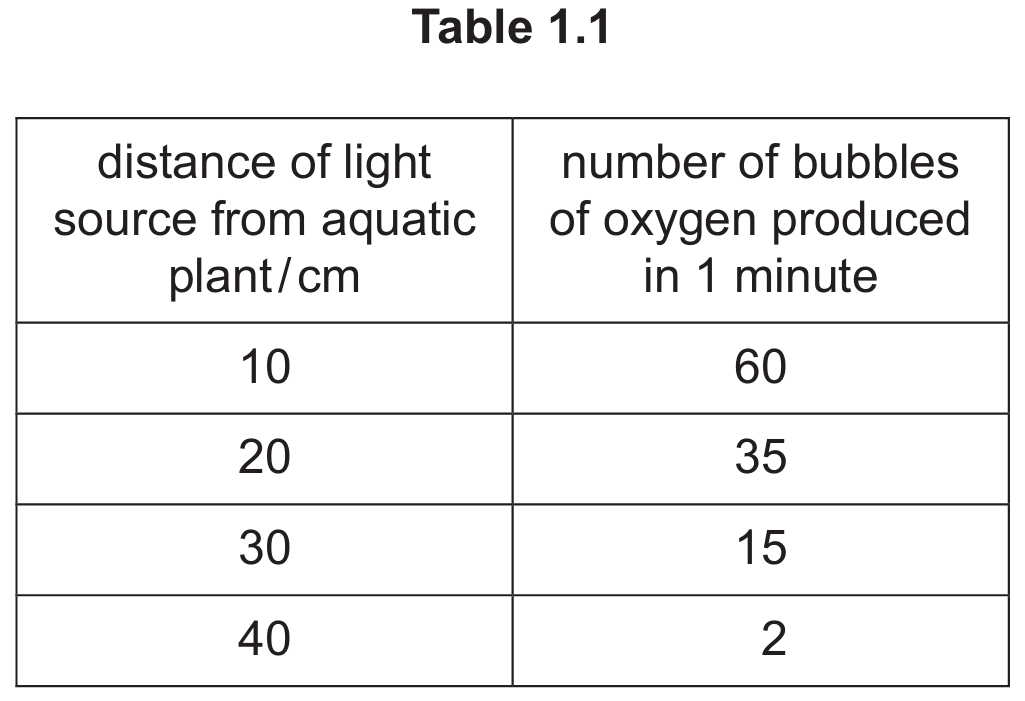
As the distance of the light source from the aquatic plant increases from 10 cm to 40 cm, the number of oxygen bubbles produced per minute decreases from 60 to 2.
Explanation:
Light intensity decreases as the distance from the light source increases (inverse square law). Since light provides the energy required for photosynthesis, a reduction in light intensity reduces the rate of photosynthesis. Oxygen gas is a product of photosynthesis, so fewer bubbles are produced at greater distances.
(b)(ii) Effect of temperature increase on the rate of photosynthesis:
The temperature increase of 3°C causes an increase in the rate of photosynthesis in the short term. The rise in temperature gives the reacting molecules (enzymes and substrates) more kinetic energy. This leads to more frequent, effective collisions between enzyme and substrate molecules, resulting in more enzyme-substrate complexes forming. However, if the temperature exceeds the optimum, enzymes would denature and the rate would decrease.
(c) Source:
A source is a part of a plant that releases sucrose or amino acids. For example, mature leaves that produce sucrose via photosynthesis or storage organs like tubers that break down starch.
Sink:
A sink is a part of a plant that uses or stores sucrose or amino acids. Examples include roots for storage, developing fruits, seeds, or actively growing meristems that require energy and building materials.
(d) Correct pathway – root hair cells → root cortex cells → xylem → mesophyll cells:
The correct route is: root hair cells absorb water from the soil → water passes through root cortex cells via osmosis → enters the xylem vessels in the root and stem → transported upwards to the leaf → moves out of xylem into mesophyll cells for photosynthesis.
Question
This creates a ………… gradient, drawing up a column of water molecules that are held together by ………… .
Most-appropriate topic codes (Cambridge IGCSE Co-ordinated Sciences 0654, 2025–2027 syllabus):
• Topic B8.2 — Water uptake (Part (a))
• Topic B6.2 — Leaf structure (Part (b))
• Topic B8.3 — Transpiration (Part (c))
• Topic B8.1 — Xylem and phloem (Part (d))
▶️ Answer/Explanation
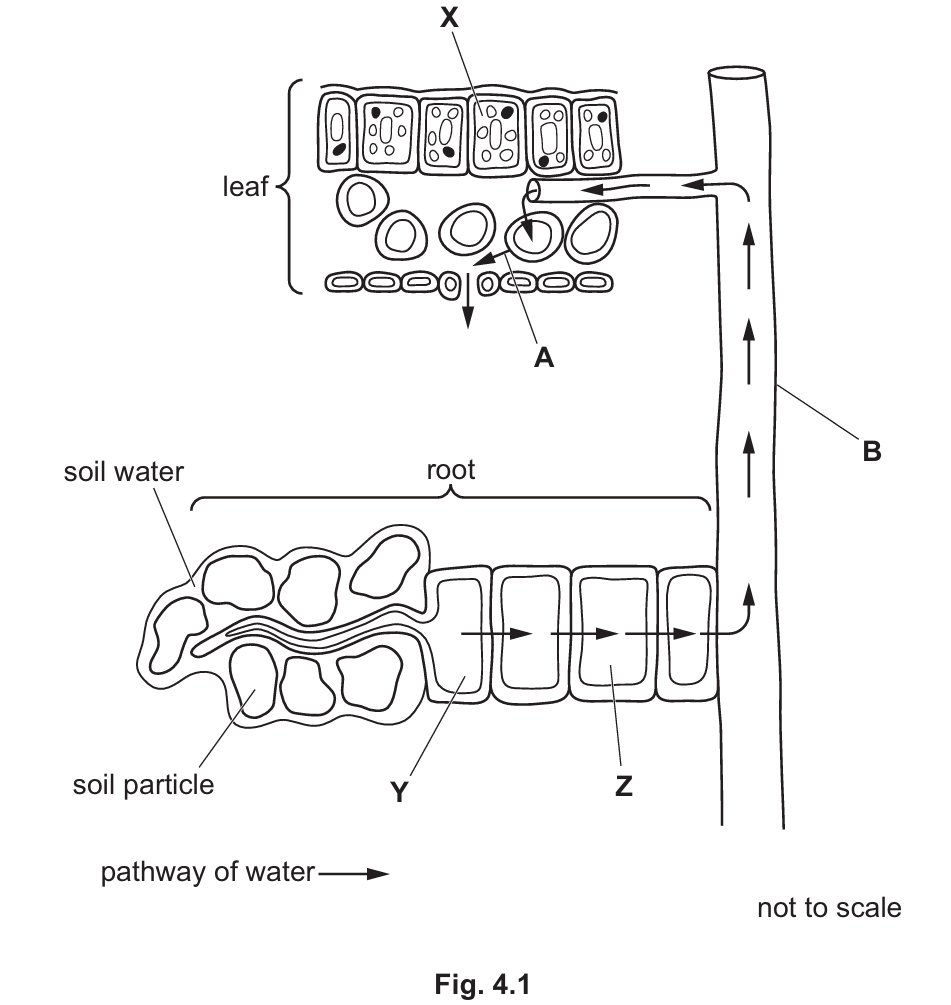
(a) Y = root hair cell, Z = (root) cortex cell
Y sits at the outer surface of the root in contact with soil water, identifying it as a root hair cell.
Z is positioned further along the water pathway inside the root, identifying it as a cortex cell.
(b) Many chloroplasts; positioned for maximum light absorption
Cell X contains numerous chloroplasts, increasing the chlorophyll available to absorb light.
It is column-shaped and positioned near the top of the leaf, maximising light capture for photosynthesis.
(c) Evaporation decreases
Increased humidity raises the water vapour concentration in the air surrounding the leaf.
This reduces the concentration (diffusion) gradient between the leaf’s air spaces and the atmosphere.
As a result, evaporation from the mesophyll cell surfaces at A decreases.
(d) Transpiration; water potential; cohesion
Water is moved up the xylem (part B) by transpiration pull.
This creates a water potential gradient along the xylem.
The column of water molecules is held together by cohesion (hydrogen bonding between water molecules).