Home / iGCSE / Coordinated Sciences / B8.3 Transpiration Paper 2

CIE iGCSE Co-Ordinated Science B8.3 Transpiration Exam Style Questions Paper 2

Question

In which weather conditions is the rate of transpiration fastest?

A. cold and dry
B. cold and wet
C. warm and dry
D. warm and wet

▶️ Answer/Explanation
Transpiration is the evaporation of water from plant leaves; it is fastest when the water vapour concentration gradient between the leaf interior and the surrounding air is greatest.
Warm conditions increase evaporation (more kinetic energy), and dry conditions keep the external humidity low, maintaining a steep diffusion gradient — so warm and dry is the fastest combination.
Answer: (C)

Question

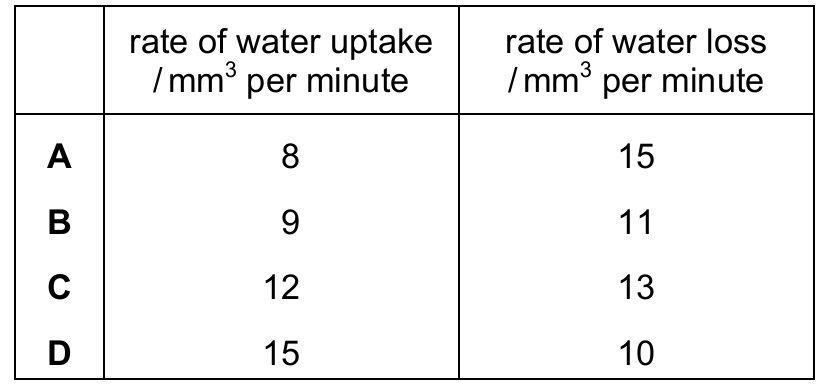
The rates of water uptake and loss are measured in four leaves. The results are shown in the table.

Which leaf is least likely to wilt?

▶️ Answer/Explanation
A leaf wilts when water loss (transpiration) exceeds water uptake, causing a net water deficit.
Leaf D is the only one where uptake (15) exceeds loss (10), giving a net water gain.
Answer: (D)

Question

Which cells lose water by evaporation from their surfaces during transpiration?

A. epidermis cells
B. guard cells
C. mesophyll cells
D. root hair cells

▶️ Answer/Explanation
Water evaporates from the moist surfaces of mesophyll cells inside the leaf, forming water vapour in the air spaces.
This vapour then diffuses out through the stomata (guard cell pores), but it is the mesophyll cells, not the guard cells themselves, where evaporation occurs.
Epidermis and root hair cells are not the sites of this evaporation step in transpiration.
Answer: (C)

Question

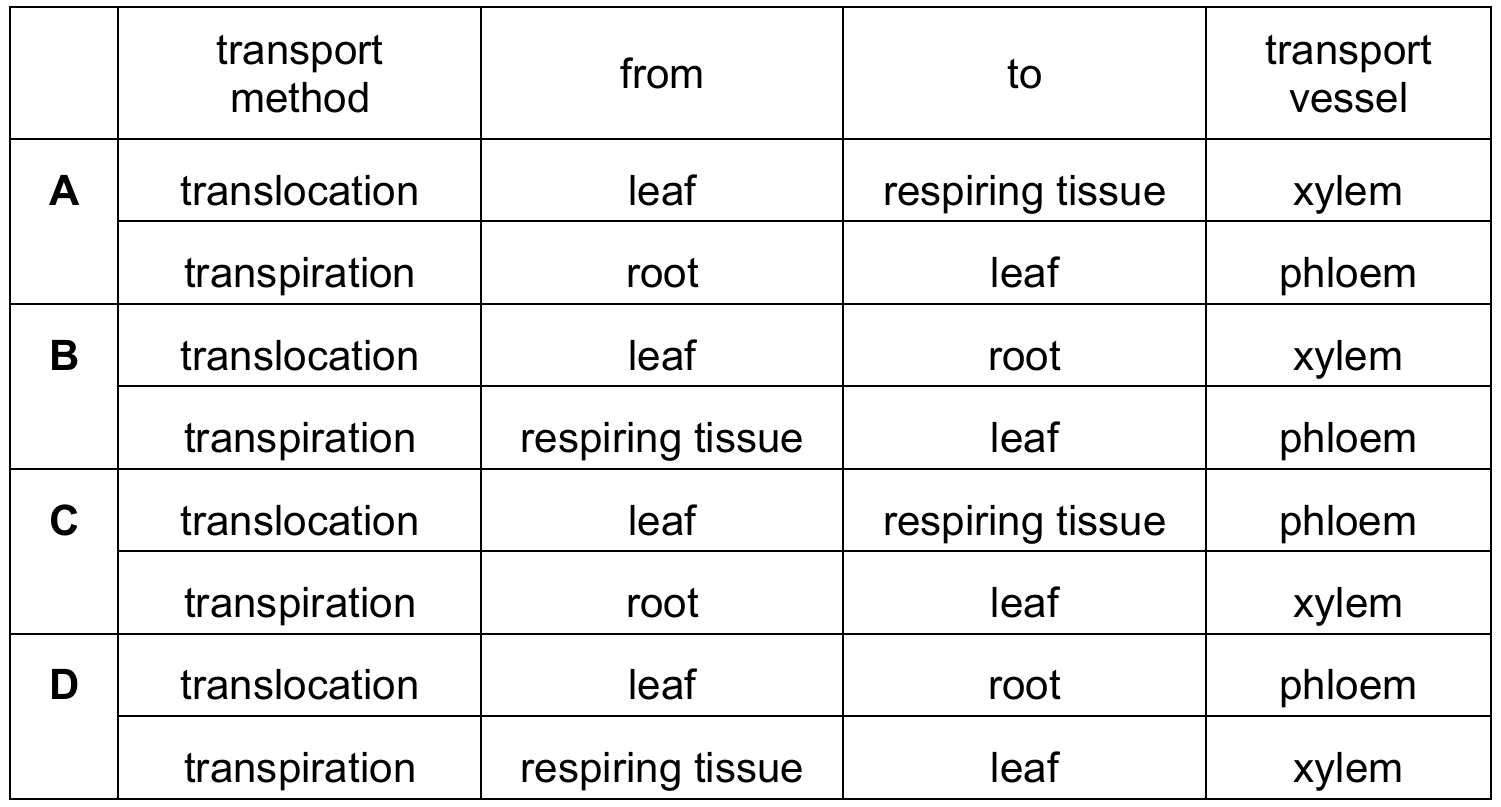
Which row correctly describes translocation and transpiration in plants?

▶️ Answer/Explanation
Translocation is the transport of sugars made in the leaf to respiring tissues (and storage organs), and it occurs in the phloem.
Transpiration is the movement of water from the root up to the leaf, and it occurs in the xylem.
Only row C matches both of these correctly (translocation: leaf → respiring tissue via phloem; transpiration: root → leaf via xylem).
Answer: (C)

Question

Where does evaporation of water occur during transpiration?

A. from the air spaces through the stomata
B. from the phloem
C. from the surfaces of mesophyll cells
D. from the xylem

▶️ Answer/Explanation
Water moves from the xylem into the mesophyll cells inside the leaf.
It evaporates from the moist surfaces of these mesophyll cells into the internal air spaces of the leaf.
The water vapour then diffuses out of the leaf through the stomata into the surrounding air, which is the final exit step rather than the evaporation site itself.
Answer: (C)
Scroll to Top