
CIE iGCSE Co-Ordinated Science B8.4 Translocation Exam Style Questions Paper 3
Question
The artery has been identified.


Fig. 10.3 is a simplified cross-section of a plant stem.

Most-appropriate topic codes (Cambridge IGCSE Co-ordinated Sciences 0654, 2025–2027 syllabus):
• Topic B9.3 — Blood vessels (Part (a))
• Topic B9.3 — Blood vessels (Part (b))
• Topic B9.1 — Circulatory systems (Part (c))
• Topic B8.1 — Xylem and phloem (Part (d)(i))
• Topic B8.4 — Translocation (Part (d)(ii))
• Topic B8.2 — Water uptake / B8.3 Transpiration (Part (d)(iii))
▶️ Answer/Explanation
(a) capillary and vein
Capillaries have a very thin wall, only one cell thick, and a narrow lumen.
Veins have a thinner wall than arteries, a wide lumen, and contain valves to prevent backflow.
(b)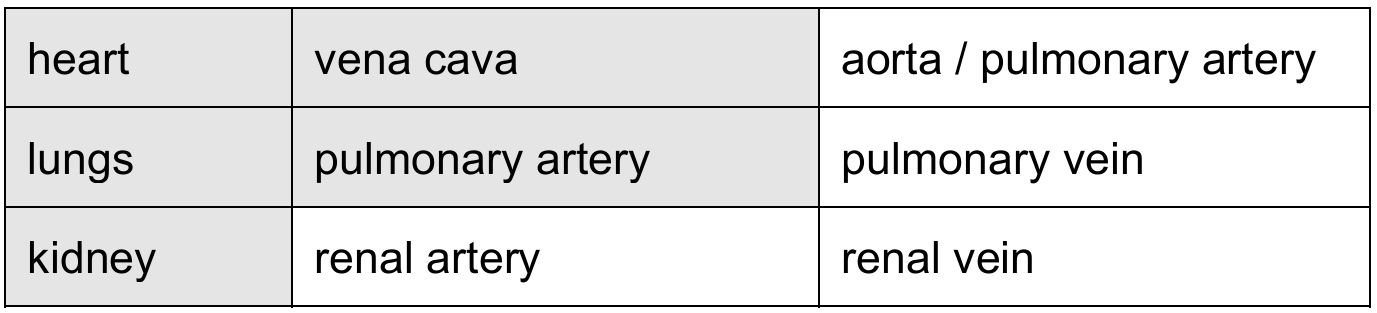
Heart: blood arrives via the vena cava and leaves via the aorta.
Lungs: blood arrives via the pulmonary artery and leaves via the pulmonary vein.
Kidney: blood arrives via the renal artery and leaves via the renal vein.
(c) airways and two-way
The circulatory system is made of blood vessels, not airways, since airways carry air to the lungs.
Valves ensure blood flows in one direction only, not two-way, preventing backflow.
(d)(i) xylem
Xylem tissue is arranged in bundles near the outside of the stem and transports water and mineral ions upward from the roots.
It also provides mechanical support to the plant.
(d)(ii) phloem
Phloem tissue transports dissolved sugars, mainly sucrose, and amino acids around the plant.
This process is called translocation, moving substances from sources (e.g. leaves) to sinks (e.g. roots, fruits).
(d)(iii)
Water enters the plant through the root hair cells, which have a large surface area for absorption.
Water exits the plant through the stomata on the leaves, as water vapour lost during transpiration.