
CIE iGCSE Co-Ordinated Science B9.4 Blood Exam Style Questions Paper 4
Question
Most-appropriate topic codes (Cambridge IGCSE Co-ordinated Sciences 0654):
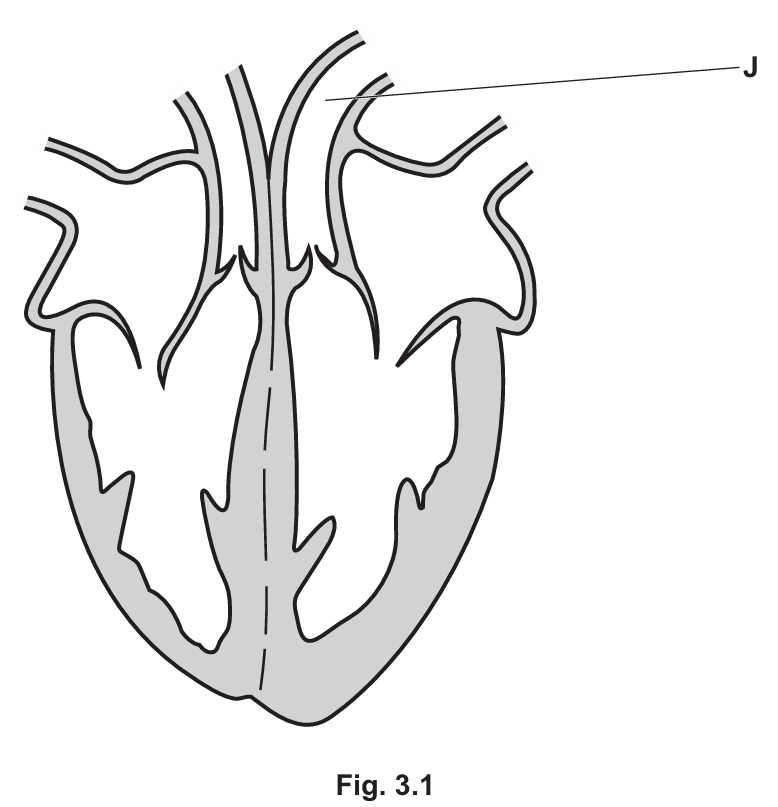
• Topic B9.2 — Heart (Part (a)(i) & (a)(ii))
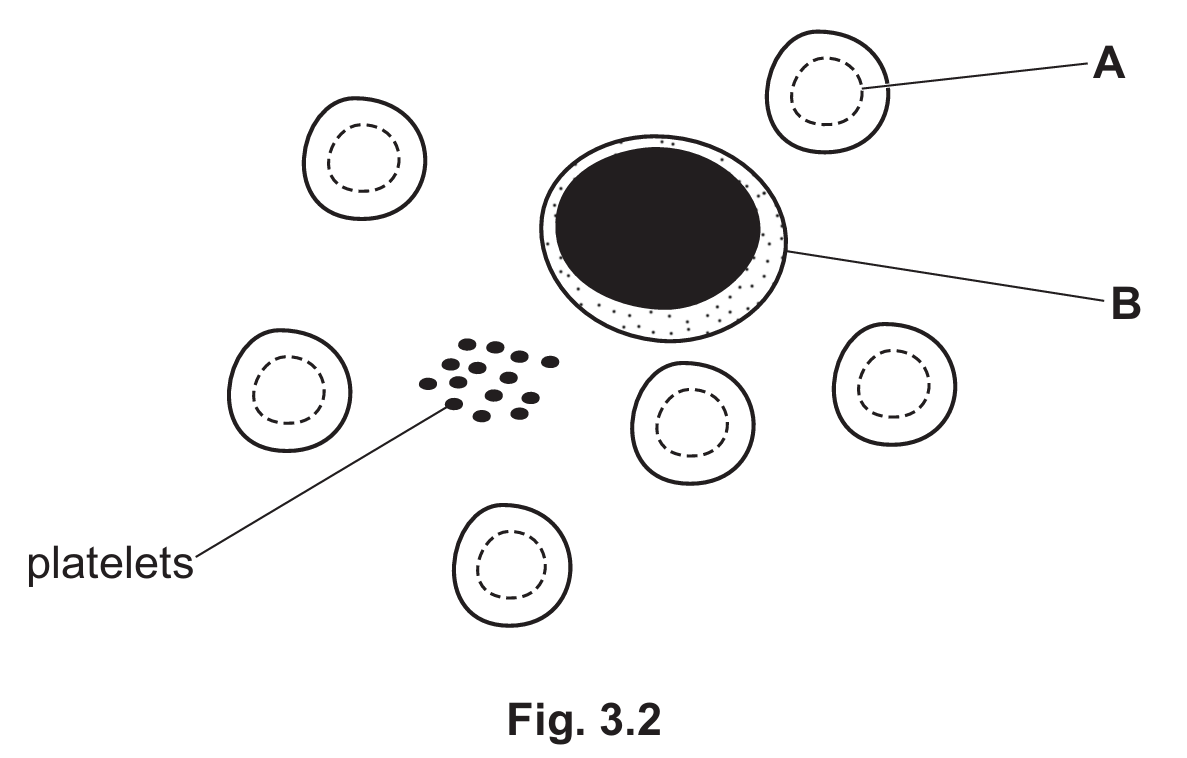
• Topic B9.4 — Blood / Platelets (Part (b)(i))
• Topic B9.4 — Blood / Plasma (Part (b)(ii))
• Topic B9.4 — Red blood cells (Part (b)(iii))
• Topic B9.4 — White blood cells / Lymphocytes (Part (b)(iv))
▶️ Answer/Explanation
(a)(i) Septum labelled S (the muscular wall dividing left and right sides); Valve labelled V (e.g. atrioventricular or semilunar valve).
The septum prevents mixing of oxygenated and deoxygenated blood. Valves ensure one-way flow of blood through the heart.
(a)(ii) Artery J has a thick muscular wall and a small lumen to maintain and withstand the high pressure of blood pumped from the heart.
The elastic and muscular tissue in the artery wall allows it to stretch and recoil, helping to maintain high blood pressure and continuous flow.
(b)(i) Platelets clot blood at wound sites, sealing the wound and preventing entry of pathogens into the body.
By forming a plug, platelets create a physical barrier that stops blood loss and prevents microorganisms from entering through damaged skin.
(b)(ii) Ions / nutrients / urea / hormones / carbon dioxide / antibodies
Plasma transports many dissolved substances including waste products, hormones, and nutrients required for cellular activities.
(b)(iii) Fewer red blood cells means insufficient oxygen is transported to muscles for aerobic respiration, so less energy is released for muscle contraction, leading to increased lactic acid and oxygen debt.
Red blood cells contain haemoglobin which carries oxygen. Without enough oxygen, muscles cannot respire aerobically, causing fatigue and cramp.
(b)(iv) Cell B (lymphocyte) produces antibodies.
Lymphocytes are white blood cells that recognise specific pathogens and produce antibodies to neutralise them or mark them for destruction.
Question
Explain the advantages of a double circulation compared to the circulation in a fish.
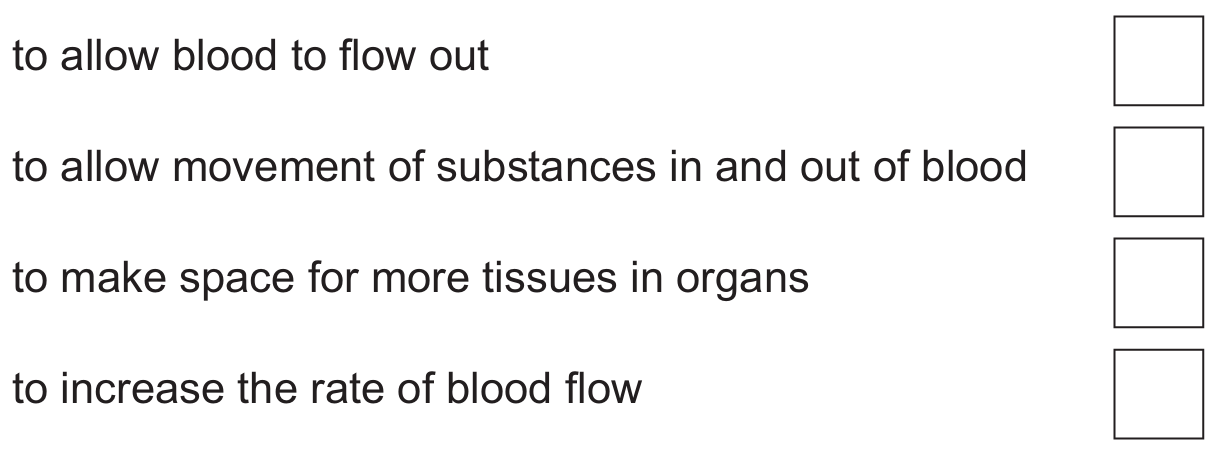
(i) Tick \((\checkmark)\) one box to identify which statement explains why capillaries have thin walls.
(ii) Fish gills have a good blood supply as they have many capillaries with thin walls. Suggest one other feature that makes the gills a good gas exchange surface.
An \(8\text{ mm}^3\) sample is taken from a patient.
The sample contains \(1.022\times 10^{6}\) platelets.
(i) Calculate the number of platelets per mm³ in the sample.
(ii) Suggest how this number of platelets may affect the patient if they cut themselves.
Most-appropriate topic codes (Cambridge IGCSE Co-ordinated Sciences 0654):
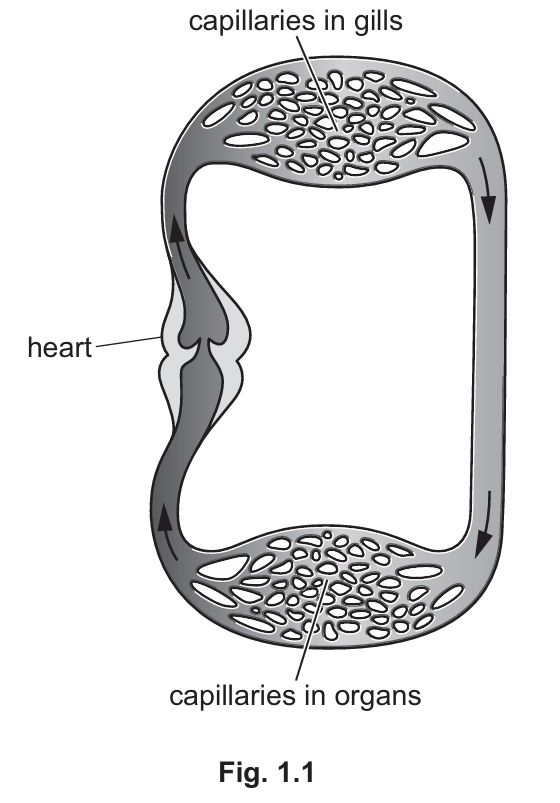
• Topic B9.1 — Circulatory systems (Parts (a) & (b))
• Topic B9.3 — Blood vessels (Part (c)(i))
• Topic B11.1 — Gas exchange in humans (Part (c)(ii))
• Topic B9.4 — Blood (Part (d)(i) & (d)(ii))
▶️ Answer/Explanation
(a) X should be placed on the right-hand side of the circulatory system (the region after the gills).
In fish, blood becomes oxygenated as it passes through the gills. The right side of the diagram shows oxygenated blood flowing from the gills to the organs.
(b) Three advantages of double circulation:
• Blood is circulated more quickly in the mammalian system.
• Higher blood pressure is maintained to supply the body tissues.
• Lower blood pressure is maintained for the lungs, preventing damage to delicate capillaries.
• More effective delivery of oxygen and nutrients to body cells.
• Oxygenated and deoxygenated blood are kept completely separate.
(c)(i) ✓ to allow movement of substances in and out of blood
Thin capillary walls (single cell layer thick) create a short diffusion distance, allowing efficient exchange of oxygen, carbon dioxide, nutrients, and waste products between blood and tissues.
(c)(ii) Large surface area / good ventilation with water.
Gills have many lamellae which increase surface area, and water flows continuously over them maintaining a steep concentration gradient for efficient gas exchange.
(d)(i) Number of platelets per mm³:
\(\frac{1.022 \times 10^6}{8} = 127750\) platelets per mm³
(Alternative: \(1.278 \times 10^5\) platelets per mm³)
(d)(ii) The platelet count is below the healthy range (127750 < 150000).
This may cause:
• Reduced blood clotting ability.
• Increased risk of pathogens entering the wound.
• Increased blood loss from the cut.
• Slower wound healing.