
CIE iGCSE Co-Ordinated Science C1.1 Solids, liquids and gases Exam Style Questions Paper 3
Question
Most-appropriate topic codes (Cambridge IGCSE Co-ordinated Sciences 0654):
• Topic C2.2 — Atomic structure and the Periodic Table (Part (a)(i) & (a)(ii))
• Topic C7.1 — Characteristic properties of acids and bases (Part (b)(i) & (b)(ii))
• Topic C6.2 — Rate of reaction (Part (c))
• Topic C1.1 — Solids, liquids and gases (Part (d))
▶️ Answer/Explanation
(a)(i)
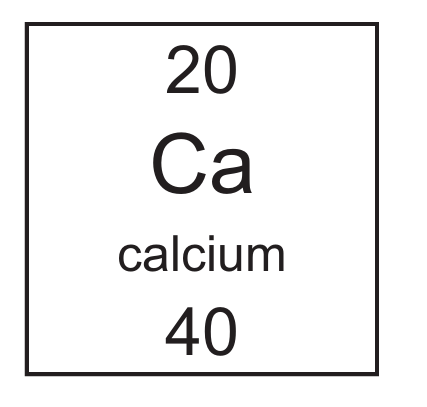
20
The number of protons is equal to the atomic number of the element, which is 20 for calcium. Ion formation involves gaining or losing electrons only — the proton number never changes and always identifies the element.
(a)(ii)
2
Calcium is in Group II and has 2 electrons in its outer shell. It loses these 2 outer-shell electrons to achieve the stable electron configuration of argon, forming the $\text{Ca}^{2+}$ ion with 18 electrons remaining.
(b)(i)
1. calcium sulfate ($\text{CaSO}_4$)
2. water ($\text{H}_2\text{O}$)
The reaction between a carbonate and an acid is a neutralisation reaction that always produces a salt, water, and carbon dioxide. Here the salt formed is calcium sulfate, since sulfuric acid provides the sulfate ion that replaces the carbonate in the product.
(b)(ii)
• $1.00\,\text{g}$ of $\text{CaCO}_3$ produces $240\,\text{cm}^3$ of $\text{CO}_2$
• Mass of $\text{CaCO}_3 = 1.00 \times \dfrac{360}{240}$
• $\boxed{\text{Mass of CaCO}_3 = 1.50\,\text{g}}$
The volume of gas produced is directly proportional to the mass of calcium carbonate used under constant conditions. Since $360\,\text{cm}^3$ is 1.5 times $240\,\text{cm}^3$, the mass required is simply $1.00 \times 1.5 = 1.50\,\text{g}$.
(c)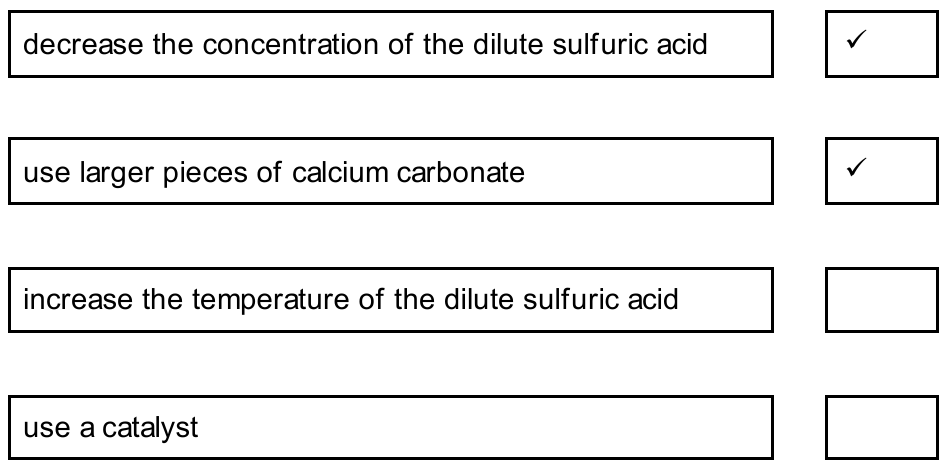
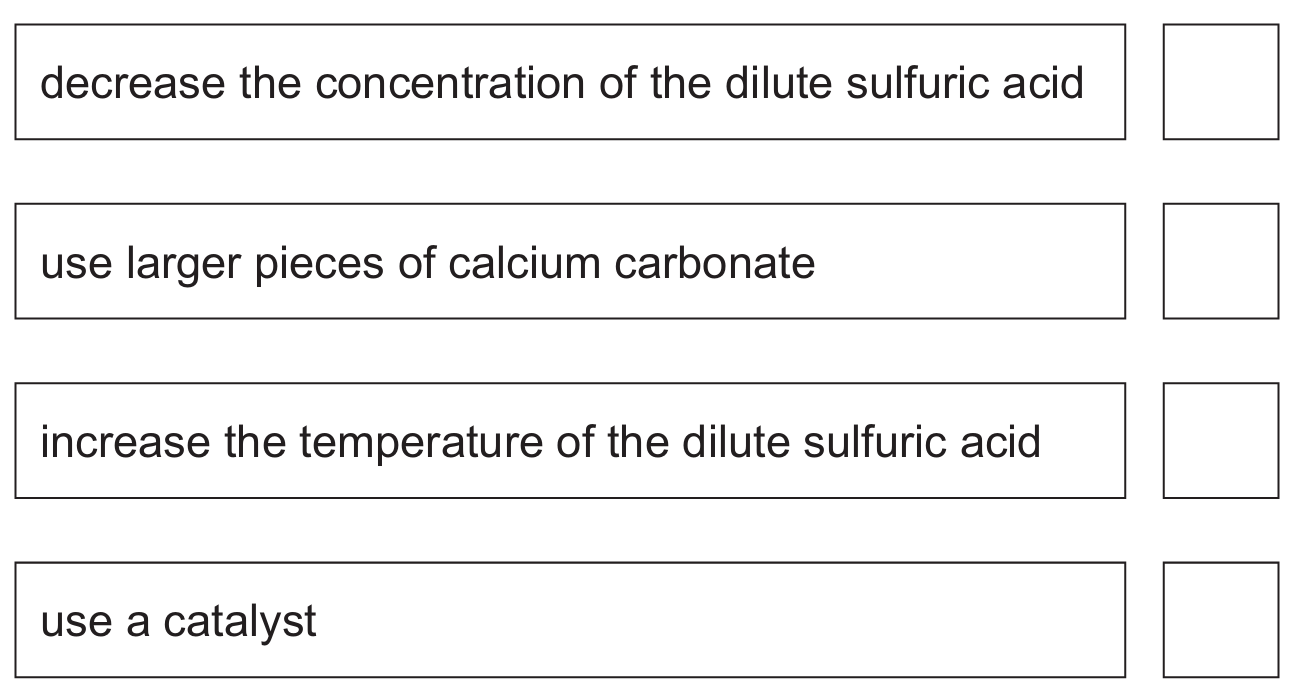
The two changes that decrease the rate are: decreasing the concentration of acid (fewer acid particles per unit volume reduces collision frequency) and using larger pieces of calcium carbonate (smaller surface area means fewer collisions per second between acid particles and the solid). Increasing temperature and adding a catalyst would both increase the rate instead.
(d)
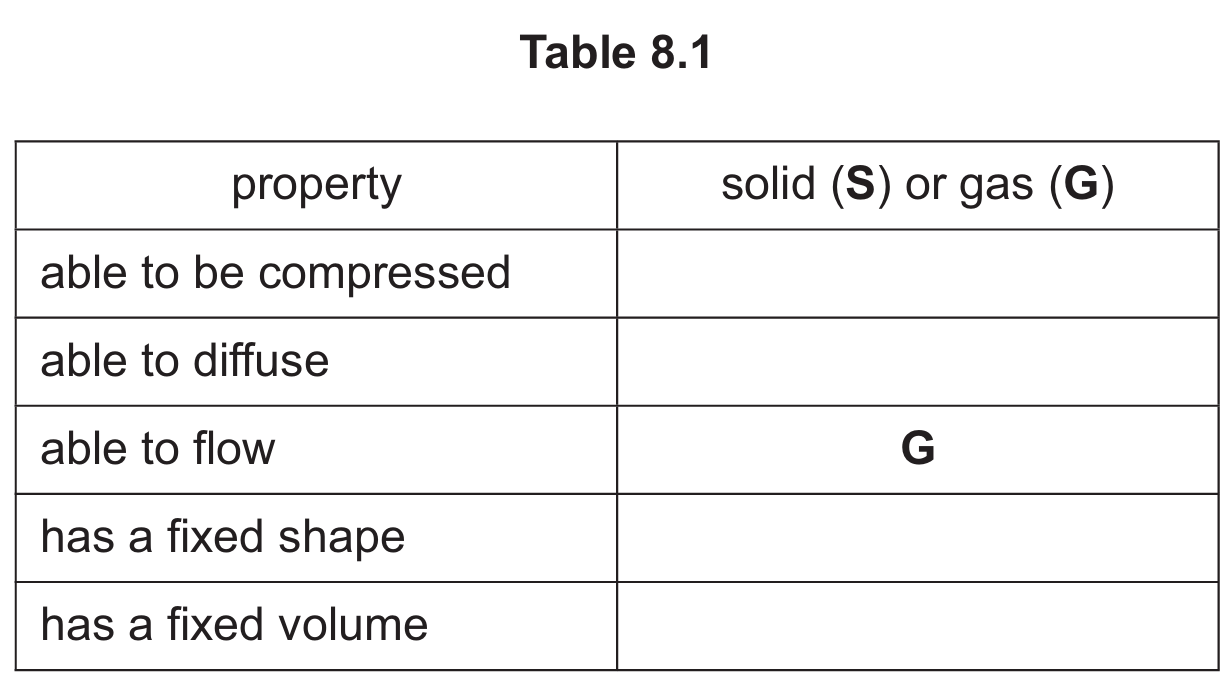
• able to be compressed → G
• able to diffuse → G
• able to flow → G
• has a fixed shape → S
• has a fixed volume → S
Gas particles are widely spaced and move rapidly and randomly, allowing compression, diffusion, and flow. Solid particles are held in fixed positions in a closely packed lattice, giving them both a definite shape and a definite volume that cannot easily be changed.
Question
Topic codes:
• Topic C3.1 — Formulas (Part (a)(i) & (a)(ii))
• Topic C6.2 — Rate of reaction (Part (b)(i), (b)(ii), (b)(iv) & (c))
• Topic C12.4 — Separation and purification (Part (b)(iii))
• Topic C1.1 — Solids, liquids and gases (Part (c))
▶️ Answer/Explanation
(a)(i) 3 different elements
Calcium carbonate (CaCO₃) contains three different elements: calcium (Ca), carbon (C), and oxygen (O).
(a)(ii) 5 atoms
The formula CaCO₃ shows 1 calcium atom, 1 carbon atom, and 3 oxygen atoms. Total atoms = 1 + 1 + 3 = 5.
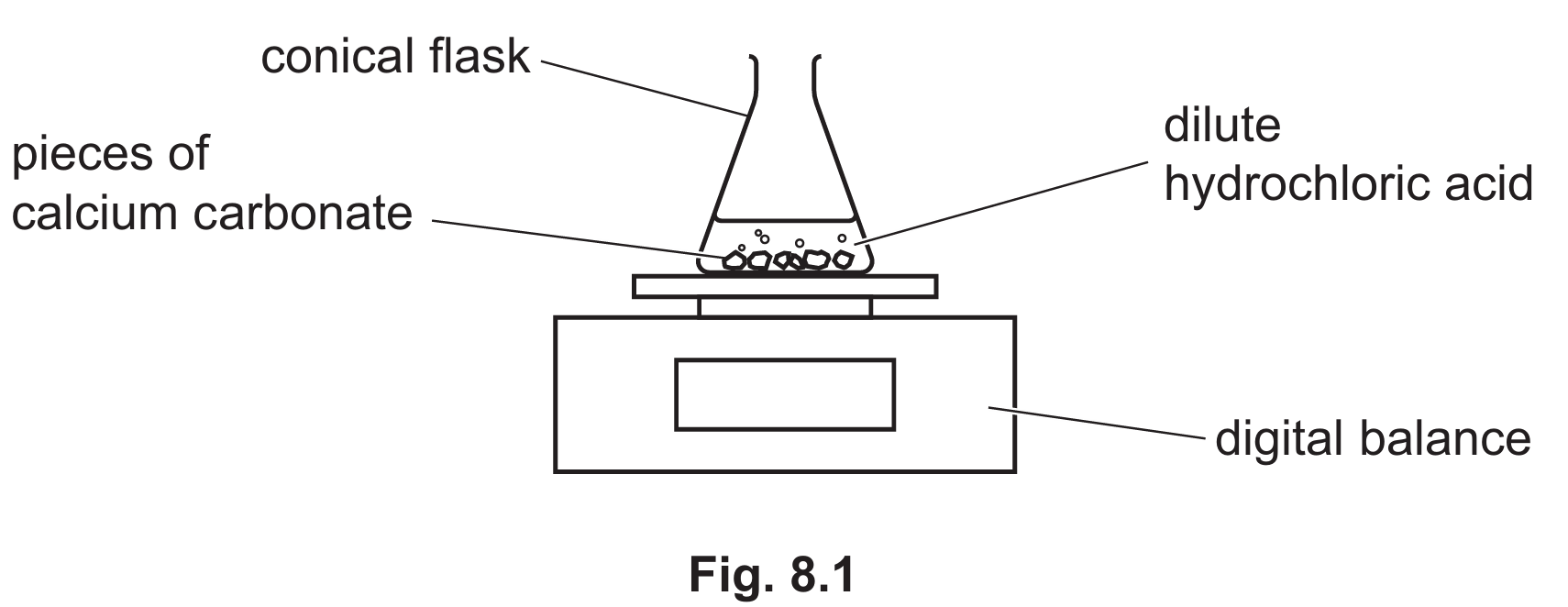
(b)(i) Stopwatch / timer / clock
To investigate the rate of reaction, the student needs to measure the time taken for the reaction to proceed. A stopwatch, timer, or clock is required to record time intervals.
(b)(ii) Carbon dioxide gas is lost from the conical flask.
The reaction produces carbon dioxide gas, which escapes from the open flask into the atmosphere. This loss of gas causes the total mass of the flask and its contents to decrease.
(b)(iii) Filtration
Filtration is used to separate an insoluble solid (unreacted calcium carbonate) from a liquid (calcium chloride solution). The solid remains on the filter paper as residue, and the solution passes through as filtrate.
(b)(iv) Two changes to increase the rate of reaction:
- Increase concentration of the acid — more acid particles per unit volume lead to more frequent collisions with calcium carbonate particles.
- Increase temperature of the acid — particles have more kinetic energy, leading to more frequent and more energetic collisions.
- Increase surface area of calcium carbonate — using powder instead of lumps exposes more particles to the acid, increasing collision frequency.
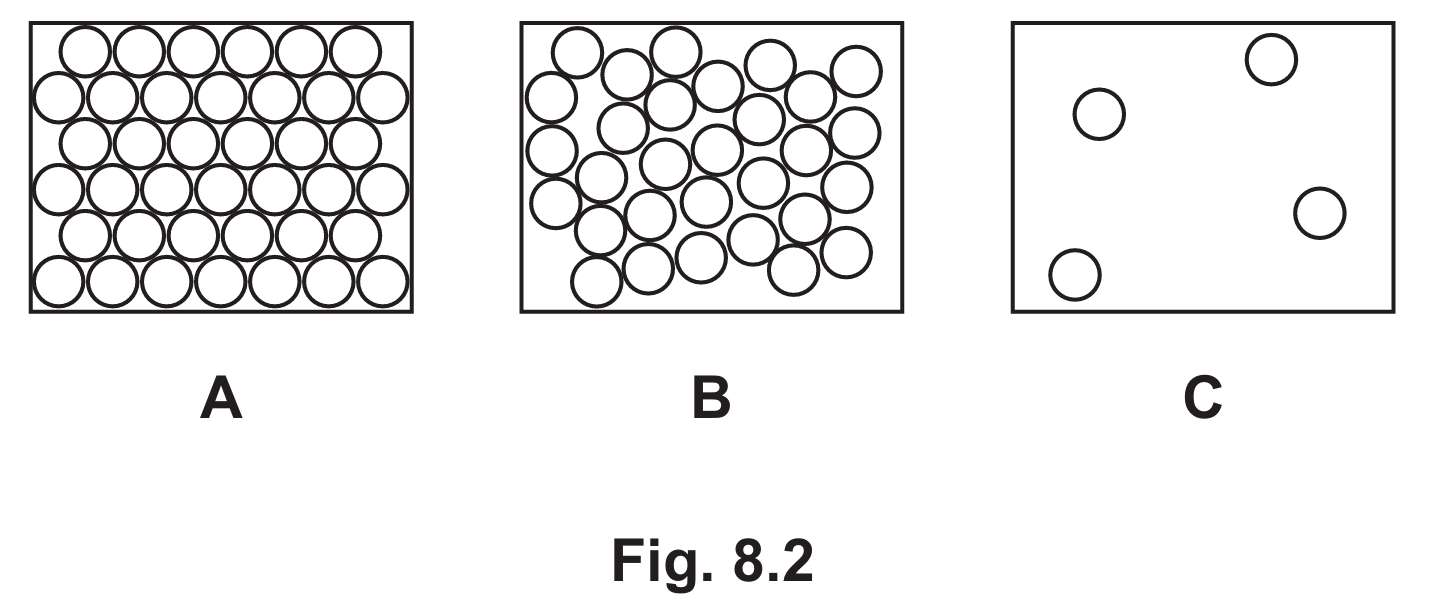
(c) A represents solid calcium carbonate because particles are touching and have a regular arrangement.
In a solid, particles are closely packed in a fixed, regular lattice structure. The strong forces between particles keep them in fixed positions, giving solids a definite shape and volume.
C represents carbon dioxide gas because particles are widely spaced and have a random arrangement.
In a gas, particles are far apart with no regular arrangement. They move rapidly and randomly in all directions, filling the available space. The weak forces between particles allow them to move freely.