
CIE iGCSE Co-Ordinated Science C1.1 Solids, liquids and gases Exam Style Questions Paper 4
Question
- the chromatogram the student obtains
- the measurements the student may make.
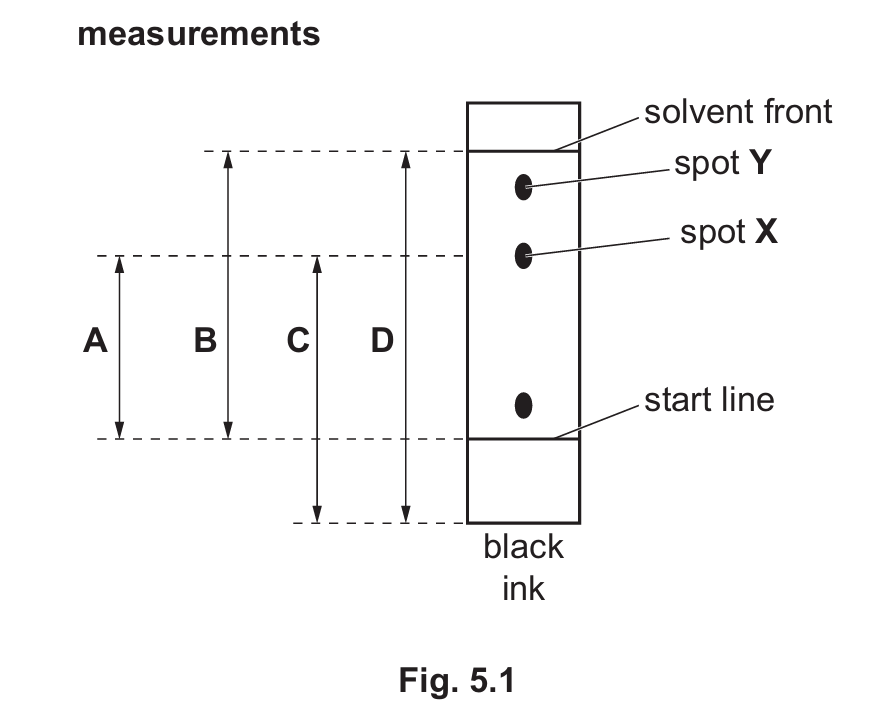
The distance travelled by spot Y is 2.8 cm.
Calculate the distance travelled by the solvent.
Most-appropriate topic codes (Cambridge IGCSE Co-ordinated Sciences 0654):
• Topic C12.3 — Chromatography (Parts (a), (b) & (c))
• Topic C1.1 — Solids, liquids and gases (Part (d))
• Topic C2.5 — Simple molecules and covalent bonds / C2.6 — Giant covalent structures (Part (e))
▶️ Answer/Explanation
(a) Statement: Black ink is an impure substance.
Explanation: The chromatogram shows more than one spot, indicating that the ink contains multiple different substances (components).
(b) Measurements A and B.
\(R_f = \frac{\text{distance travelled by substance}}{\text{distance travelled by solvent}}\).
A is the distance travelled by spot X from the origin, and B is the distance travelled by the solvent front from the origin.
(c) Calculation:
\(R_f = \frac{\text{distance travelled by substance}}{\text{distance travelled by solvent}}\)
\(0.80 = \frac{2.8}{\text{distance travelled by solvent}}\)
Distance travelled by solvent = \(\frac{2.8}{0.80} = 3.5\text{ cm}\)
(d) Separation: Particles in a liquid are slightly further apart than in a solid (but still touching).
Motion: Particles in a liquid move faster than in a solid. They move randomly in a liquid, whereas they vibrate about a fixed position in a solid.
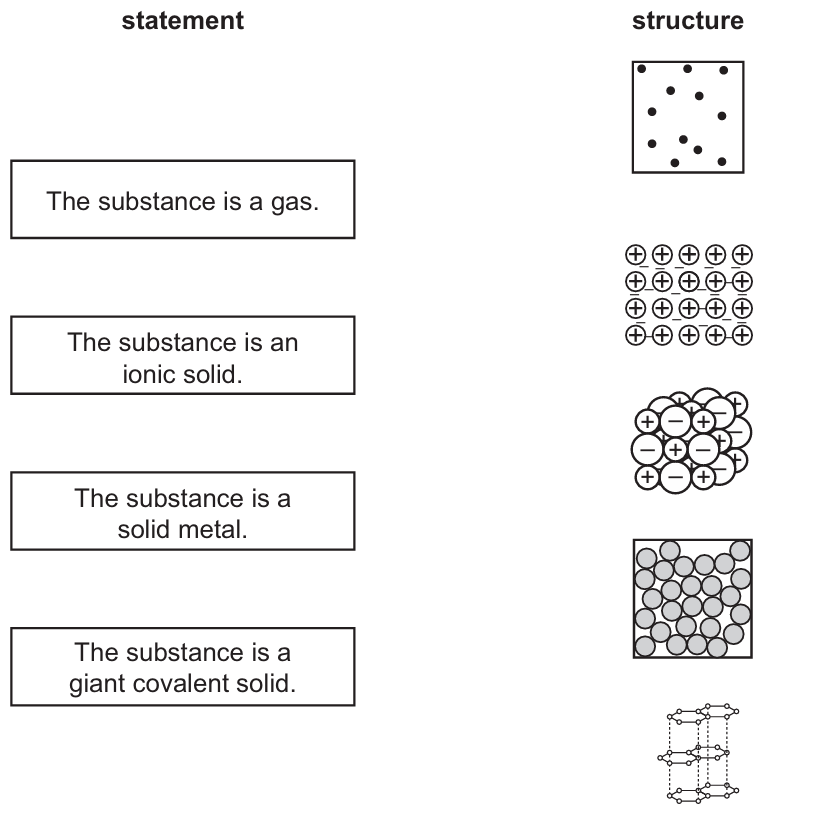
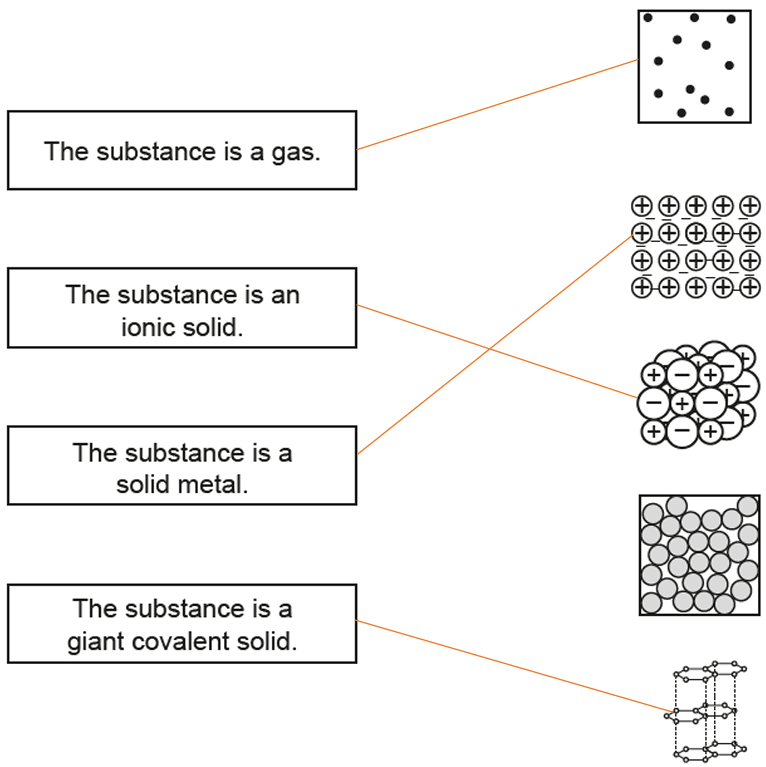
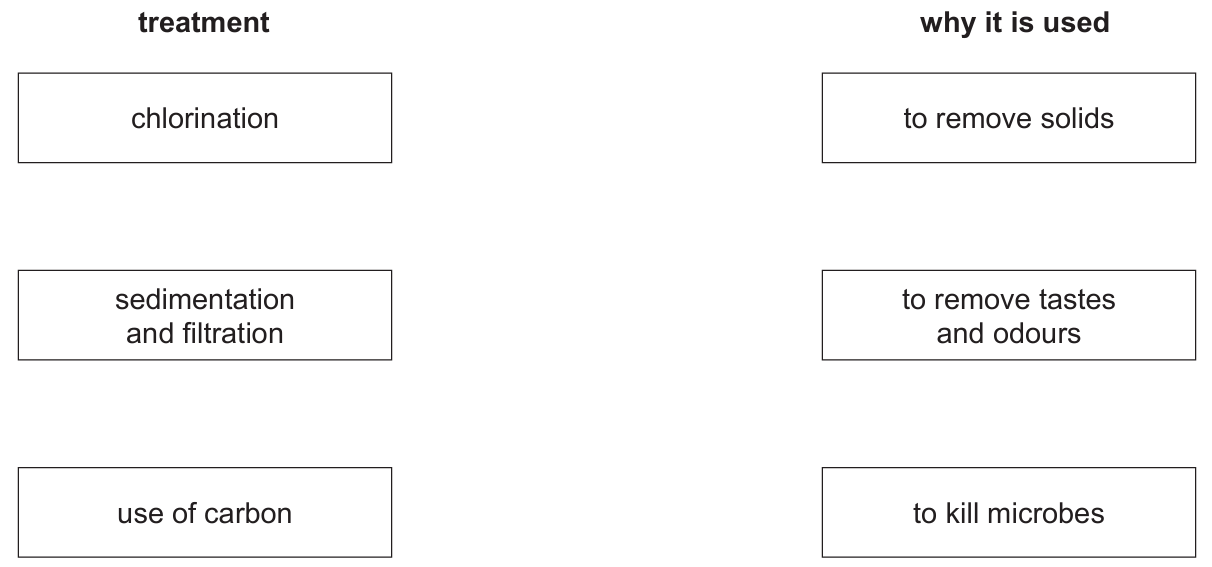
(e) Correct matching:
Question
Topic codes:
• Topic C1.1 — Solids, liquids and gases (Part (a) & (b))
• Topic C10.1 — Water (Part (c) & (d))
• Topic C2.5 — Simple molecules and covalent bonds (Part (e))
▶️ Answer/Explanation
(a) Gas — water particles are furthest apart in the gaseous state.
(b) During melting, the movement of water particles changes from vibrating about fixed positions (in the solid state) to moving around each other (in the liquid state). The particles gain kinetic energy and move faster as the solid melts.
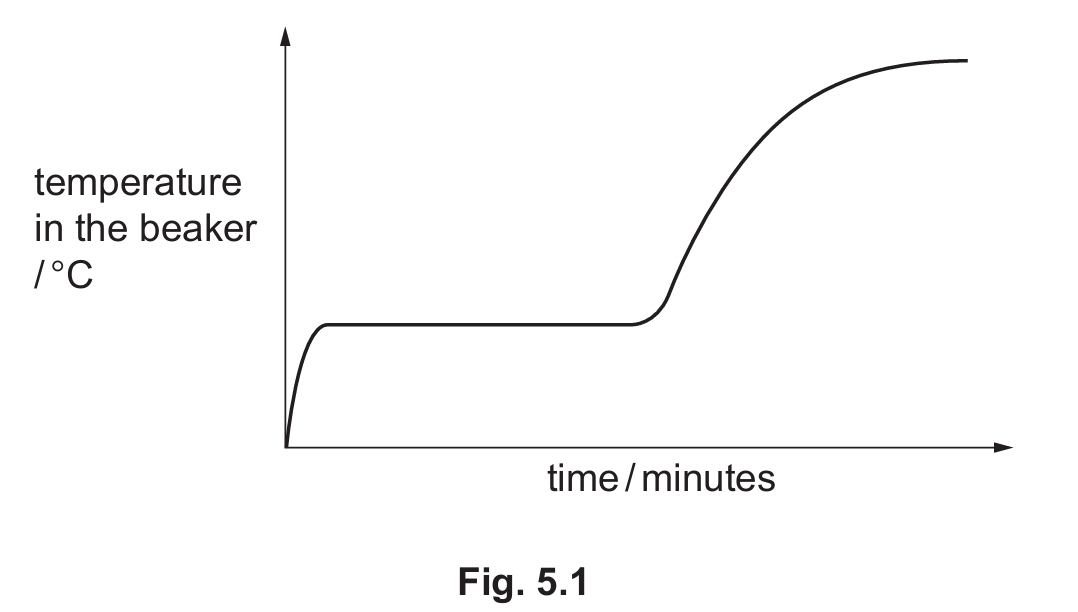
(c)(i) The ice is melting during the horizontal part of the graph where the temperature remains constant at 0°C (the plateau). The letter X should be placed on this horizontal section.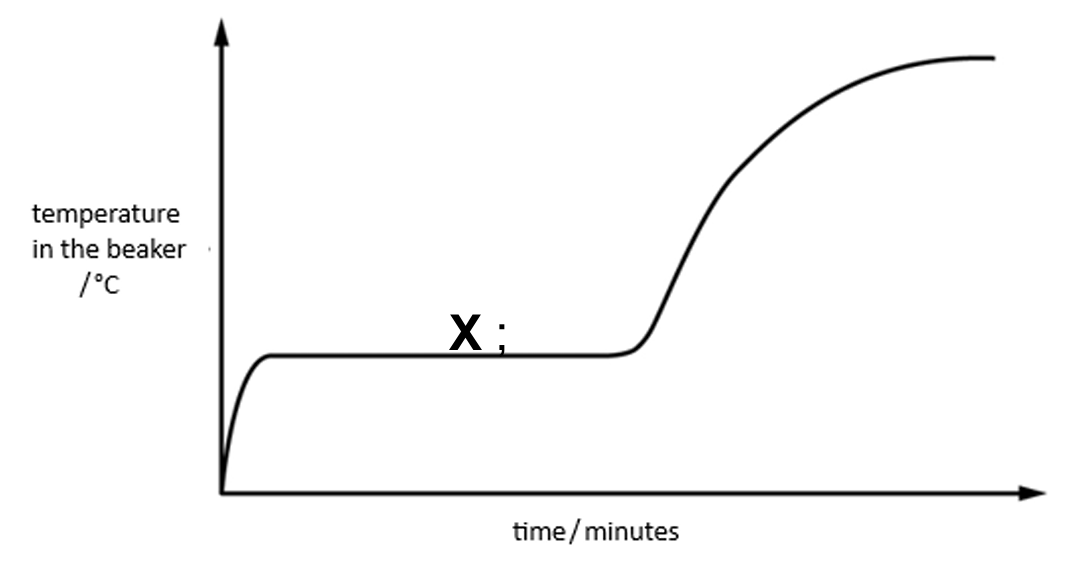
(c)(ii) Fig. 5.1 shows that the ice is pure because there is a horizontal part to the graph at the melting point. A pure substance melts at a single, specific temperature, whereas a mixture melts over a range of temperatures.
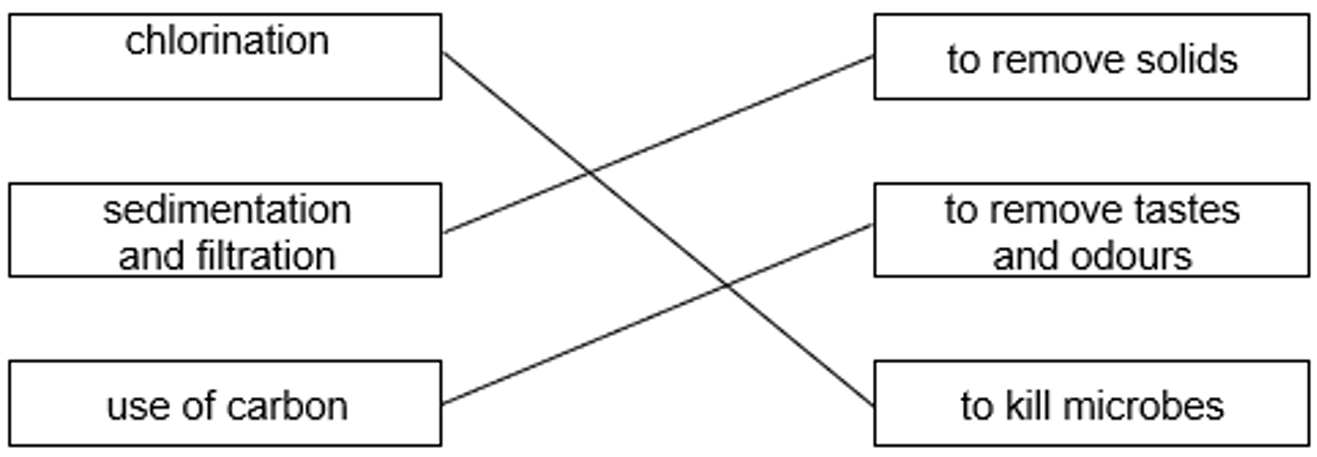
(d) The correct matching is:
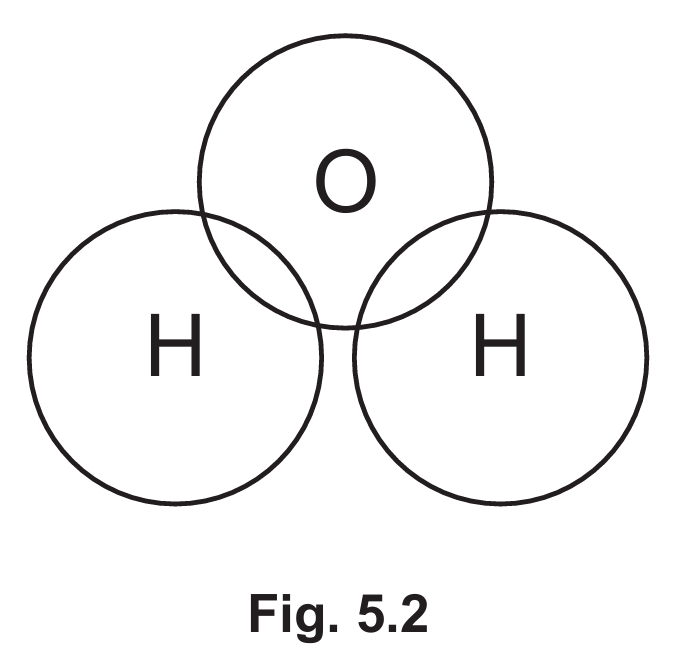
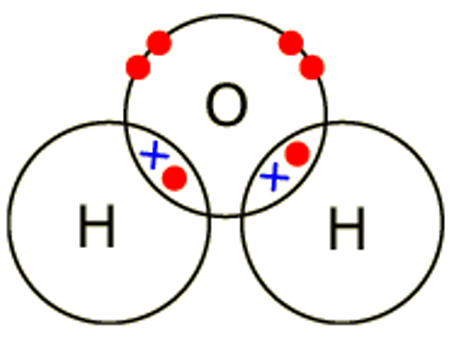
(e)(i) The completed dot-and-cross diagram for water should show:
- Oxygen atom with 6 outer-shell electrons (2 pairs and 2 unpaired)
- Two hydrogen atoms each with 1 electron
- Two shared pairs of electrons (covalent bonds) between oxygen and each hydrogen
- The remaining 4 electrons on oxygen shown as two lone pairs
(e)(ii) Pure water is a poor conductor of electricity because it does not contain any free (moving) electrons or ions. For electrical conduction, charged particles (ions or electrons) must be free to move. In pure water, the molecules are neutral and there are no mobile charge carriers.