CIE iGCSE Co-Ordinated Science C1.2 Diffusion Exam Style Questions Paper 2
Question
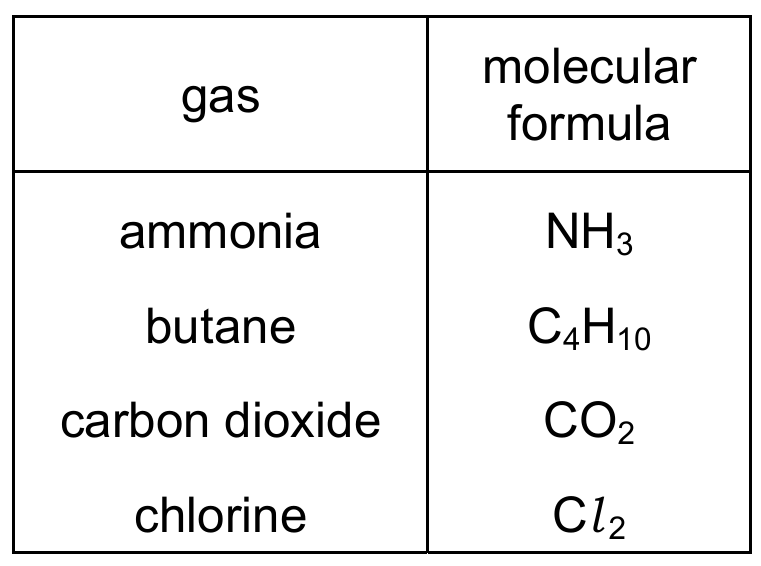
Information about four gases is shown.

Which gas has the greatest rate of diffusion?
A. ammonia
B. butane
C. carbon dioxide
D. chlorine
▶️ Answer/Explanation
The rate of diffusion is inversely proportional to the square root of the molar mass. Ammonia (NH₃) has the smallest molar mass (17 g/mol) compared to butane (58), CO₂ (44), and Cl₂ (71). Hence, ammonia diffuses fastest.
✅ Answer: (A)
✅ Answer: (A)
Question
The element phosphorus burns in air, as shown.
\(4P + 5O_2 \rightarrow P_4O_{10}\)
What does the formula \(P_4O_{10}\) show?
A. a mixture of atoms of two elements
B. a mixture of molecules of two elements
C. a molecule of a compound
D. an atom of a compound
▶️ Answer/Explanation
\(P_4O_{10}\) contains \(4\) phosphorus atoms and \(10\) oxygen atoms chemically combined in a fixed ratio, making it a compound.
Since it contains more than one atom bonded together, it represents a single molecule of that compound, not just an atom or a mixture.
✅ Answer: (C)
Since it contains more than one atom bonded together, it represents a single molecule of that compound, not just an atom or a mixture.
✅ Answer: (C)
Question
Some physical and chemical changes are listed.
- burning methane
- dissolving sugar in water
- evaporating ethanol
- rusting iron
Which changes are chemical changes?
A. 1 and 2
B. 1 and 4
C. 2 and 3
D. 3 and 4
▶️ Answer/Explanation
A chemical change produces one or more new substances, whereas a physical change does not.
Burning methane produces carbon dioxide and water, and rusting iron produces iron oxide, so both are chemical changes.
Dissolving sugar and evaporating ethanol are both physical changes, since no new substance is formed and the process is reversible.
✅ Answer: (B)
Burning methane produces carbon dioxide and water, and rusting iron produces iron oxide, so both are chemical changes.
Dissolving sugar and evaporating ethanol are both physical changes, since no new substance is formed and the process is reversible.
✅ Answer: (B)
Question
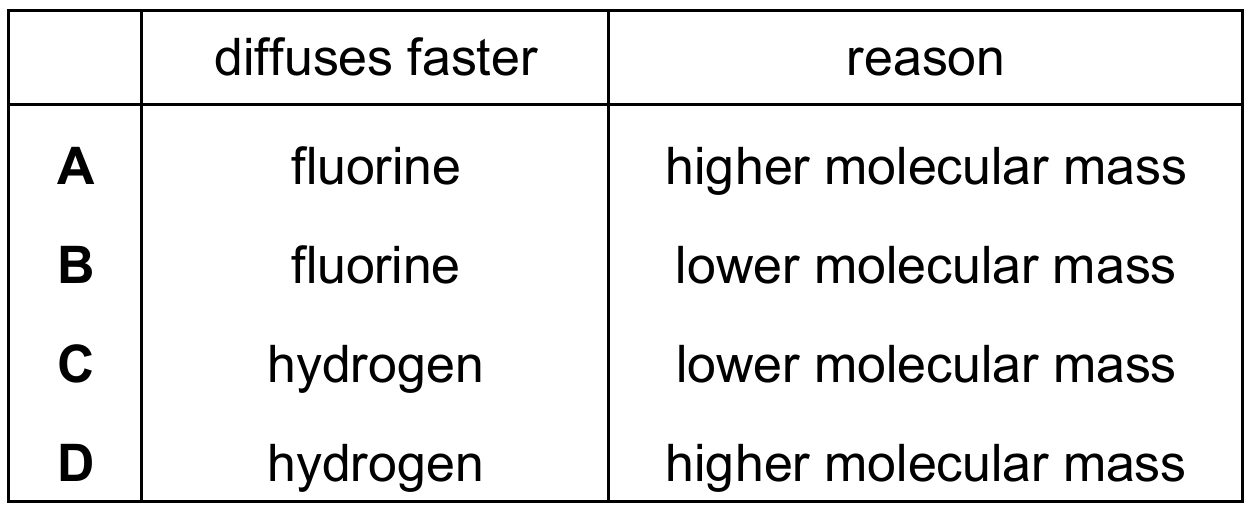
Which row compares the rates of diffusion of fluorine and hydrogen?

▶️ Answer/Explanation
Hydrogen has a lower molecular mass (2) than fluorine (38). According to kinetic theory, lighter gas particles move faster at the same temperature, so hydrogen diffuses faster. The reason is its lower molecular mass.
✅ Answer: (C)
✅ Answer: (C)
