
CIE iGCSE Co-Ordinated Science C1.2 Diffusion Exam Style Questions Paper 3
Question
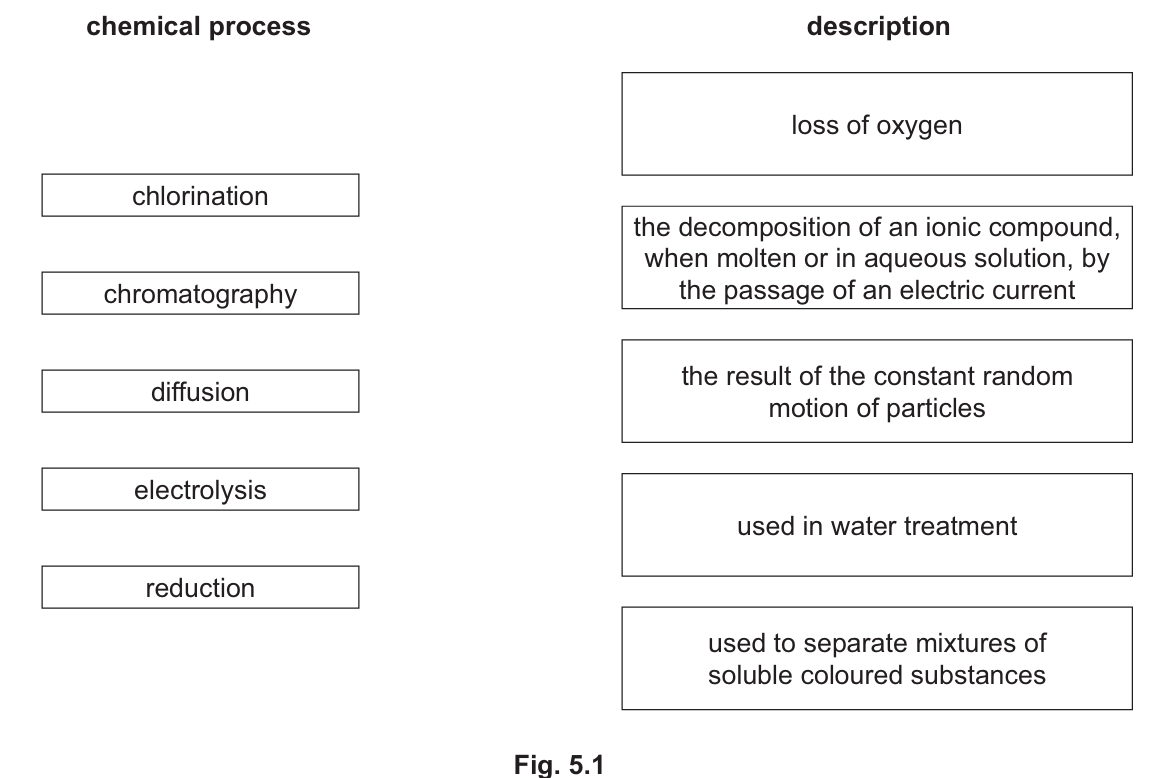
Topic codes:
• Topic C1.2 — Diffusion (Part (a))
• Topic C2.3 — Isotopes (Part (b)(i))
• Topic C3.2 — Relative masses of atoms and molecules (Part (b)(ii))
• Topic C5.1 — Exothermic and endothermic reactions (Part (b)(iii))
• Topic C7.1 — Characteristic properties of acids and bases (Part (b)(iv))
• Topic C8.3 — Group VII properties (Part (b)(v))
• Topic C4.1 — Electrolysis (Part (a))
• Topic C10.2 — Air quality and climate (Part (a))
• Topic C12.3 — Chromatography (Part (a))
▶️ Answer/Explanation
(a) Matching: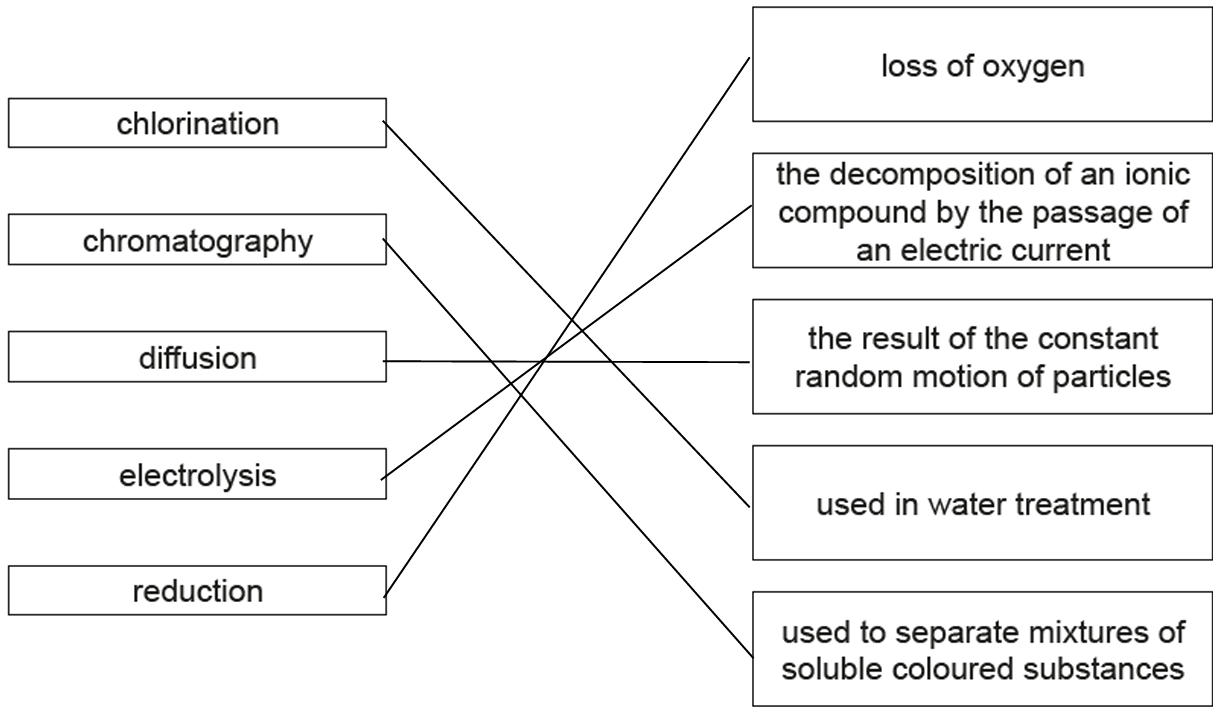
(b)(i) Isotopes are atoms of the same element with the same number of protons but different numbers of neutrons.
Isotopes have the same atomic number (proton number) but different mass numbers (nucleon numbers). They have identical chemical properties because they have the same electronic configuration, but different physical properties due to their different masses.
(b)(ii) The relative atomic mass of chlorine is 35.5 because it is the average mass of the two isotopes, \(^{35}\text{Cl}\) and \(^{37}\text{Cl}\), taking into account their relative abundances.
Chlorine has two naturally occurring isotopes: chlorine-35 and chlorine-37. The average mass is 35.5 because there are approximately three times more chlorine-35 atoms than chlorine-37 atoms.
(b)(iii) The reaction is not endothermic because thermal energy is released to the surroundings.
An endothermic reaction takes in thermal energy from the surroundings, causing a temperature decrease. Since this reaction releases thermal energy (and light), it is exothermic (\(\Delta H\) is negative).
(b)(iv) Acid: (dilute) hydrochloric acid ; Alkali: (aqueous) sodium hydroxide
Sodium chloride can be prepared by neutralisation: \(\text{HCl} + \text{NaOH} \rightarrow \text{NaCl} + \text{H}_2\text{O}\). This is a typical acid-alkali neutralisation reaction producing a salt and water.
(b)(v) The halogens have similar chemical properties because they all have the same number of electrons in their outer shell (seven electrons).
Elements in the same group of the Periodic Table have the same number of outer-shell (valence) electrons, which determines their chemical reactivity. Halogens all have 7 electrons in their outer shell and therefore react similarly by gaining one electron to achieve a stable noble gas configuration.
Question
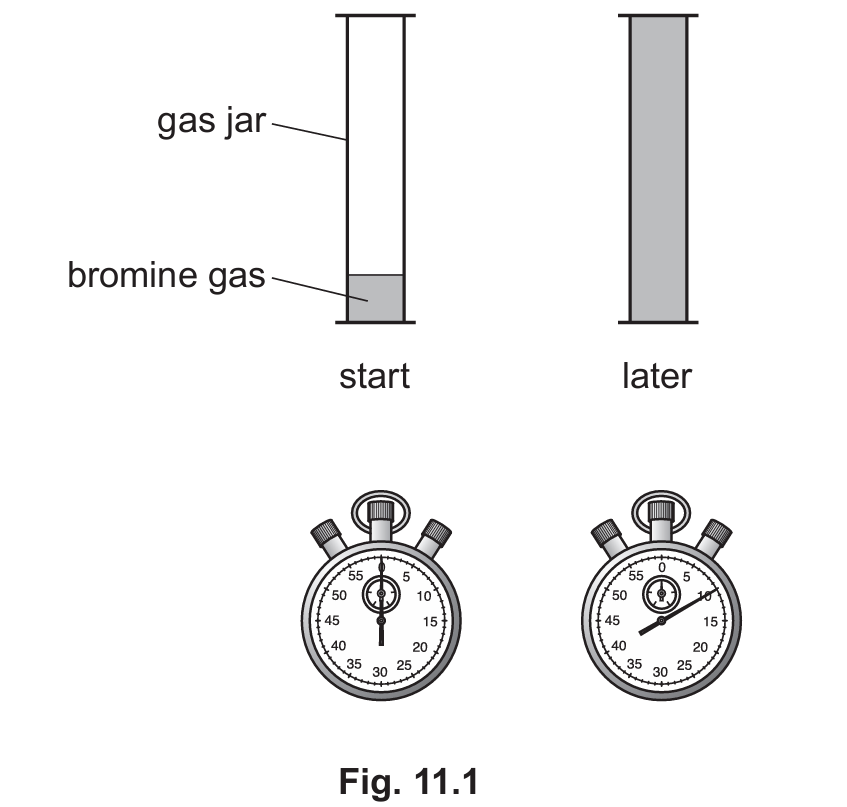
After a short time, the bromine gas spreads out to fill the gas jar.
This process is called diffusion.
Most-appropriate topic codes (Cambridge IGCSE Co-ordinated Sciences 0654):
• Topic C1.2 — Diffusion (Part (a))
• Topic C8.3 — Group VII properties (Part (b))
• Topic C8.1 — Arrangement of elements (Part (c))
• Topic C10.1 — Water (Part (d))
• Topic C2.5 — Simple molecules and covalent bonds (Parts (e), (f)(ii))
• Topic C3.1 — Formulas (Part (f)(i))
▶️ Answer/Explanation
(a) Gas particles are in constant random motion; particles move from a region of high concentration to a region of low concentration
Bromine particles move randomly and continuously due to their kinetic energy.
They spread from the area where they are highly concentrated to areas of lower concentration until evenly distributed.
(b) Iodine (or fluorine or astatine)
Chlorine and bromine belong to Group VII, the halogens.
Other halogens in this group include fluorine, iodine, and astatine.
(c) Metallic character decreases from left to right across Period 3
Elements on the left side of Period 3, such as sodium and magnesium, are metals.
Moving across the period, elements become progressively less metallic and more non-metallic, such as chlorine and argon.
(d) To kill microorganisms/bacteria/pathogens
Chlorine is added to drinking water as a disinfectant.
It kills harmful microorganisms and pathogens, making the water safe to drink.
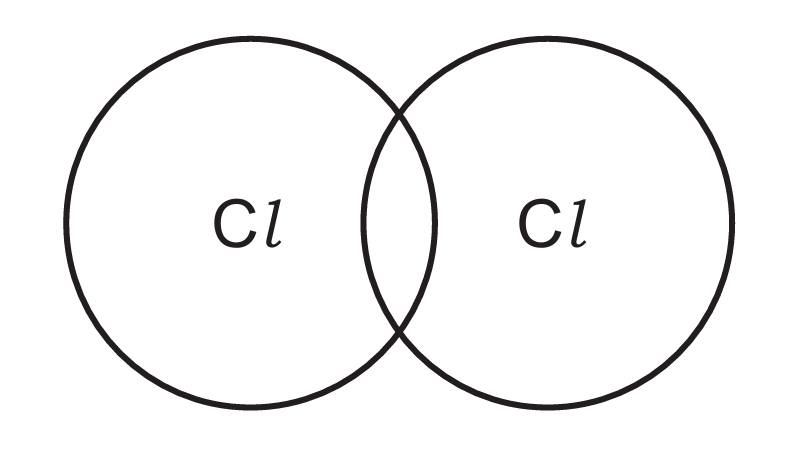
(e) Shared pair of electrons; correct number of electrons shown (14 electrons in total)
Each chlorine atom contributes one electron to a shared pair, forming a single covalent bond.
Each chlorine atom also has three additional lone pairs of outer shell electrons, giving 14 electrons in total across the molecule.
(f)(i) 2 HCl
The equation must be balanced so the number of atoms of each element is equal on both sides.
\(\text{H}_2 + \text{Cl}_2 \rightarrow 2\text{HCl}\).
(f)(ii) Two non-metals bonding; shared pair of electrons
Hydrogen and chlorine are both non-metal elements.
When two non-metals bond, they share electrons to form a covalent bond rather than transferring electrons as in ionic bonding.