
CIE iGCSE Co-Ordinated Science C1.2 Diffusion Exam Style Questions Paper 4
Question

\( 2SO_2 + \text{……..} \rightleftharpoons \text{…..} \, SO_3 \)
\( \text{……} + SO_3 \rightarrow H_2S_2O_7 \)
\( H_2S_2O_7 + \text{…….} \rightarrow 2H_2SO_4 \)
Most-appropriate topic codes (Cambridge IGCSE Co-ordinated Sciences 0654):
• Topic C1.1 — Solids, liquids and gases (Parts (a), (b))
• Topic C1.2 — Diffusion (Part (c))
• Topic C10.2 — Air quality and climate (Part (d))
▶️ Answer/Explanation
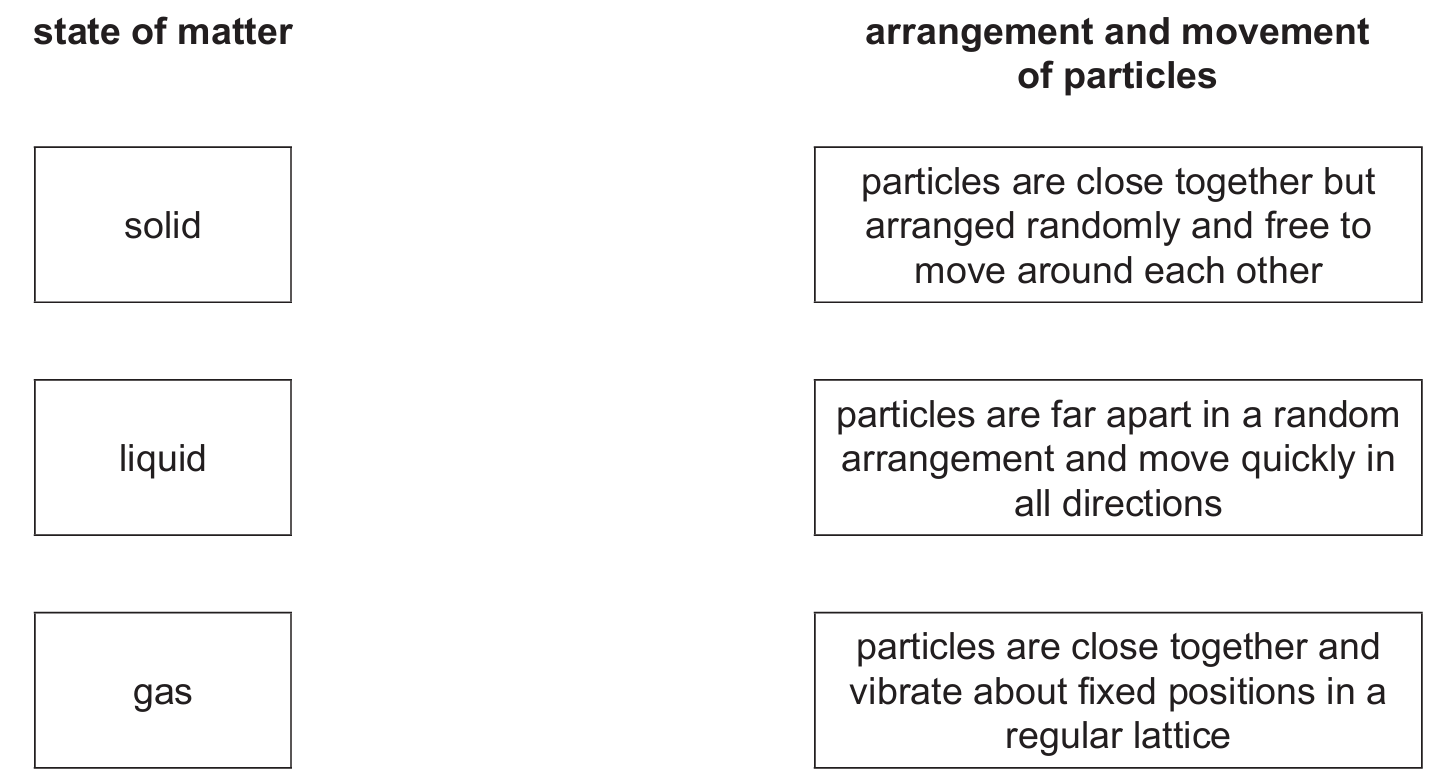
(a) 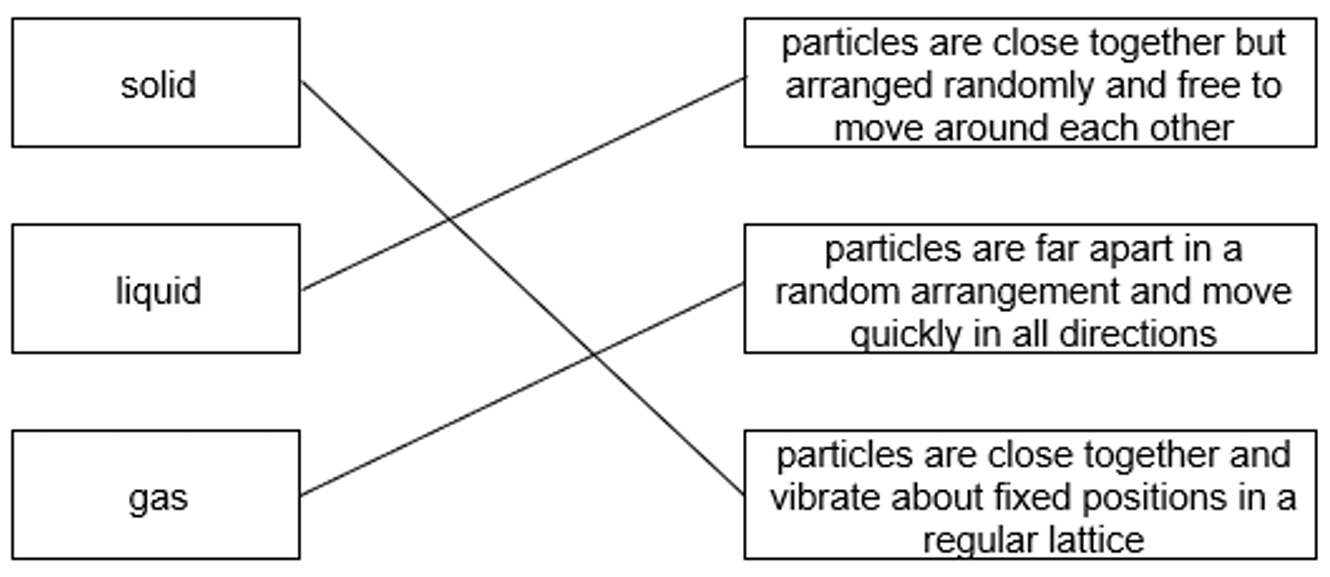
In a solid, strong forces hold particles in fixed positions in a lattice, so they can only vibrate.
In a liquid, particles stay close together but the weaker forces let them move past one another.
In a gas, particles are far apart with negligible forces between them, so they move rapidly and randomly.
(b) Solid B; melts over a range of temperatures rather than at one sharp point
A pure substance melts at one fixed, sharp temperature.
Solid B melts over a range (81–88 °C) instead of at a single value, which is the signature of an impure substance/mixture.
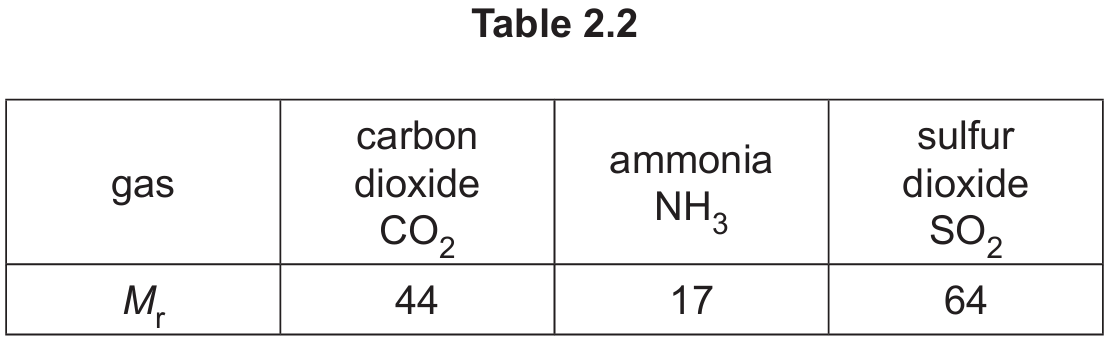
(c) Ammonia, NH\(_3\); it has the lowest \(M_r\) (17), so it is the lightest/fastest-moving gas
Rate of diffusion is inversely related to the mass of the gas particles.
Since NH\(_3\) has the smallest relative molecular mass (17, compared with 44 for CO\(_2\) and 64 for SO\(_2\)), its particles move fastest and diffuse fastest.
(d)(i) Combustion of fossil fuels containing sulfur compounds
Sulfur impurities in coal and oil are oxidised to sulfur dioxide gas when these fuels are burned in power stations, vehicles, and industry.
(d)(ii) Causes acid rain (or causes breathing difficulties such as asthma)
Sulfur dioxide dissolves in atmospheric water to form dilute sulfurous/sulfuric acid, which falls as acid rain and damages buildings, water bodies and vegetation.
It also irritates the respiratory system, worsening conditions such as asthma.
(e) \(2SO_2 + O_2 \rightleftharpoons 2SO_3\); \(H_2SO_4 + SO_3 \rightarrow H_2S_2O_7\); \(H_2S_2O_7 + H_2O \rightarrow 2H_2SO_4\)
Sulfur dioxide is catalytically oxidised to sulfur trioxide in a reversible reaction.
Sulfur trioxide is then dissolved in concentrated sulfuric acid to form oleum (\(H_2S_2O_7\)), since SO\(_3\) reacts too violently with water directly.
The oleum is finally diluted carefully with water to give concentrated sulfuric acid.
Question
[\(A_r\) : H, 1; N, 14]
Most-appropriate topic codes (Cambridge IGCSE Co-ordinated Sciences 0654):
• Topic C2.1 — Elements, compounds and mixtures (Part (a))
• Topic C1.2 — Diffusion (Part (b)(i))
• Topic C3.3 — The mole and the Avogadro constant (Part (b)(ii))
▶️ Answer/Explanation
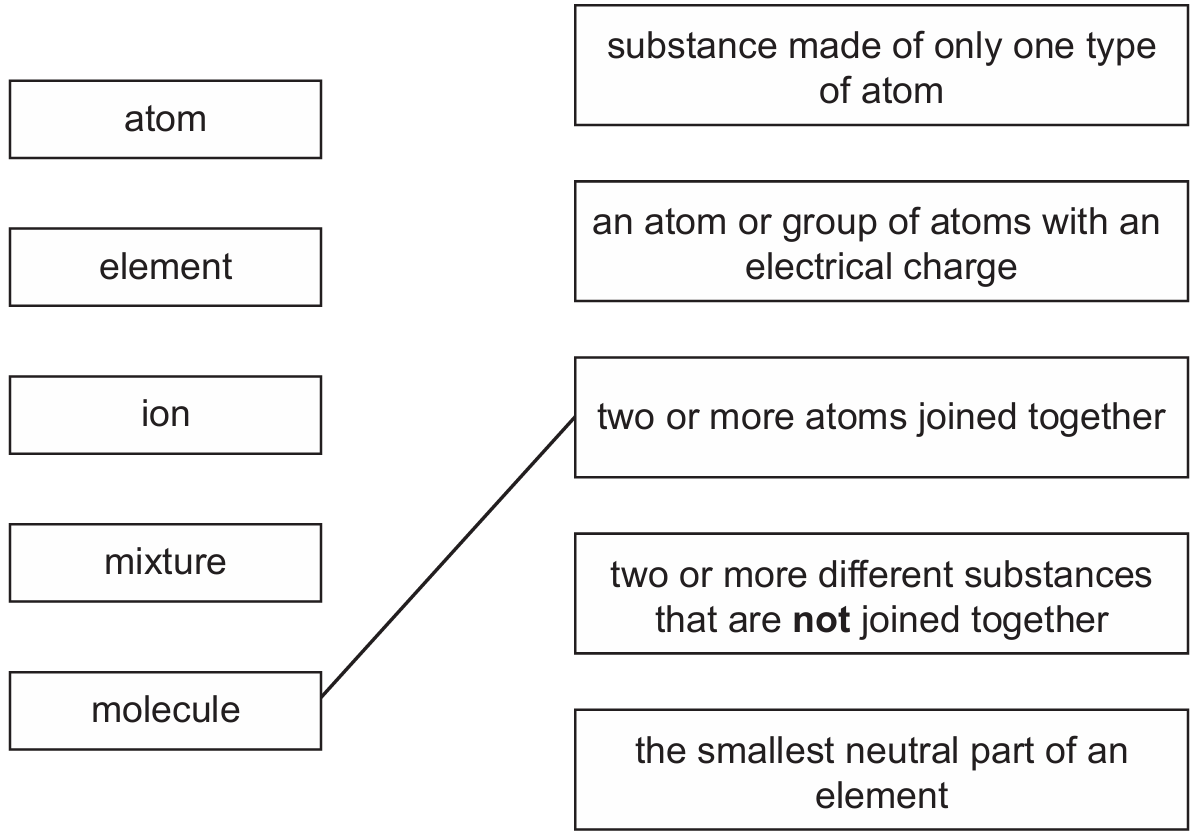
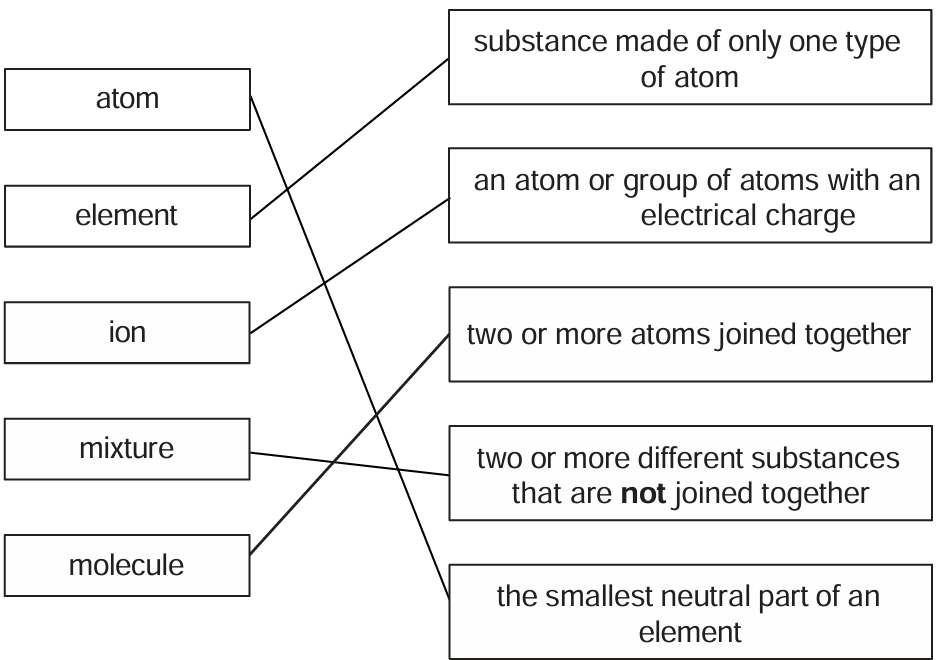
(a)
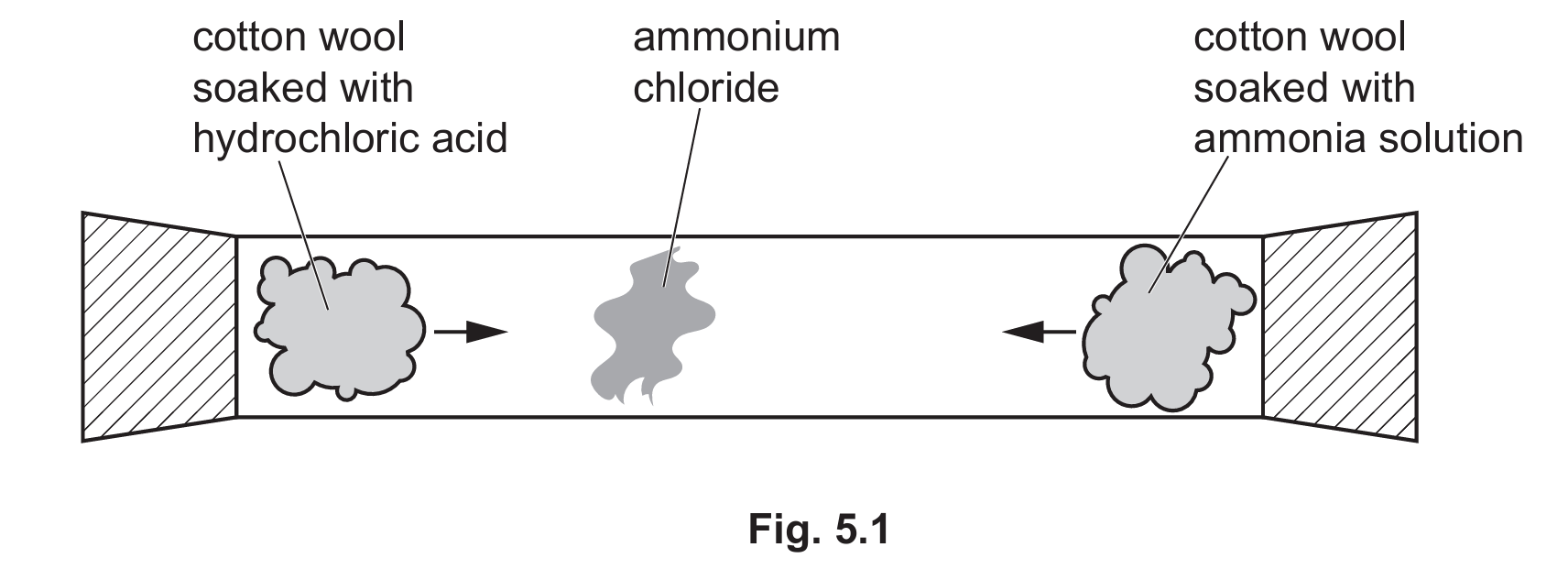
(b)(i) Ammonia molecules are lighter and diffuse faster
The molecular mass of ammonia (\( M_r = 17 \)) is less than that of hydrogen chloride (\( M_r = 36.5 \)).
Lighter molecules move faster and diffuse a greater distance in the same time, so ammonia travels further along the tube before meeting the hydrogen chloride, forming the cloud nearer the HCl end.
(b)(ii) \( 7.20 \, \text{dm}^3 \)
\( M_r \) of \( \text{NH}_3 = 14 + (3 \times 1) = 17 \).
moles of \( \text{NH}_3 = \dfrac{5.1}{17} = 0.3 \, \text{mol} \).
volume \( = 0.3 \times 24 = 7.2 \, \text{dm}^3 \).