
▶️ Answer/Explanation
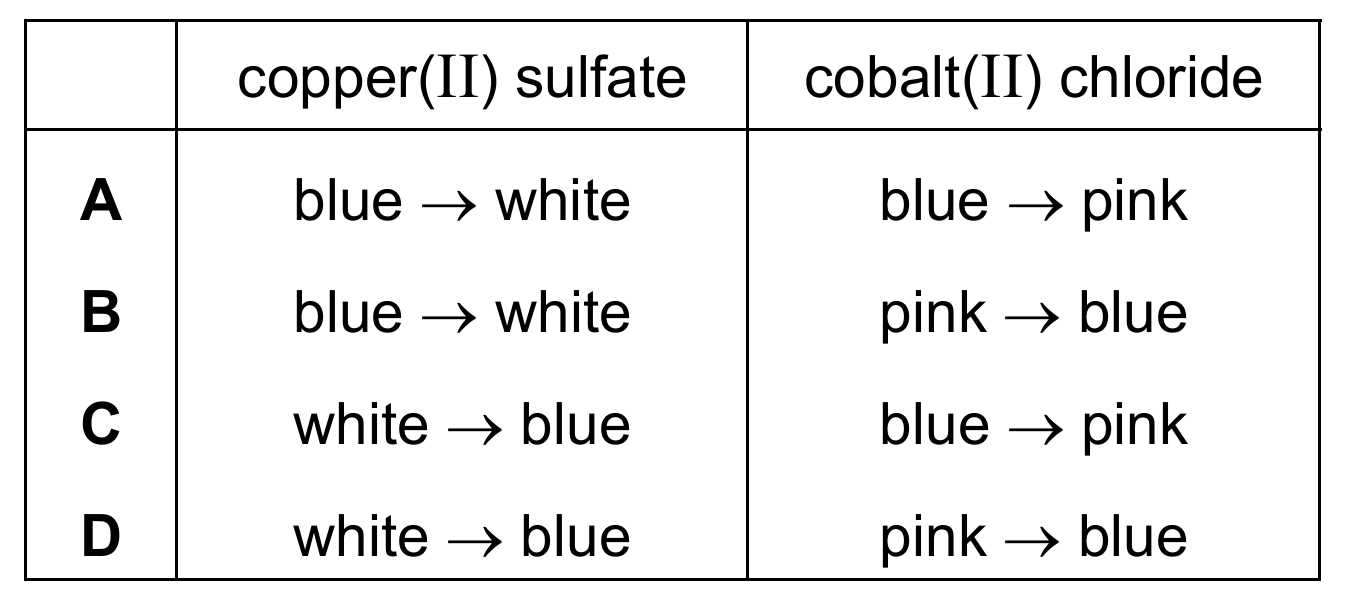
Anhydrous copper(II) sulfate is white and turns blue when water is added (forming hydrated copper(II) sulfate). Anhydrous cobalt(II) chloride is blue and turns pink when water is added (forming hydrated cobalt(II) chloride). Row C correctly shows both these colour changes: white → blue for copper(II) sulfate and blue → pink for cobalt(II) chloride. Option A reverses the copper sulfate change, option B reverses both changes, and option D reverses the cobalt chloride change.
✅ Answer: (C)
✅ Answer: (C)
▶️ Answer/Explanation
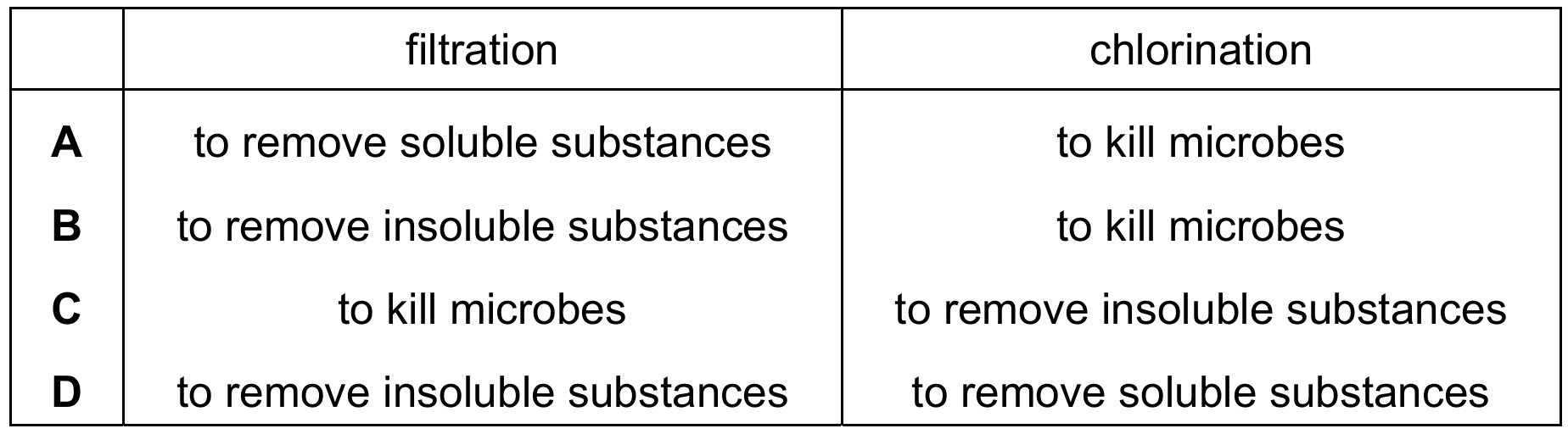
Filtration is used to remove insoluble substances (solid particles) from the water supply. Chlorination is used to kill microbes (pathogens) to make the water safe for drinking. Option B correctly pairs filtration with the removal of insoluble substances and chlorination with killing microbes. Option A is incorrect because filtration does not remove soluble substances. Options C and D incorrectly swap the functions or assign incorrect purposes.
✅ Answer: (B)
✅ Answer: (B)
▶️ Answer/Explanation
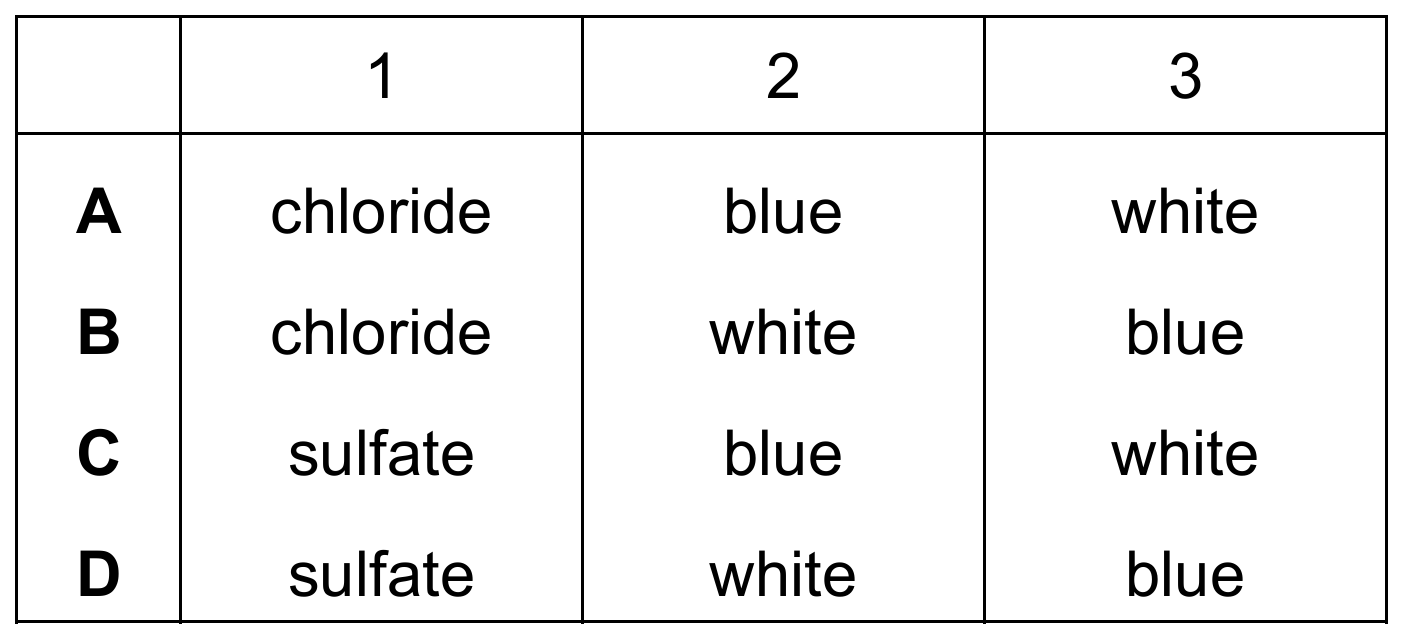
Anhydrous copper(II) sulfate is white; when water is added it becomes hydrated copper(II) sulfate, which is blue — so the sentence reads: “water turns anhydrous copper(II) sulfate from white to blue“.
This is a standard test for the presence of water; the colour change from white to blue is a positive result, matching row D in the table.
✅ Answer: (D)
This is a standard test for the presence of water; the colour change from white to blue is a positive result, matching row D in the table.
✅ Answer: (D)

▶️ Answer/Explanation
Adding water to anhydrous (white) copper(II) sulfate turns it blue, and hydrated (blue) copper(II) sulfate simply dissolves to give a blue solution.
Adding water to anhydrous (blue) cobalt(II) chloride turns it pink, and hydrated (pink) cobalt(II) chloride dissolves to give a pink solution.
So every watch-glass, once water is added, ends up as either a blue or a pink solution.
✅ Answer: (A)
Adding water to anhydrous (blue) cobalt(II) chloride turns it pink, and hydrated (pink) cobalt(II) chloride dissolves to give a pink solution.
So every watch-glass, once water is added, ends up as either a blue or a pink solution.
✅ Answer: (A)