
CIE iGCSE Co-Ordinated Science C11.3 Fuels Exam Style Questions Paper 3
Question
Most-appropriate topic codes (Cambridge IGCSE Co-ordinated Sciences 0654):
• Topic C11.5 — Alkenes (Part (a))
• Topic C11.7 — Polymers (Part (b)(iii))
• Topic C11.3 — Fuels, combustion (Part (b)(i))
• Topic C11.3 — Fuels, cracking (Part (b)(ii))
▶️ Answer/Explanation
(a)(i) 6 atoms
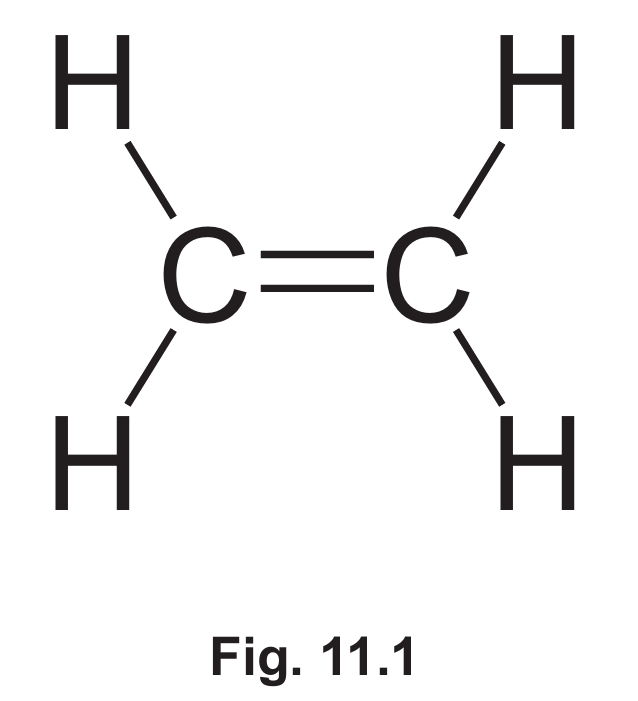
Ethene contains 2 carbon atoms and 4 hydrogen atoms.
Total atoms = \(2 + 4 = 6\)
(a)(ii) \(\text{C}_2\text{H}_4\)
The molecular formula of ethene is \(\text{C}_2\text{H}_4\), showing 2 carbon atoms and 4 hydrogen atoms per molecule.
It belongs to the alkene homologous series (general formula \(\text{C}_n\text{H}_{2n}\)).
(a)(iii) Ethene contains a C=C double bond.
Unsaturated molecules contain at least one carbon-carbon double bond (\(\text{C=C}\)).
This means not all carbon atoms are bonded to the maximum possible number of hydrogen atoms — they are not fully “saturated” with hydrogen.
(a)(iv)
test: Add aqueous bromine (bromine water).
observations (positive result): The orange/brown bromine water turns colourless.
The \(\text{C=C}\) double bond reacts with bromine in an addition reaction, decolourising the solution.
(b)(i)
1. Carbon dioxide (\(\text{CO}_2\))
2. Water (\(\text{H}_2\text{O}\))
Complete combustion of any hydrocarbon in excess oxygen produces only carbon dioxide and water.
(b)(ii) Cracking
Cracking is the process by which large hydrocarbon molecules from petroleum are broken down into smaller, more useful molecules.
It involves high temperatures (thermal cracking) or catalysts (catalytic cracking) to break C–C bonds.
(b)(iii) During polymerisation, many small ethene molecules (monomers) join together to form a single long-chain molecule (polymer).
The \(\text{C=C}\) double bond in each ethene monomer opens up, allowing the carbon atoms to bond to adjacent monomers.
This addition polymerisation produces poly(ethene), a long-chain polymer with repeating \(-\text{CH}_2\text{CH}_2-\) units.
Question
Most-appropriate topic codes (Cambridge IGCSE Co-ordinated Sciences 0654):
• Topic C11.3 — Fuels (Part (a), (b))
• Topic C11.1 — Formulas and terminology (Part (c)(i), (c)(ii), (c)(iii), (c)(iv))
• Topic C11.4 — Alkanes (Part (c)(v))
• Topic C12.4 — Separation and purification (Part (b)(i), (b)(ii))
▶️ Answer/Explanation
(a)(i) Coal
Coal is a fossil fuel formed from the remains of ancient plants. Along with natural gas and petroleum, it is one of the three main fossil fuels.
(a)(ii) Methane
Natural gas is primarily composed of methane (CH₄), which makes up about 70–90% of its volume.
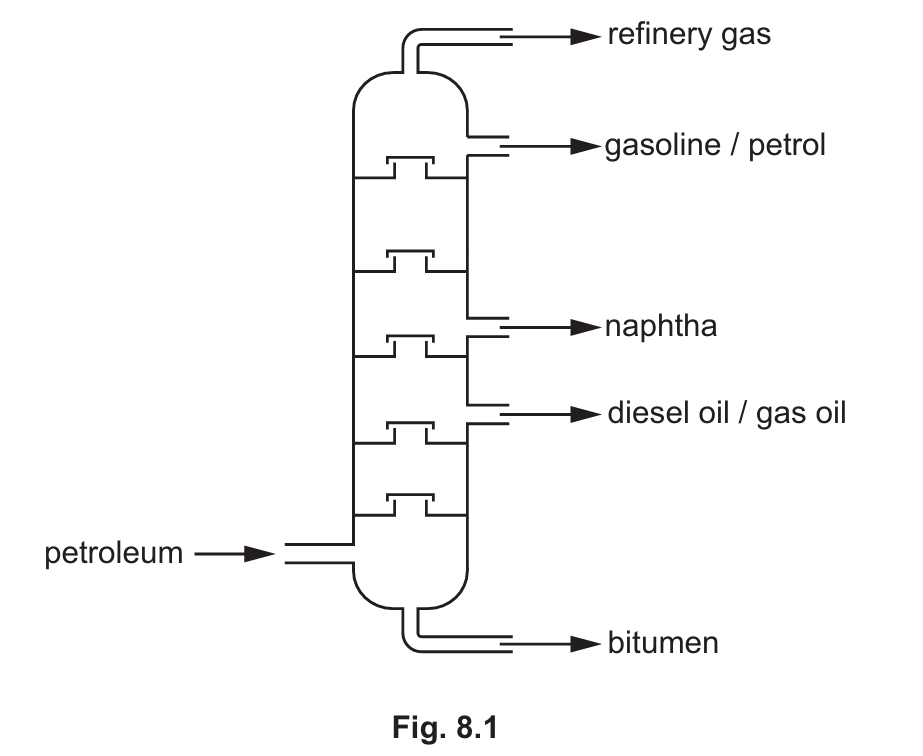
(b)(i) Fractional distillation
Fractional distillation is the process used to separate petroleum into different fractions based on their boiling points.
(b)(ii) No new substances are made / It is a separation process.
Fractional distillation is a physical change because it only separates the components of petroleum based on their boiling points. No chemical bonds are broken or formed, and no new compounds are created.
(b)(iii) Road surfaces / making roads
Bitumen is the thickest fraction obtained from petroleum distillation and is commonly used for surfacing roads and making roofing materials.
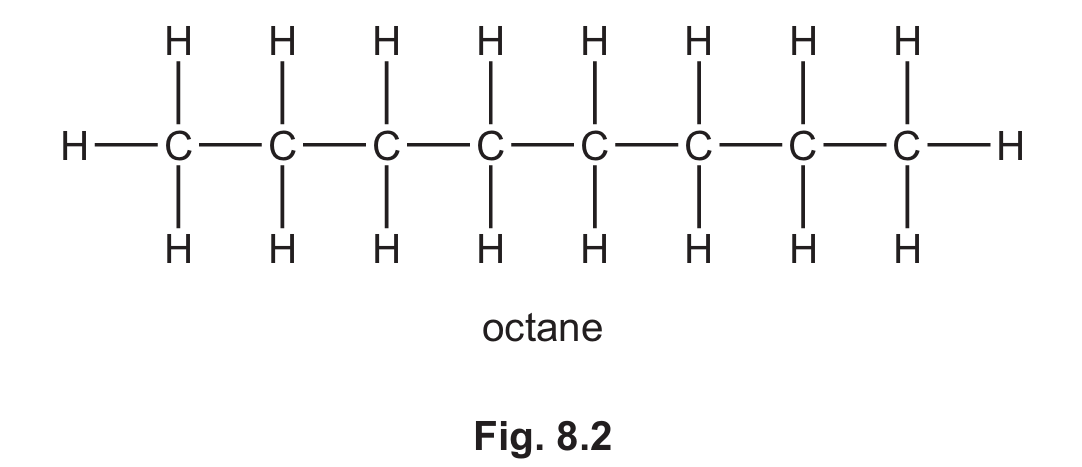
(c)(i) Octane is a hydrocarbon because it contains carbon and hydrogen atoms only.
Hydrocarbons are compounds that consist entirely of carbon and hydrogen atoms. Octane’s structure shows only carbon and hydrogen atoms bonded together.
(c)(ii) C₈H₁₈
Octane has 8 carbon atoms and 18 hydrogen atoms. The general formula for alkanes is CₙH₂ₙ₊₂, so for n=8, the formula is C₈H₁₈.
(c)(iii) Covalent bonding
Octane contains covalent bonds between its carbon and hydrogen atoms. These bonds are formed by sharing pairs of electrons between non-metal atoms.
(c)(iv) Octane contains only C–C single bonds / does not contain a C=C double bond.
Saturated hydrocarbons contain only single bonds between carbon atoms. Octane has all single bonds, making it saturated. Alkanes are saturated hydrocarbons.
(c)(v) carbon dioxide and water
Complete combustion of any hydrocarbon in excess oxygen produces carbon dioxide (CO₂) and water (H₂O) as the only products.