CIE iGCSE Co-Ordinated Science C11.4 Alkanes Exam Style Questions Paper 2
Question
Pentane, \( C_5H_{12} \), burns in a limited air supply to produce some carbon dioxide and some carbon monoxide.
What is a balanced equation for this reaction?
A. \( C_5H_{12} + 7O_2 \rightarrow 3CO_2 + 2CO + 6H_2O \)
B. \( C_5H_{12} + 9O_2 \rightarrow CO_2 + 4CO + 12H_2O \)
C. \( C_5H_{12} + 14O \rightarrow 3CO_2 + 2CO + 6H_2O \)
D. \( C_5H_{12} + 18O \rightarrow CO_2 + 4CO + 12H_2O \)
▶️ Answer/Explanation
Balancing carbon gives 5 carbon atoms split between \( CO_2 \) and \( CO \), and balancing hydrogen gives \( 6H_2O \); checking option A: \( 3CO_2 + 2CO + 6H_2O \) uses \( (3\times2)+2+6 = 14 \) oxygen atoms, matching \( 7O_2 \).
Option B does not balance oxygen atoms correctly, so it is incorrect.
✅ Answer: (A)
Question
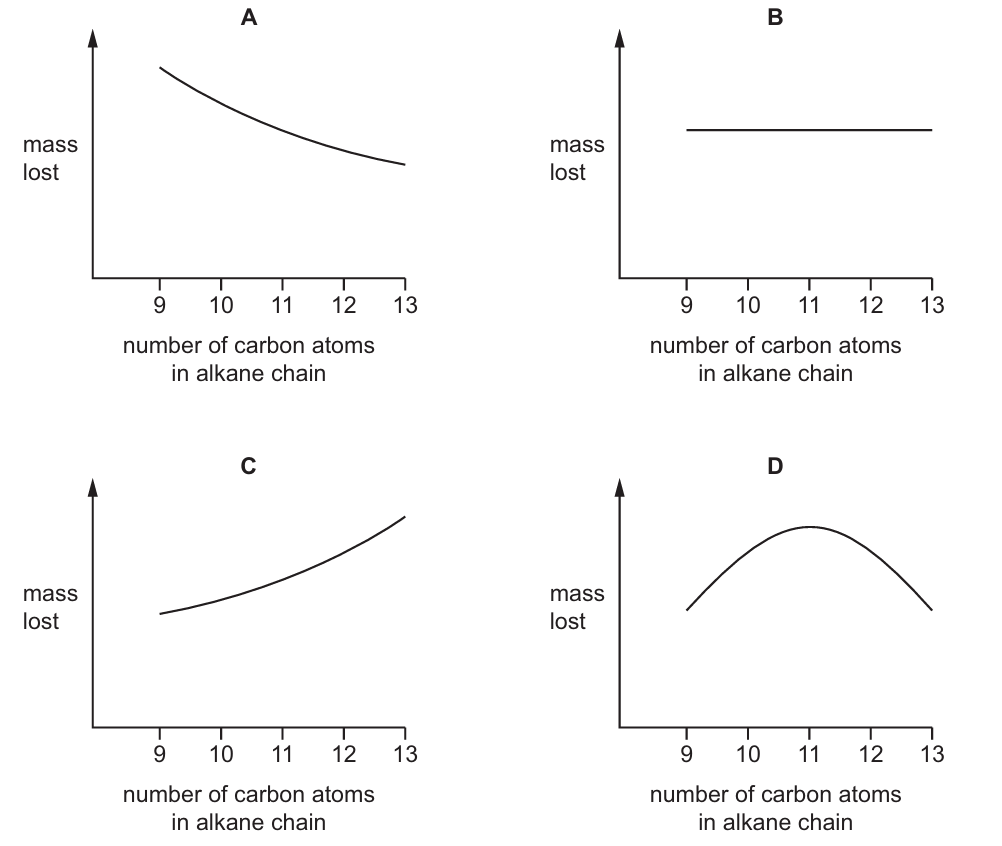
The same mass of five different alkanes are left to evaporate under identical conditions.
The mass lost by each alkane in one day is measured.
Which graph shows the mass lost against the number of carbon atoms in each alkane chain?

▶️ Answer/Explanation
Stronger intermolecular forces mean more energy is needed for molecules to escape into the gas phase, so evaporation is slower.
This means mass lost through evaporation decreases steadily as the number of carbon atoms in the chain increases, giving a downward-sloping line.
✅ Answer: (A)
Question
Reactants for three chemical processes are listed.
1 ethene + steam
2 ethene + hydrogen
3 ethene forming poly(ethene)
Which processes form saturated hydrocarbons?
(A) 1, 2 and 3
(B) 1 and 2 only
(C) 1 and 3 only
(D) 2 and 3 only
▶️Answer/Explanation
Ans : D
Question
The Haber process is used to make ammonia.
Which statement about the Haber process is not correct?
A A vanadium(V) oxide catalyst is used.
B The nitrogen used is obtained from the air.
C The pressure used is 200 atmospheres.
D The temperature used is 450 ºC.
▶️Answer/Explanation
Ans : A
Question
The cracking of decane molecules is represented by the equation shown.
![]()
What is Y?
- A: C₄H₈
- B: C₄H₁₀
- C: C₇H₁₄
- D: C₇H₁₆
▶️Answer/Explanation
Answer: B
Explanation: The cracking of decane (C₁₀H₂₂) produces smaller alkanes and alkenes. In this case, Y is C₄H₁₀, which is butane.
