CIE iGCSE Co-Ordinated Science C11.5 Alkenes Exam Style Questions Paper 2
Question
Which type of reaction occurs when ethene reacts with steam?
A. addition
B. cracking
C. displacement
D. polymerisation
▶️ Answer/Explanation
Ethene reacts with steam (water) to produce ethanol in an addition reaction. In this process, the double bond between the two carbon atoms in ethene breaks, and hydrogen and oxygen atoms from steam are added across the double bond. This type of reaction is known as addition because atoms are added to the unsaturated molecule without removing anything.
✅ Answer: (A)
✅ Answer: (A)
Question
Hydrocarbon X has two carbon atoms in each molecule. It does not decolourise bromine water.
Hydrocarbon Y has three carbon atoms in each molecule. It does decolourise bromine water.
What is the difference in the number of hydrogen atoms in the molecules of X and Y?
A. 0
B. 1
C. 2
D. 4
▶️ Answer/Explanation
X does not decolourise bromine water, so it is a saturated alkane; with 2 carbons this is ethane, \(C_2H_6\).
Y decolourises bromine water, so it is an unsaturated alkene; with 3 carbons this is propene, \(C_3H_6\).
Comparing hydrogen atoms: X has 6 and Y has 6, so the difference is \(6 – 6 = 0\).
✅ Answer: (A)
Y decolourises bromine water, so it is an unsaturated alkene; with 3 carbons this is propene, \(C_3H_6\).
Comparing hydrogen atoms: X has 6 and Y has 6, so the difference is \(6 – 6 = 0\).
✅ Answer: (A)
Question
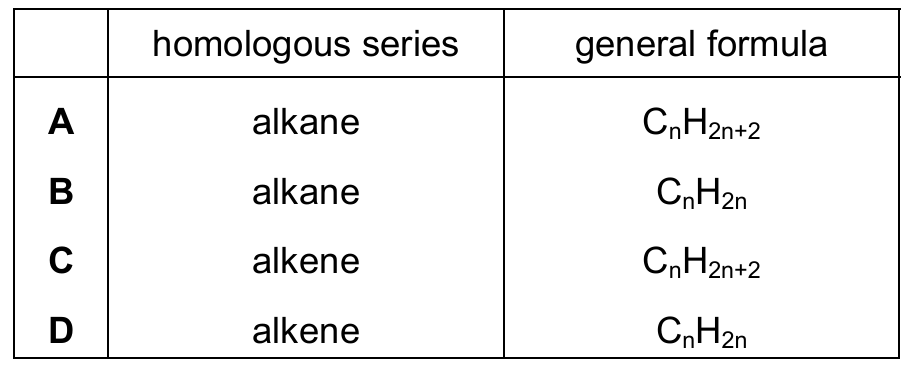
Which row describes the hydrocarbon CH3CHCH2?

▶️ Answer/Explanation
\( CH_3CHCH_2 \) is propene, which contains a carbon–carbon double bond, so it belongs to the alkene homologous series, not the alkane series.
Alkenes have the general formula \( C_nH_{2n} \), since they have two fewer hydrogen atoms than the corresponding alkane due to the double bond.
This matches row D; the alkane formula \( C_nH_{2n+2} \) in rows A and C would apply to a saturated hydrocarbon instead.
✅ Answer: (D)
Alkenes have the general formula \( C_nH_{2n} \), since they have two fewer hydrogen atoms than the corresponding alkane due to the double bond.
This matches row D; the alkane formula \( C_nH_{2n+2} \) in rows A and C would apply to a saturated hydrocarbon instead.
✅ Answer: (D)
Question
Which statements about ethene and but-1-ene are correct?
- Only ethene reacts with bromine water.
- They are both formed by cracking alkanes.
- They both react with steam to form alcohols.
- They have different general formulae.
A. 1 and 2
B. 1 and 4
C. 2 and 3
D. 3 and 4
▶️ Answer/Explanation
Both ethene and but-1-ene are alkenes formed by cracking larger alkane molecules, so statement 2 is correct.
As alkenes with a C=C double bond, both add steam to form the corresponding alcohol, so statement 3 is also correct; both share the same general formula (C_nH_{2n}), and both decolourise bromine water, so statements 1 and 4 are false.
✅ Answer: (C)
As alkenes with a C=C double bond, both add steam to form the corresponding alcohol, so statement 3 is also correct; both share the same general formula (C_nH_{2n}), and both decolourise bromine water, so statements 1 and 4 are false.
✅ Answer: (C)
Question
Which statements about the addition reactions of ethene are correct?
- Ethene reacts with hydrogen to form ethane.
- Ethene reacts with steam to form ethane.
- Ethene undergoes addition reactions because it is a saturated hydrocarbon.
- During addition reactions of ethene, only one product is produced.
A. 1 and 2
B. 1 and 4
C. 2 and 3
D. 3 and 4
▶️ Answer/Explanation
Ethene reacts with hydrogen to form ethane (hydrogenation). Addition reactions only produce one product because the double bond opens to add atoms. Ethene is unsaturated, not saturated. Reaction with steam forms ethanol, not ethane.
✅ Answer: (B)
✅ Answer: (B)
