
▶️ Answer/Explanation
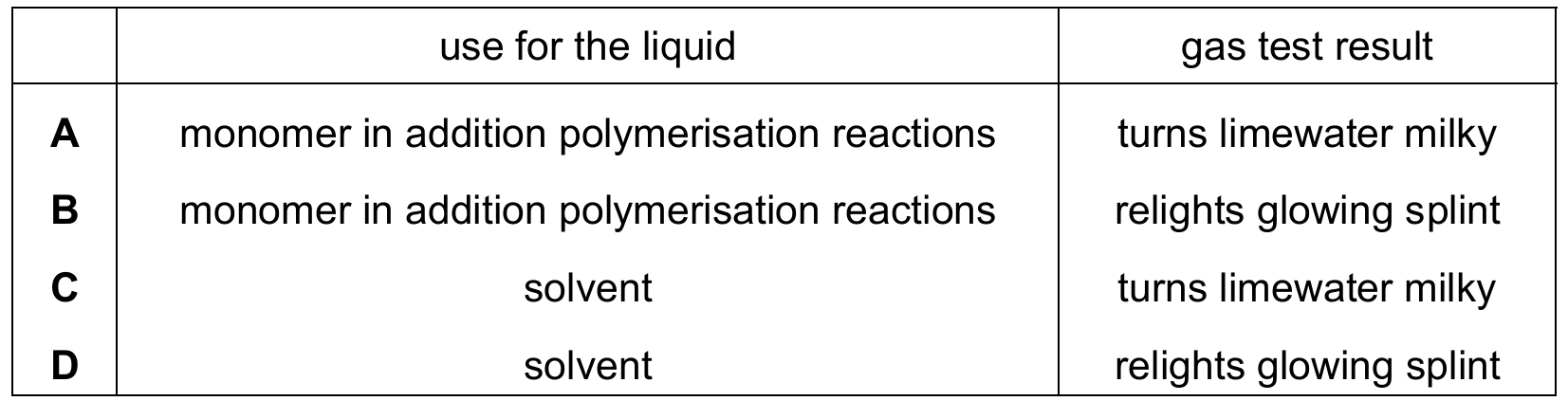
Fermentation of glucose produces ethanol (the organic liquid) and carbon dioxide gas.
Ethanol is widely used as a solvent, not as a monomer for addition polymerisation.
Carbon dioxide gas turns limewater milky, which is the standard test for this gas.
✅ Answer: (C)
Ethanol is widely used as a solvent, not as a monomer for addition polymerisation.
Carbon dioxide gas turns limewater milky, which is the standard test for this gas.
✅ Answer: (C)
▶️ Answer/Explanation
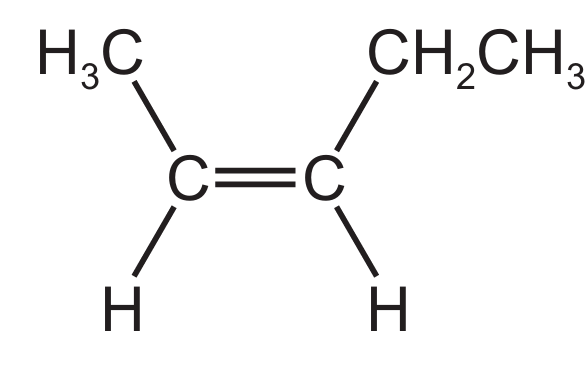
In addition polymerisation, the carbon–carbon double bond in each monomer opens up to form single bonds linking repeating units together.
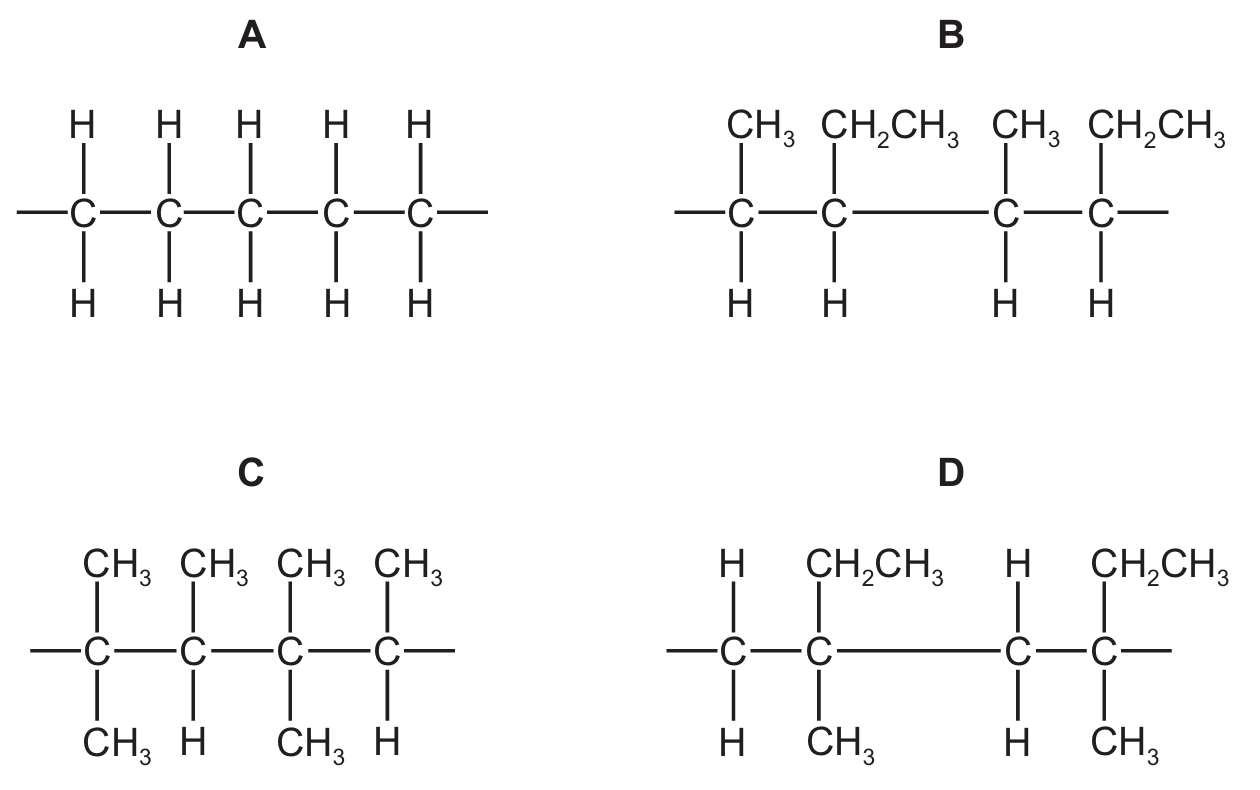
The side groups on the monomer (here a \( CH_3 \) and a \( CH_2CH_3 \) group) must be carried unchanged onto every repeat unit of the backbone.
Only the structure with a continuous carbon backbone carrying both of these side groups on alternating carbons, and no double bonds remaining, correctly represents the addition polymer, matching option B.
✅ Answer: (B)
The side groups on the monomer (here a \( CH_3 \) and a \( CH_2CH_3 \) group) must be carried unchanged onto every repeat unit of the backbone.
Only the structure with a continuous carbon backbone carrying both of these side groups on alternating carbons, and no double bonds remaining, correctly represents the addition polymer, matching option B.
✅ Answer: (B)


▶️ Answer/Explanation
Fermentation of glucose solution with yeast produces compound X, which is ethanol, along with carbon dioxide.
Ethanol then undergoes process Y (combustion) to produce water and carbon dioxide, releasing energy.
✅ Answer: (A)
Ethanol then undergoes process Y (combustion) to produce water and carbon dioxide, releasing energy.
✅ Answer: (A)
Question
Four molecules are shown. Which structure represents ethanol?

▶️Answer/Explanation
Answer: A
Explanation: Ethanol has the chemical formula C₂H₅OH, and Structure A correctly represents this molecule.