
CIE iGCSE Co-Ordinated Science C11.6 Alcohols Exam Style Questions Paper 3
Question
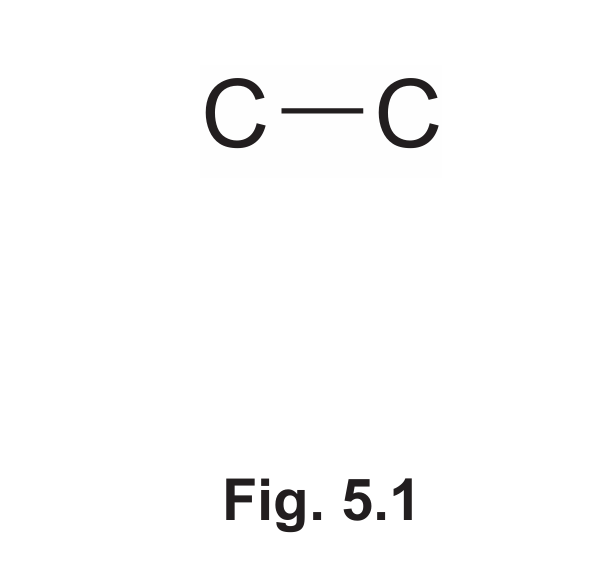
(ii) Write the word equation for the complete combustion of ethanol.
…………………… + …………………… → …………………… + ……………………
State what is meant by an exothermic reaction.
(d) Ethanol is a liquid at room temperature.
Describe the motion and separation of the particles in ethanol.
Most-appropriate topic codes (Cambridge IGCSE Co-ordinated Sciences 0654):
• Topic C11.6 — Alcohols (Parts (a), (b)(i)–(b)(ii), (c))
• Topic C5.1 — Exothermic and endothermic reactions (Part (b)(iii))
• Topic C1.1 — Solids, liquids and gases (Part (d))
▶️ Answer/Explanation
(a) 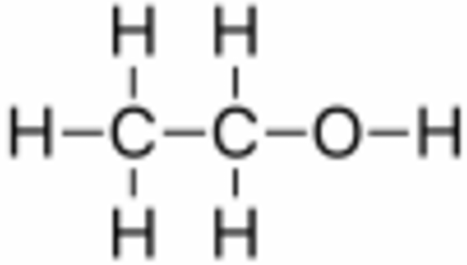
The left carbon has 3 H atoms attached, and the right carbon has 2 H atoms and the –OH group.
The structural formula is: \(\text{H}_3\text{C} – \text{CH}_2 – \text{OH}\), with the C–O–H linkage clearly drawn.
Two marks are awarded: one for the correct C–O–H group, one for all remaining H atoms correctly placed.
(b)(i) solvent (e.g. in perfumes, medicines, cleaning products)
Ethanol is widely used as a solvent because it dissolves many substances that water cannot.
It is also used as an antiseptic and as an ingredient in alcoholic beverages.
Other acceptable answers include: antiseptic, or as a raw material in the chemical industry.
(b)(ii) ethanol + oxygen → carbon dioxide + water
Complete combustion requires excess oxygen and produces only carbon dioxide and water as products.
The word equation is: \(\text{ethanol} + \text{oxygen} \rightarrow \text{carbon dioxide} + \text{water}\).
One mark for correct reactants (ethanol and oxygen), one mark for correct products (carbon dioxide and water).
(b)(iii) A reaction that releases thermal energy (to the surroundings) / the products have less energy than the reactants.
In an exothermic reaction, energy is released to the surroundings, typically causing a temperature rise.
The energy released comes from the formation of new bonds in the products being greater than the energy required to break bonds in the reactants.
Examples include combustion, neutralisation, and respiration.
(c)(i) steam / water
Ethanol is manufactured from ethene by the addition of steam (water) in the presence of a phosphoric acid catalyst.
The reaction is: \(\text{C}_2\text{H}_4 + \text{H}_2\text{O} \rightarrow \text{C}_2\text{H}_5\text{OH}\).
High temperature (~300°C) and high pressure (~60–70 atm) are used to increase the rate and yield.
(c)(ii) A catalyst increases the rate of reaction (without being used up / without being consumed).
A catalyst provides an alternative reaction pathway with a lower activation energy, allowing more particles to react.
The catalyst is not consumed in the reaction and can be recovered unchanged at the end.
This means a small amount of catalyst can speed up a large quantity of reaction.
(c)(iii) fermentation
Ethanol can also be made by fermentation of glucose using yeast in the absence of oxygen (anaerobic conditions).
The equation is: \(\text{C}_6\text{H}_{12}\text{O}_6 \rightarrow 2\text{C}_2\text{H}_5\text{OH} + 2\text{CO}_2\).
Fermentation is carried out at approximately 25–37°C and produces a dilute solution of ethanol.
(d) motion: random; separation: touching (close together / particles in contact).
In a liquid, particles move randomly in all directions but are not completely free as in a gas.
The particles are close together and touching (in contact), with very little space between them, unlike gas particles.
This is why liquids have a definite volume but take the shape of their container.
Question
Topic codes:
• Topic C11.2 — Naming organic compounds (Part (a)(iii))
• Topic C11.6 — Alcohols (Part (a)(i), (a)(ii) & (b))
• Topic C3.2 — Relative masses of atoms and molecules (Part (a)(iv))
• Topic C10.2 — Air quality and climate (Part (b)(i))
• Topic C10.1 — Water (Part (b)(ii))
• Topic C2.5 — Simple molecules and covalent bonds (Part (b)(iii))
▶️ Answer/Explanation
(a)(i) Hydrocarbons only contain carbon and hydrogen.
Ethanol contains carbon, hydrogen, and oxygen atoms. The presence of oxygen means it is not a hydrocarbon. Hydrocarbons are compounds that contain only carbon and hydrogen atoms.
(a)(ii) Solvent or fuel
Ethanol is commonly used as a solvent in manufacturing and as a fuel (e.g., in alcoholic drinks, as a fuel additive in petrol, or as a biofuel).
(a)(iii) Displayed formula of ethanol:
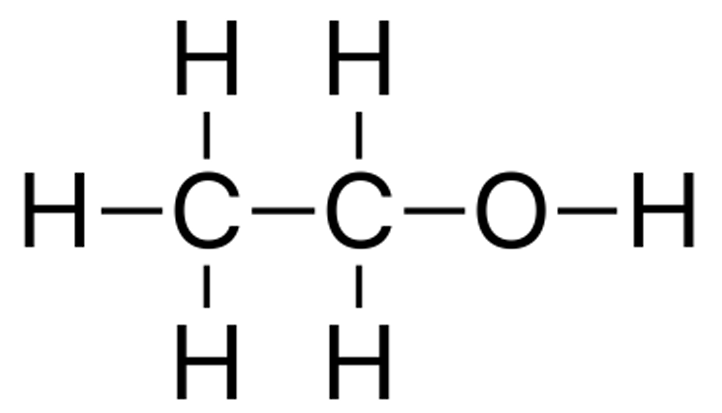
The displayed formula shows all the atoms and all the bonds in the molecule. Each line represents a covalent bond (shared pair of electrons).
(a)(iv) \(M_r = 46\)
Calculation: \((2 \times 12) + (6 \times 1) + (1 \times 16) = 24 + 6 + 16 = 46\)
Ethanol has 2 carbon atoms, 6 hydrogen atoms (5 from C₂H₅ and 1 from OH), and 1 oxygen atom.
(b)(i) Increased global warming / climate change
Carbon dioxide is a greenhouse gas that traps heat in the atmosphere. Higher levels of CO₂ lead to enhanced greenhouse effect, causing global warming and climate change.
(b)(ii) Anhydrous copper(II) sulfate: white to blue
Test: Add anhydrous copper(II) sulfate (white powder) to the sample. If water is present, it turns blue because copper(II) sulfate forms hydrated copper(II) sulfate (CuSO₄·5H₂O).
Alternative test: Anhydrous cobalt(II) chloride (blue) turns pink in the presence of water.
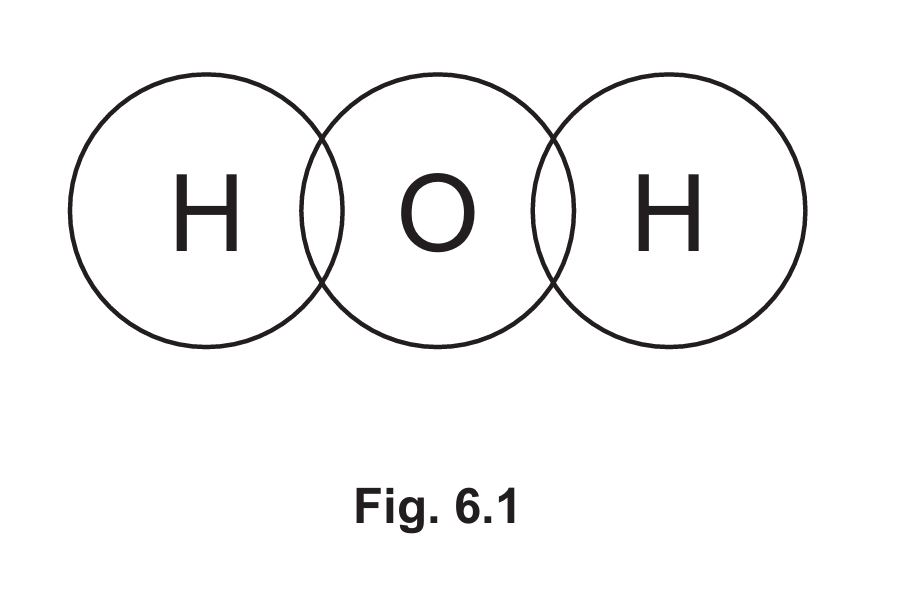
(b)(iii) Dot-and-cross diagram for water (\(\text{H}_2\text{O}\)):
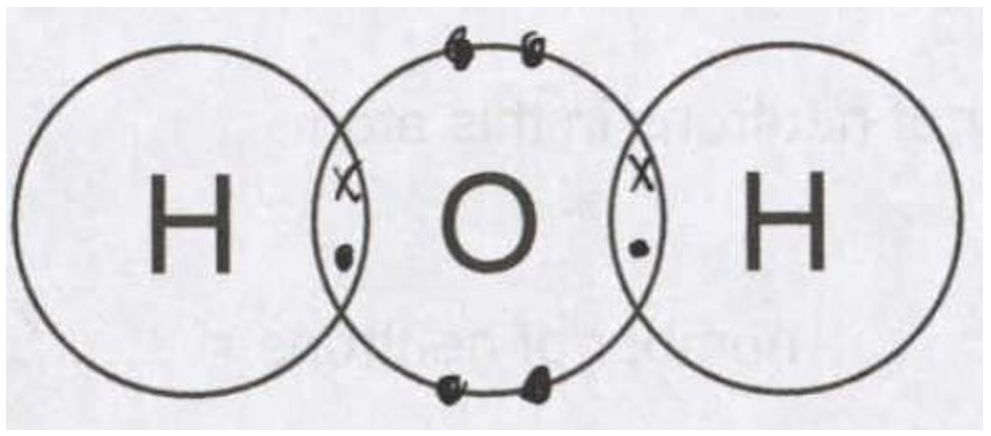
In a water molecule, the oxygen atom shares one electron with each of the two hydrogen atoms, forming two single covalent bonds. Oxygen has 6 outer-shell electrons, and each hydrogen has 1 outer-shell electron. Each shared pair of electrons is drawn as a cross (×) for one atom and a dot (•) for the other. Oxygen also has two lone pairs of electrons (not involved in bonding).