
CIE iGCSE Co-Ordinated Science C11.6 Alcohols Exam Style Questions Paper 4
Question
Construct the balanced symbol equation for the reaction.
Most-appropriate topic codes (Cambridge IGCSE Co-ordinated Sciences 0654):
• Topic C11.2 — Naming organic compounds (Part (a)(i) & (a)(ii))
• Topic C11.6 — Alcohols (Part (a)(iii) & (b))
• Topic C11.7 — Polymers (Part (a)(iv))
• Topic C3.3 — The mole and the Avogadro constant / Stoichiometry (Part (c))
• Topic C2.5 — Simple molecules and covalent bonds (Part (d))
▶️ Answer/Explanation
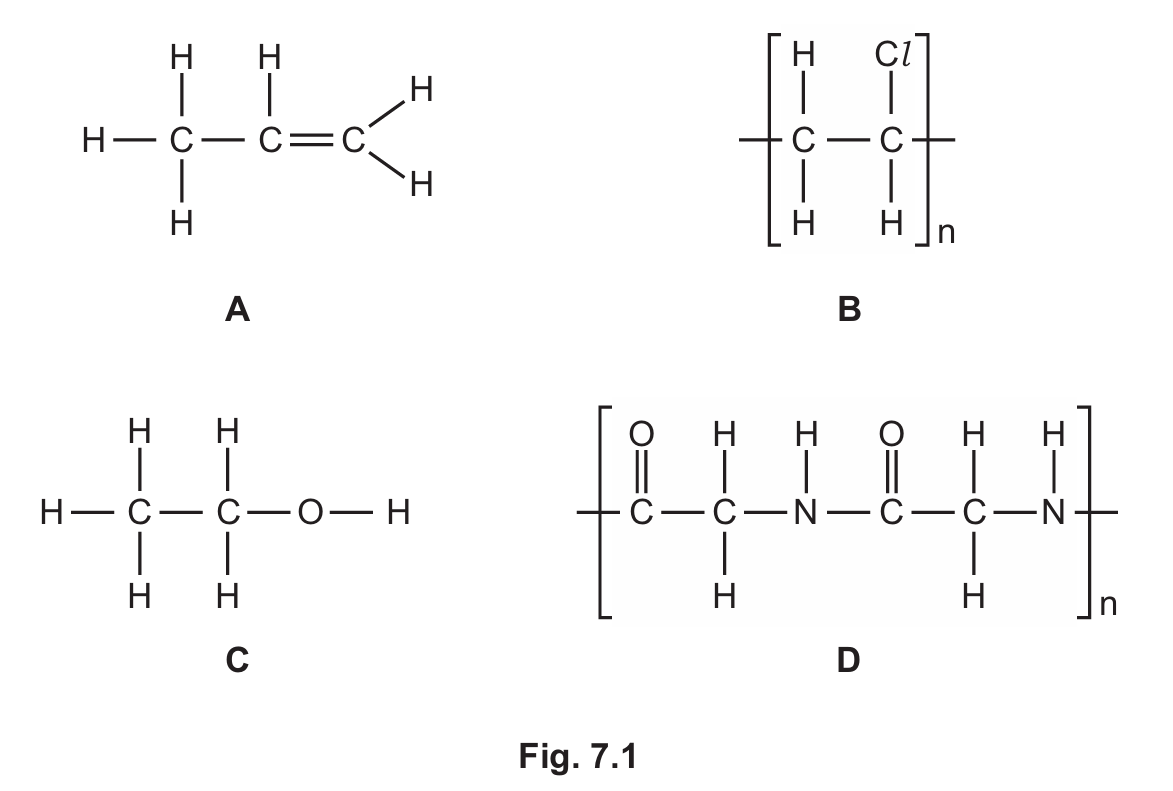
(a)(i) A is a hydrocarbon.
A hydrocarbon is a compound that contains only hydrogen and carbon atoms. Compound A (propene) contains only C and H atoms.
(a)(ii) A is propene.
Propene has the formula \(\text{C}_3\text{H}_6\) and contains a carbon-carbon double bond. Compound A shows this structure.
(a)(iii) C is made from the reaction of ethene with steam in the presence of an acid catalyst.
Ethene reacts with steam (hydration) in the presence of an acid catalyst to produce ethanol (\(\text{C}_2\text{H}_5\text{OH}\)), which is compound C.
(a)(iv) D is made in a condensation polymerisation reaction.
Compound D shows a repeating unit characteristic of a condensation polymer (such as nylon or a polyester).
(b) Balanced equation for complete combustion of ethanol:
\(\text{C}_2\text{H}_5\text{OH} + 3\text{O}_2 \rightarrow 2\text{CO}_2 + 3\text{H}_2\text{O}\)
(c) Limiting reactant calculation:
\(M_r\) of \(\text{C}_4\text{H}_8 = (4 \times 12) + (8 \times 1) = 48 + 8 = 56\)
Moles of \(\text{C}_4\text{H}_8 = \frac{11.2}{56} = 0.2\) mol
\(M_r\) of \(\text{H}_2 = 2 \times 1 = 2\)
Moles of \(\text{H}_2 = \frac{0.6}{2} = 0.3\) mol
\(\text{C}_4\text{H}_8\) is the limiting reactant because 0.2 mol is less than the 0.3 mol of \(\text{H}_2\).
The reaction requires a 1:1 mole ratio of \(\text{C}_4\text{H}_8\) to \(\text{H}_2\). Since there are fewer moles of \(\text{C}_4\text{H}_8\) (0.2 mol) than \(\text{H}_2\) (0.3 mol), \(\text{C}_4\text{H}_8\) is the limiting reactant and will be used up first.
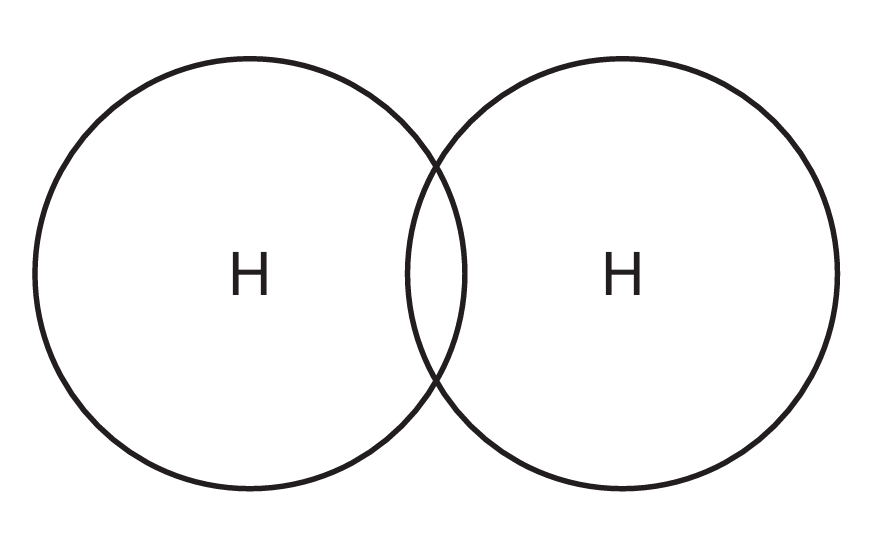
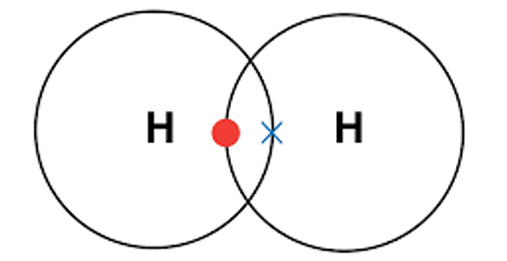
(d) Dot-and-cross diagram for hydrogen molecule (\(\text{H}_2\)):
Each hydrogen atom has one electron in its outer shell. Two hydrogen atoms share a pair of electrons to achieve a stable electron configuration (like helium). The shared pair represents a single covalent bond.
Question
Choose from A, B, C or D.
Choose from A, B, C or D.
State what type of reaction takes place.
State two similarities between the members of a homologous series.
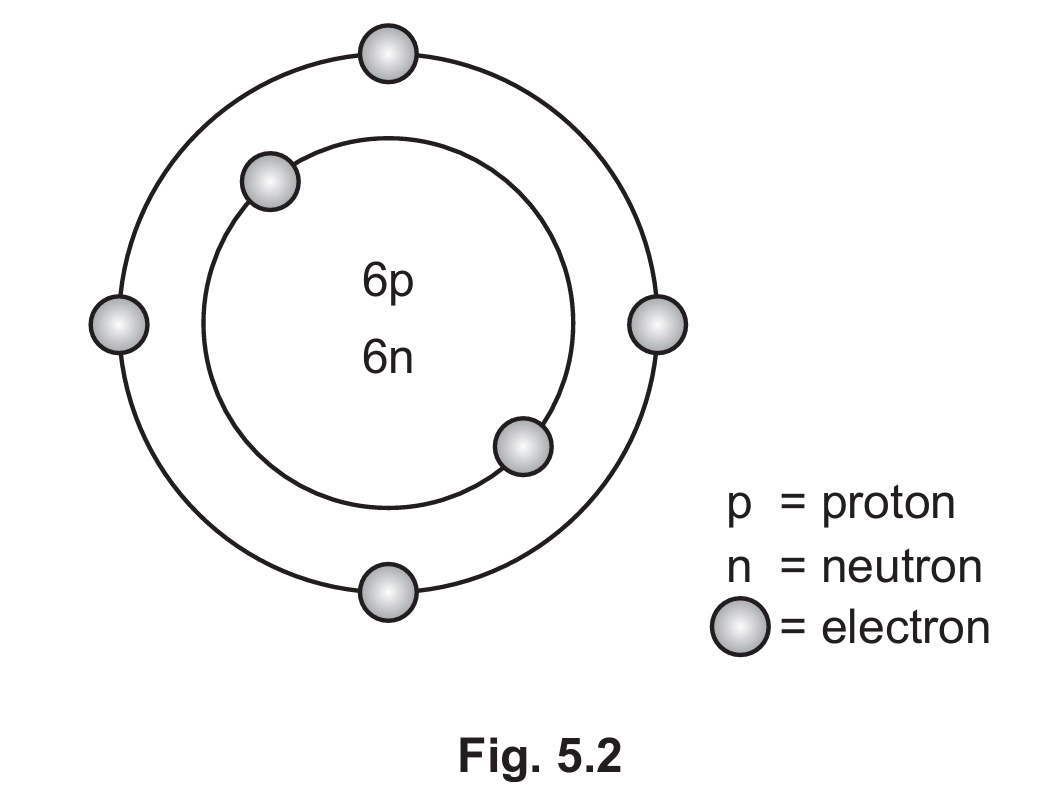
Describe how to deduce from Fig. 5.2 that carbon is in Group IV.
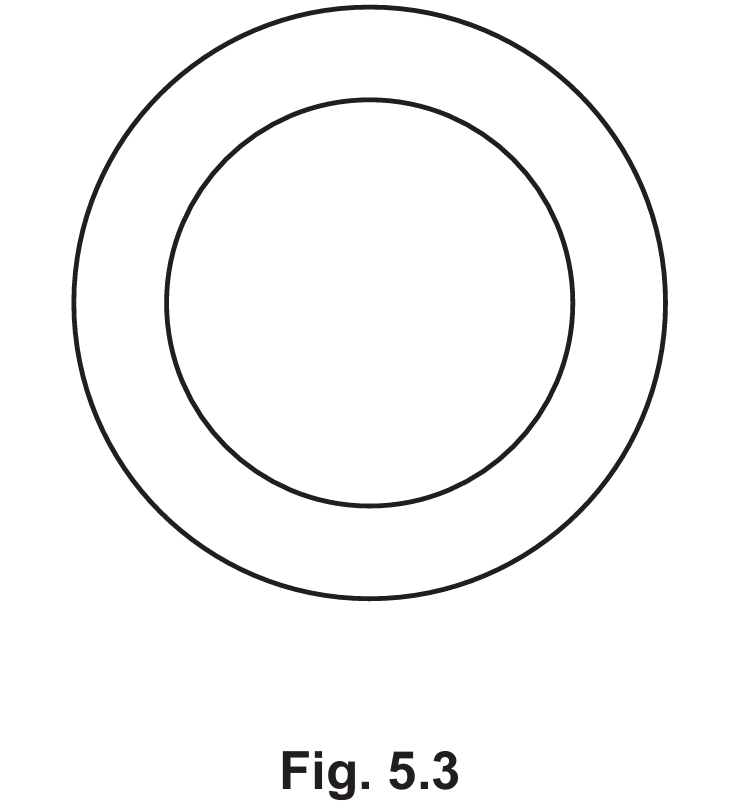
Complete Fig. 5.3 to show a different isotope of carbon from that shown in Fig. 5.2.
Most-appropriate topic codes (Cambridge IGCSE Co-ordinated Sciences 0654, 2025–2027 syllabus):
• Topic C11.5 — Alkenes (Parts (a)(i)–(iii))
• Topic C11.6 — Alcohols (Part (a)(iv))
• Topic C11.1 — Formulas and terminology (Part (a)(v))
• Topic C2.2 — Atomic structure and the Periodic Table (Part (b)(i))
• Topic C2.3 — Isotopes (Part (b)(ii))
▶️ Answer/Explanation
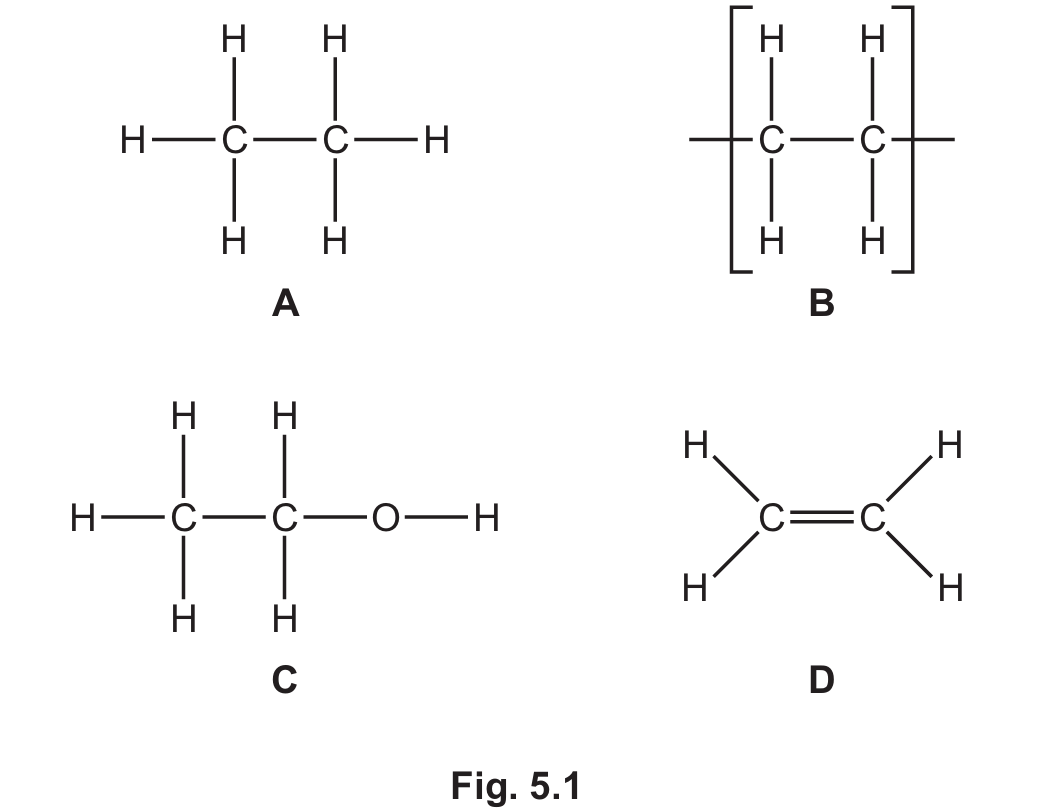
(a)(i) D
Compound D has the structure \(H_2C=CH_2\), which is ethene.
(a)(ii) D
Compound D contains a C=C double bond, making it an unsaturated hydrocarbon.
Compounds A and B contain only single C–C bonds (saturated), and compound C contains an oxygen atom so is not a hydrocarbon.
(a)(iii) Addition polymerisation
Many ethene (D) monomer molecules join together by opening their double bonds.
This forms the long-chain polymer poly(ethene), shown as compound B.
(a)(iv) Addition of steam using a catalyst
Ethene (D) reacts with steam (\(H_2O\)) in the presence of a catalyst (e.g. phosphoric acid).
This addition reaction converts the C=C double bond into a single bond and adds an –OH group, forming ethanol (C).
(a)(v) Same general formula; similar chemical properties
Members of a homologous series all fit the same general formula.
They show a gradual change in physical properties (e.g. boiling point) but similar chemical properties, differing by a \(CH_2\) unit between consecutive members.
(b)(i) 4 electrons in the outer shell
Fig. 5.2 shows carbon has 4 electrons in its outer shell.
The Group number of an element corresponds to the number of electrons in its outer shell, so carbon is in Group IV.
(b)(ii) Same protons, different neutrons
The diagram should keep 6 protons (same as Fig. 5.2, since isotopes are atoms of the same element).
The electron arrangement of 2,4 must also be shown to be correct.
The number of neutrons drawn must be different from 6 (e.g. 7 or 8), since isotopes differ only in their number of neutrons.