
▶️ Answer/Explanation
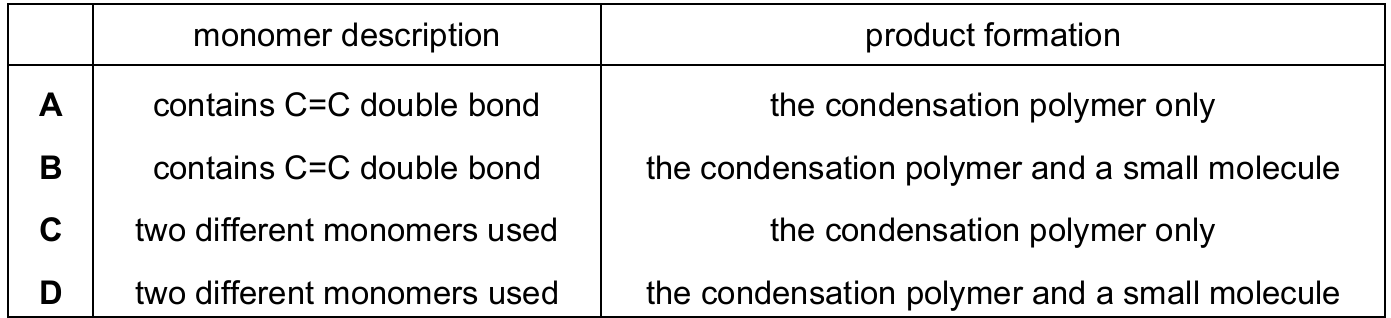
Condensation polymerisation uses two different monomers, unlike addition polymerisation which uses one monomer containing a C=C bond.
Condensation polymerisation also produces a small molecule (such as water) alongside the polymer.
✅ Answer: (D)
Condensation polymerisation also produces a small molecule (such as water) alongside the polymer.
✅ Answer: (D)
▶️ Answer/Explanation
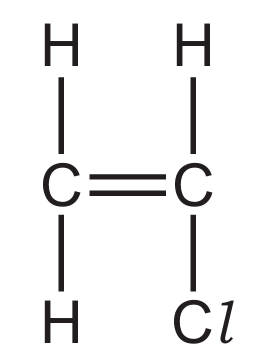
In addition polymerisation, the C=C double bond in each chloroethene monomer opens up to form a single bond.
Monomers then join end-to-end through these single bonds, keeping the chlorine atom attached to every other carbon.
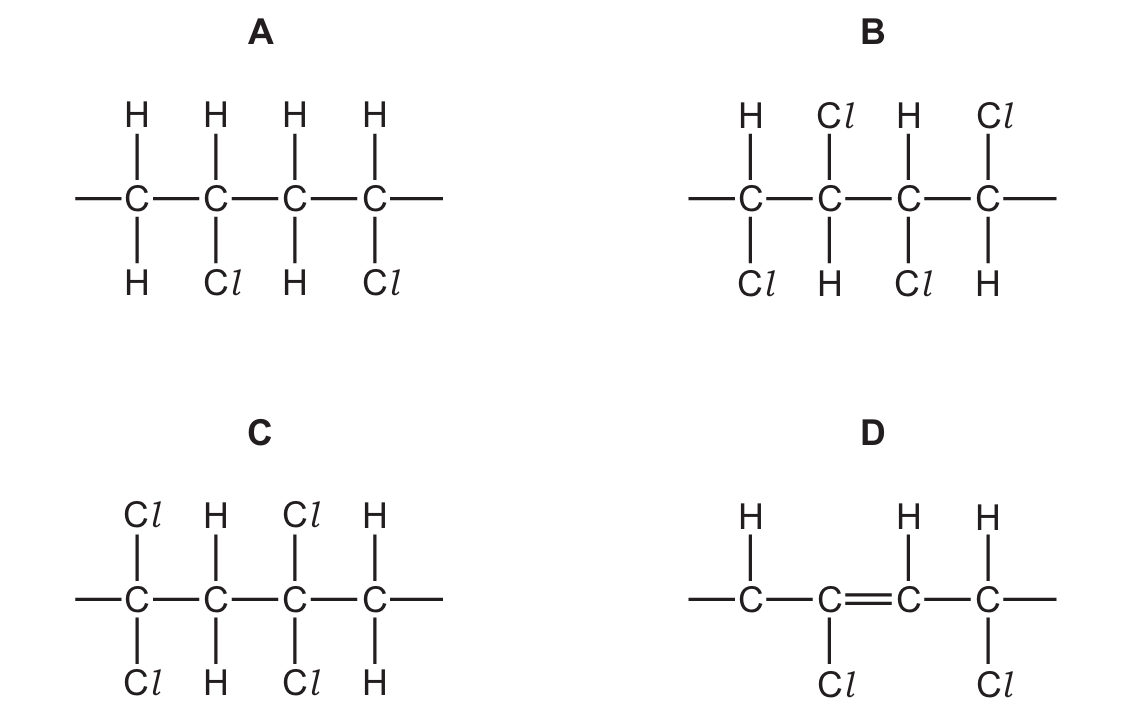
The repeat unit must show single C–C bonds throughout the backbone with one Cl per carbon, which matches diagram A.
✅ Answer: (A)
Monomers then join end-to-end through these single bonds, keeping the chlorine atom attached to every other carbon.
The repeat unit must show single C–C bonds throughout the backbone with one Cl per carbon, which matches diagram A.
✅ Answer: (A)
▶️ Answer/Explanation
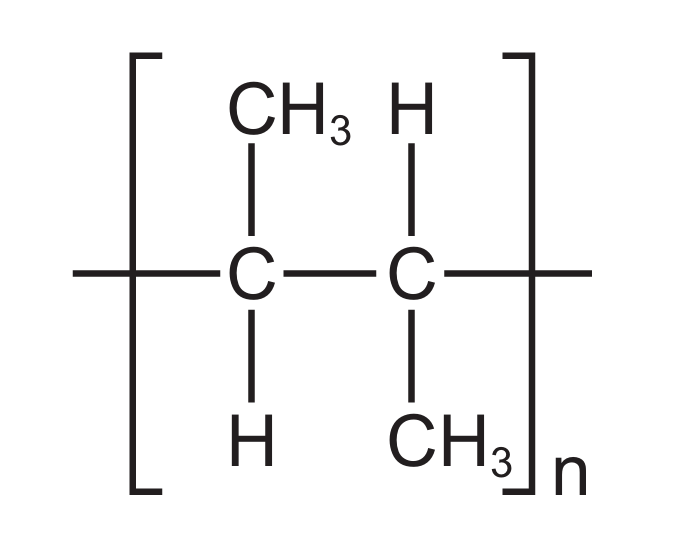
The polymer repeat unit shown has a backbone of four carbon atoms in a continuous chain, indicating it was formed from but-2-ene via addition polymerisation. Addition polymers form from alkenes without loss of any atoms.
✅ Answer: (D)
✅ Answer: (D)
▶️ Answer/Explanation
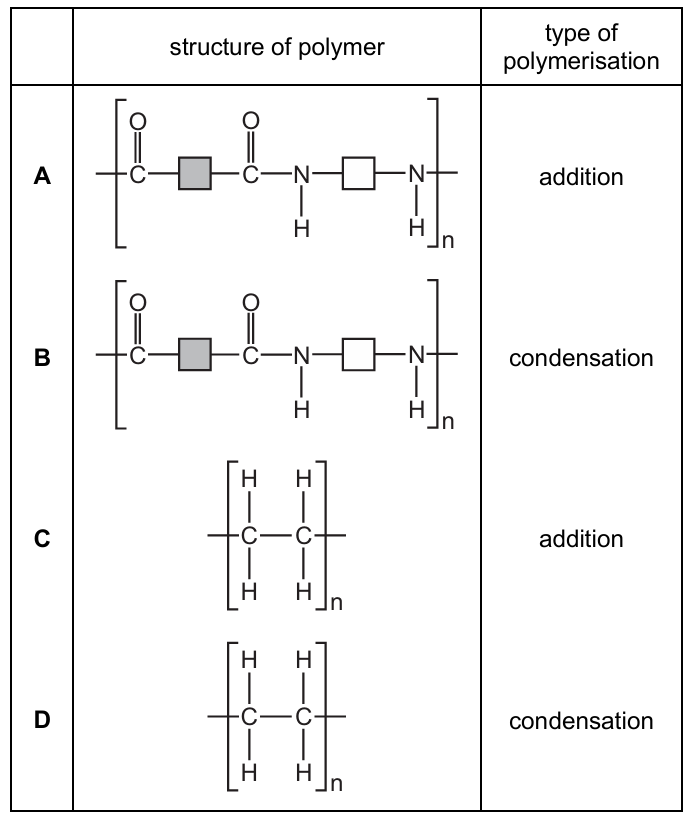
Poly(ethene) is made by addition polymerisation of ethene monomers. The repeating unit in poly(ethene) is \(-CH_2-CH_2-\), not a structure containing nitrogen or oxygen. Addition polymerisation involves monomers joining without loss of small molecules, unlike condensation polymerisation.
✅ Answer: (C)
✅ Answer: (C)