
▶️ Answer/Explanation
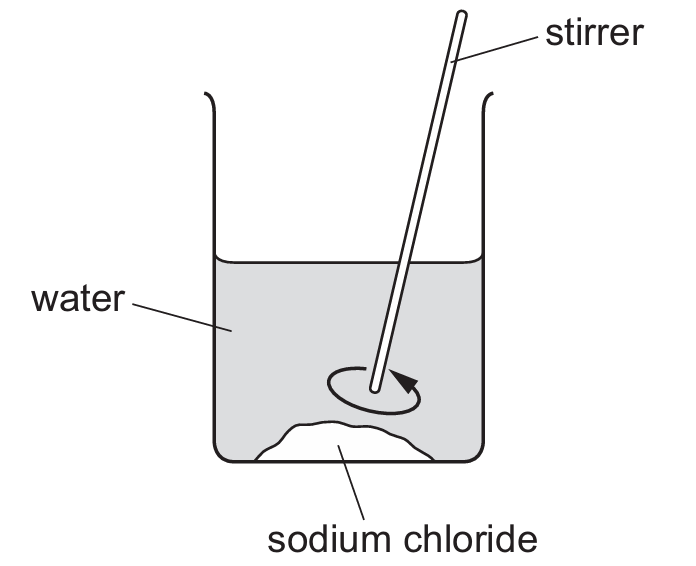
When sodium chloride is dissolved in water, two key terms are used:
- Solvent: The substance that dissolves the solute. In this case, water dissolves the sodium chloride, so water is the solvent.
- Solute: The substance that is dissolved. Sodium chloride is the solute.
- Solution: The homogeneous mixture formed when the solute dissolves in the solvent. The resulting mixture (salt water) is the solution.
- Sediment: Solid particles that settle at the bottom of a liquid. No sediment is formed here because sodium chloride dissolves completely.
Therefore, the correct term for the water is solvent.
✅ Answer: (A)
▶️ Answer/Explanation
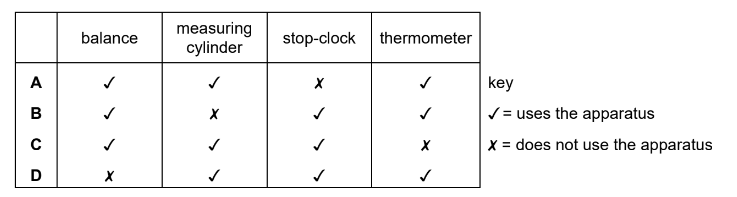
The experiment needs: a balance to weigh 5 g of magnesium, a measuring cylinder to measure 20 cm³ of acid, a beaker to hold the reaction mixture, and a stopwatch to time how long effervescence takes to stop.
No thermometer or gas syringe is required since the measurement is only of time (not temperature or gas volume), so the correct apparatus set is the one in option C.
✅ Answer: (C)
No thermometer or gas syringe is required since the measurement is only of time (not temperature or gas volume), so the correct apparatus set is the one in option C.
✅ Answer: (C)

▶️ Answer/Explanation
A burette has fine graduations (usually to 0.1 cm³) and a tap, allowing precise measurement of the volume of liquid delivered.
Beakers and measuring cylinders have wider graduations and are far less precise for measuring small changes in volume.
The burette is therefore the apparatus of choice when accuracy in measuring volume change matters.
✅ Answer: (C)
Beakers and measuring cylinders have wider graduations and are far less precise for measuring small changes in volume.
The burette is therefore the apparatus of choice when accuracy in measuring volume change matters.
✅ Answer: (C)