

▶️ Answer/Explanation
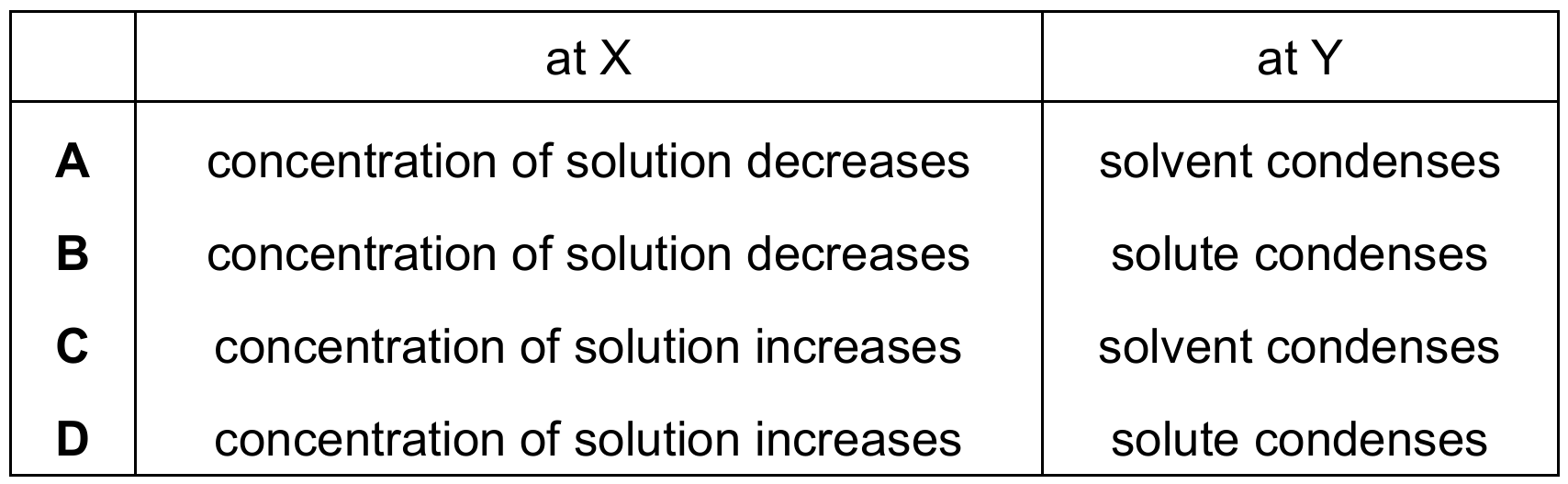
This is a simple distillation setup for purifying water from sea water: at position X (the heated flask), water evaporates (changes from liquid to gas), while at position Y (the condenser/collection flask), the water vapour condenses (changes from gas to liquid).
The salt remains behind in the flask because it does not evaporate; only pure water vapour travels to the collection vessel — matching row C which shows evaporation at X and condensation at Y.
✅ Answer: (C)
The salt remains behind in the flask because it does not evaporate; only pure water vapour travels to the collection vessel — matching row C which shows evaporation at X and condensation at Y.
✅ Answer: (C)
▶️ Answer/Explanation
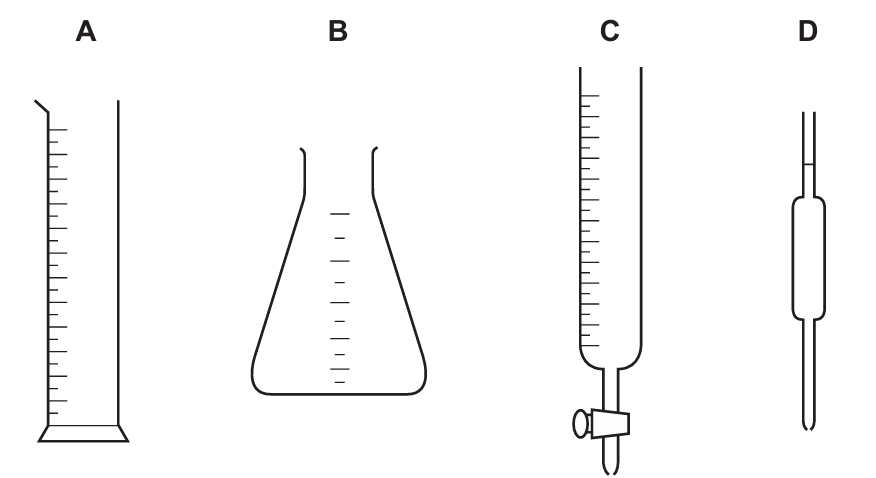
The accuracy of measuring volume depends on the fineness of the scale divisions on the apparatus.
A burette has the finest graduations of the common volume-measuring apparatus, allowing volume changes to be read most precisely.
Beakers and conical flasks only have very approximate volume markings, so they give the least accurate readings.
✅ Answer: (C)
A burette has the finest graduations of the common volume-measuring apparatus, allowing volume changes to be read most precisely.
Beakers and conical flasks only have very approximate volume markings, so they give the least accurate readings.
✅ Answer: (C)
Question
A student breathed gently in and out of the mouthpiece of the apparatus shown.

What were the results after 10 breaths?

▶️Answer/Explanation
Ans: B
Question
Sea water is heated in the apparatus shown.

Which row describes changes at positions X and Y?

▶️Answer/Explanation
Ans: C