
CIE iGCSE Co-Ordinated Science C12.1 Experimental design Exam Style Questions Paper 3
Question
After a few hours, no water is left in the cup.
State the name of the process that has occurred.
State the pH number of pure water.
Define the terms solute and solvent.
Most-appropriate topic codes (Cambridge IGCSE Co-ordinated Sciences 0654):
• Topic P2.1.2 — Particle model of matter (Part (a))
• Topic P2.1.1 — States of matter / evaporation (Part (b))
• Topic C7.1 — Acids, bases and pH (Part (c))
• Topic C10.1 — Water treatment (Part (d))
• Topic C2.5 — Simple molecules and covalent bonds (Part (e))
• Topic C12.1 — Experimental design: solute and solvent (Part (f))
▶️ Answer/Explanation
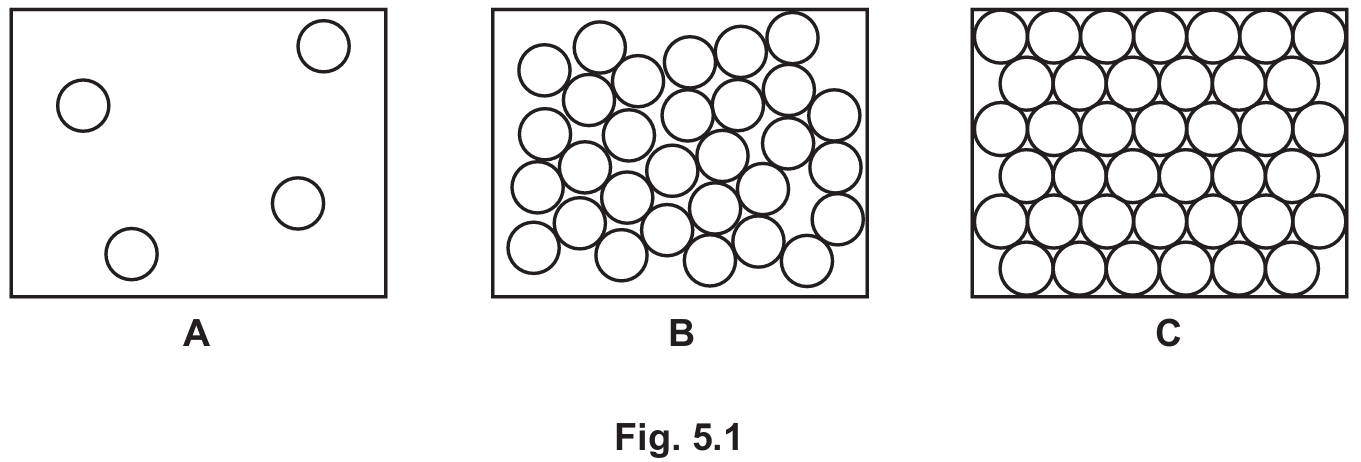
(a) Ice is diagram C; water is diagram B; steam is diagram A
In ice (a solid), particles are closely packed in a regular, fixed arrangement, shown by diagram C.
In water (a liquid), particles are close together but in an irregular, more loosely packed arrangement, shown by diagram B.
In steam (a gas), particles are widely spaced and move randomly, shown by diagram A.
(b) Evaporation
The water changes from a liquid to a gas (water vapour) at a temperature below its boiling point.
This change of state at the surface of a liquid is called evaporation.
(c) pH = 7
A neutral substance has a pH value that is neither acidic nor alkaline.
Pure water has a pH of exactly 7.
(d) Chlorine kills harmful microorganisms/bacteria/pathogens in the water
Drinking water can contain disease-causing microorganisms.
Chlorine is added because it kills these microbes, making the water safe to drink.
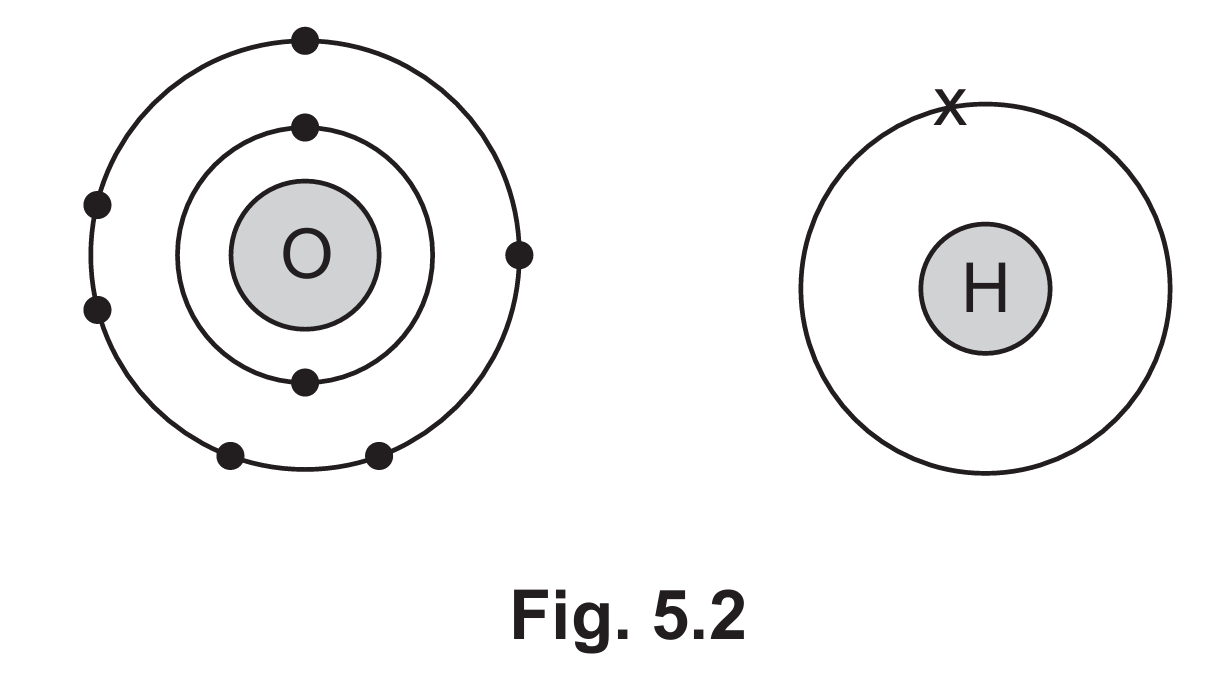
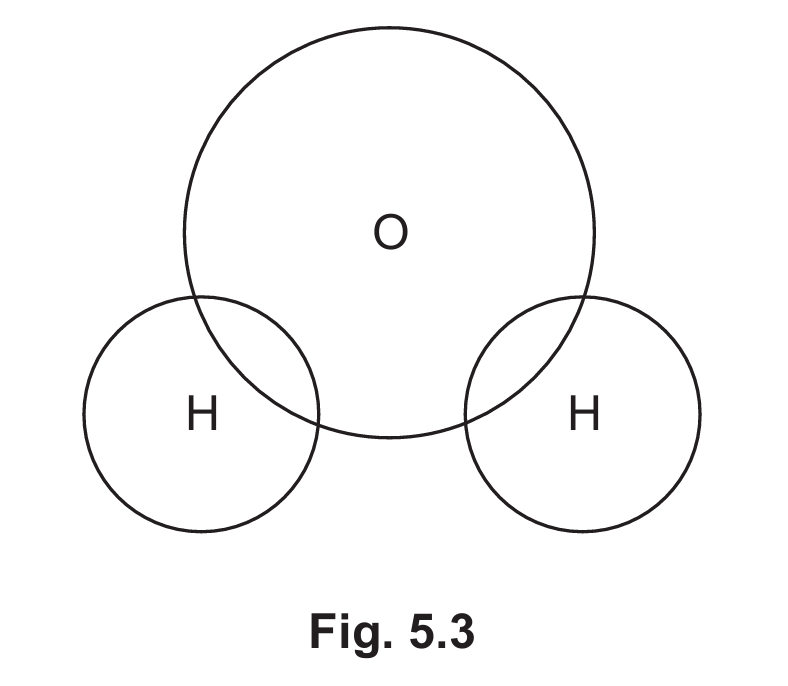
(e) One shared (bonding) pair of electrons drawn between O and each H, with all other electrons shown correctly around O
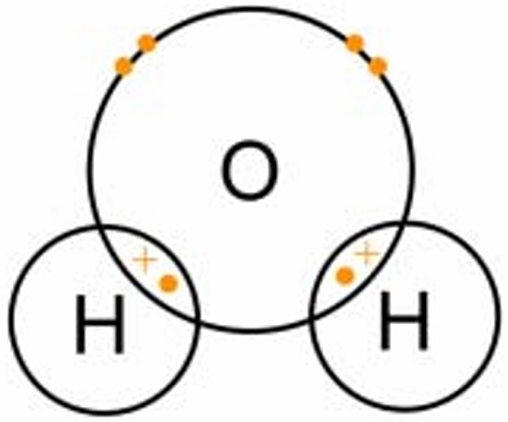
Each hydrogen atom shares its single electron with one of oxygen’s outer-shell electrons, forming a covalent bond.
Two covalent bonds are formed in total (one O–H bond to each hydrogen), giving oxygen a full outer shell of eight electrons.
(f) Solute — a substance that is dissolved in a solvent; Solvent — a substance/liquid that dissolves a solute
A solute is the substance present in smaller amount that gets dissolved, such as sodium chloride.
A solvent is the substance, usually a liquid such as water, that does the dissolving.
Question
Draw one straight line from each word to its correct description.
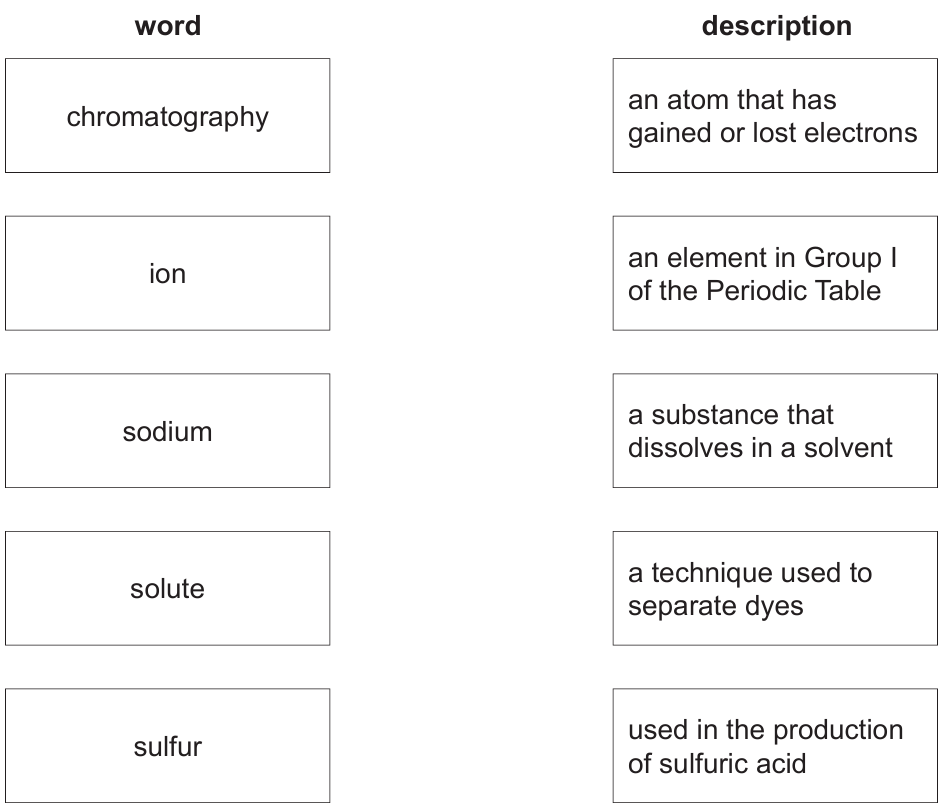
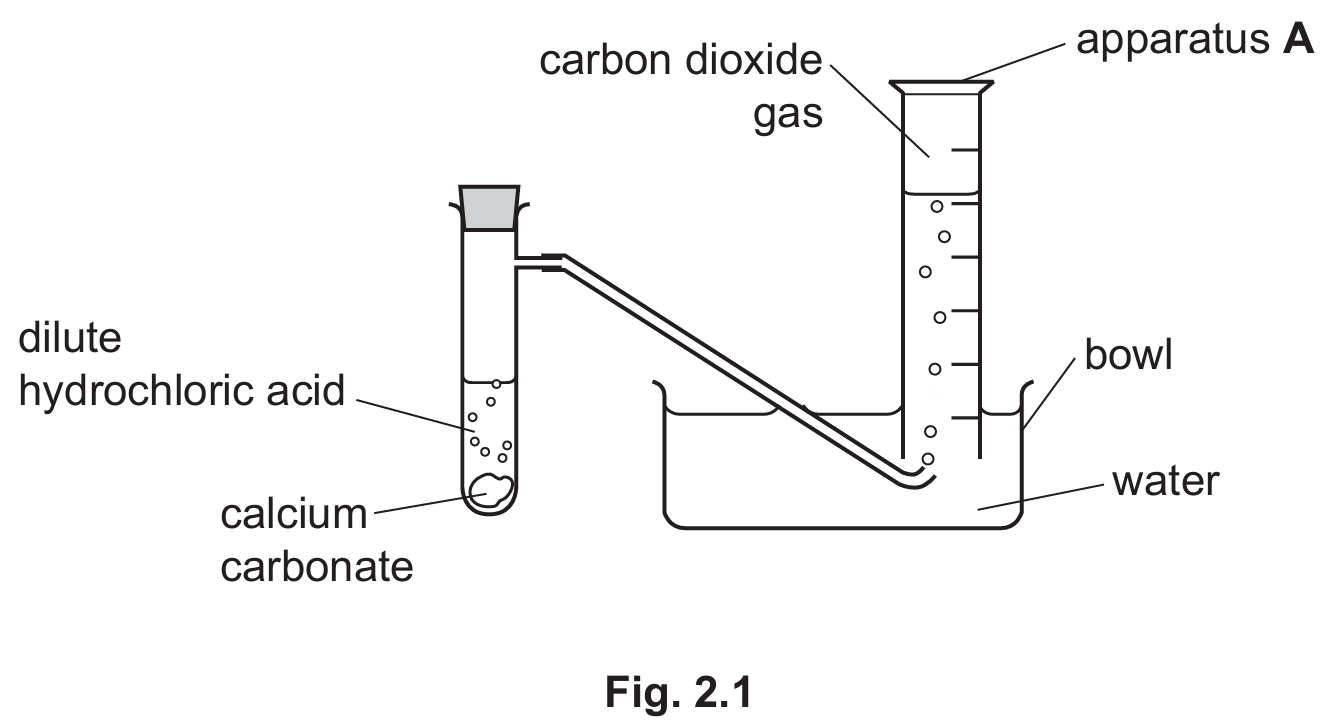
Fig. 2.1 shows the apparatus the student uses.
Calculate the rate at which carbon dioxide is made in \(\text{cm}^3/\text{s}\).
State the number of different elements present in calcium carbonate.
Most-appropriate topic codes (Cambridge IGCSE Co-ordinated Sciences 0654):
• Topics C2.1, C2.4, C12.3 — Elements/compounds/mixtures, Ions and ionic bonds, Chromatography (Part (a))
• Topic C12.1 — Experimental design (Part (b)(i))
• Topic C7.3 — Preparation of salts (Part (b)(ii))
• Topic C12.5 — Identification of ions and gases (Part (b)(iii))
• Topic C6.2 — Rate of reaction (Parts (b)(iv), (b)(v))
• Topic C2.1 — Elements, compounds and mixtures (Part (b)(vi))
▶️ Answer/Explanation
(a)
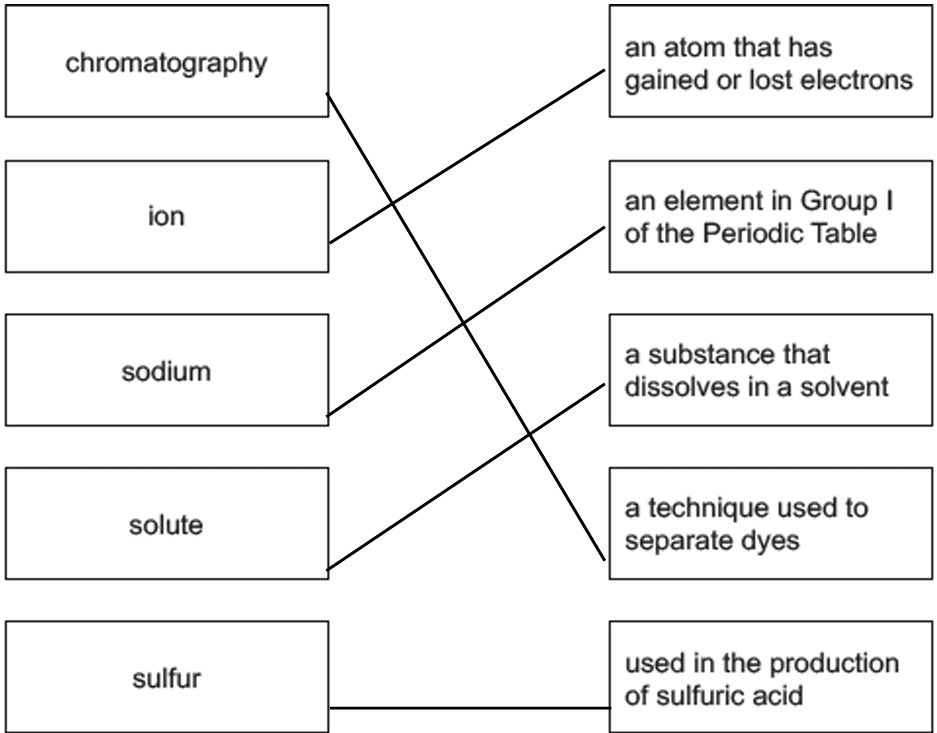
Ion is an atom that has gained or lost electrons.
Sodium is an element in Group I of the Periodic Table.
Solute is a substance that dissolves in a solvent.
Chromatography is a technique used to separate dyes.
Sulfur is used in the production of sulfuric acid.
(b)(i) Measuring cylinder
Apparatus A is used to collect and measure the volume of gas produced by downward displacement of water.
Its graduated scale allows the volume of carbon dioxide to be read directly.
(b)(ii) Calcium chloride
Calcium carbonate reacts with hydrochloric acid to form a calcium salt.
Since hydrochloric acid is used, the salt formed is calcium chloride.
(b)(iii) Bubble the gas through limewater; it turns milky/cloudy
Carbon dioxide is tested for by bubbling the gas through limewater.
A positive result is shown by the limewater turning milky or cloudy.
(b)(iv) 1.8 cm³/s
Rate = volume ÷ time.
Rate = \(\dfrac{90 \, \text{cm}^3}{50 \, \text{s}} = 1.8 \, \text{cm}^3/\text{s}\).
(b)(v) Lower temperature of acid; lower concentration of acid (or decrease surface area)
Reducing the temperature of the acid slows down particle collisions, reducing the rate.
Reducing the concentration of the acid also lowers the frequency of successful collisions.
Alternatively, decreasing the surface area of the calcium carbonate would reduce the rate.
(b)(vi) 3
The formula \(\text{CaCO}_3\) contains calcium (Ca), carbon (C), and oxygen (O).
This gives a total of 3 different elements.