
CIE iGCSE Co-Ordinated Science C12.1 Experimental design Exam Style Questions Paper 4
Question
The student uses dilute hydrochloric acid with the same concentration each time.
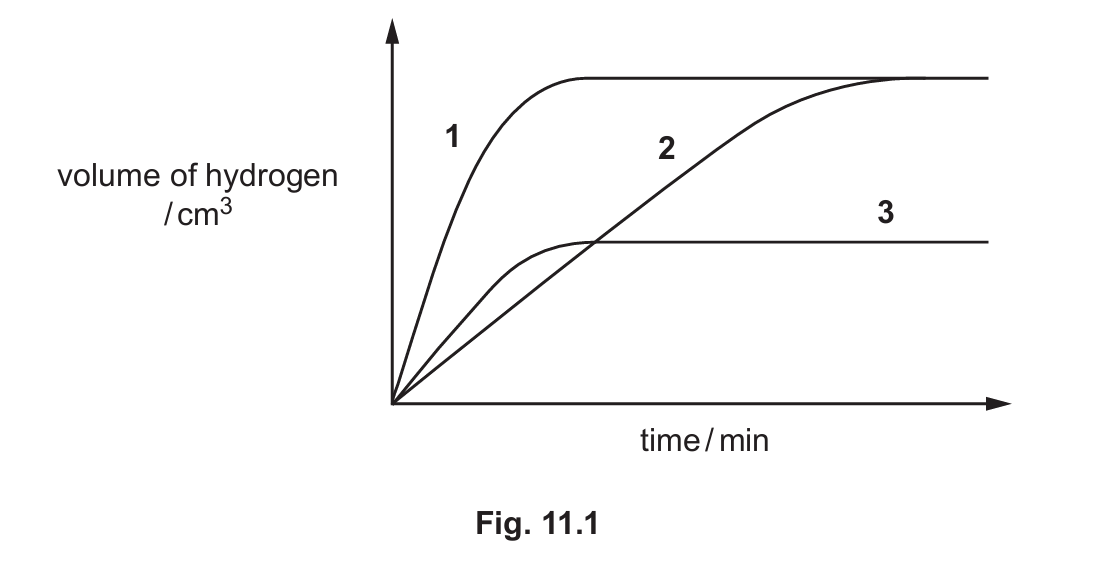
Choose from experiments 1, 2 or 3.
- volume of dilute hydrochloric acid
- concentration of dilute hydrochloric acid
- size pieces of zinc.
Suggest the mass of zinc used in experiment 3.
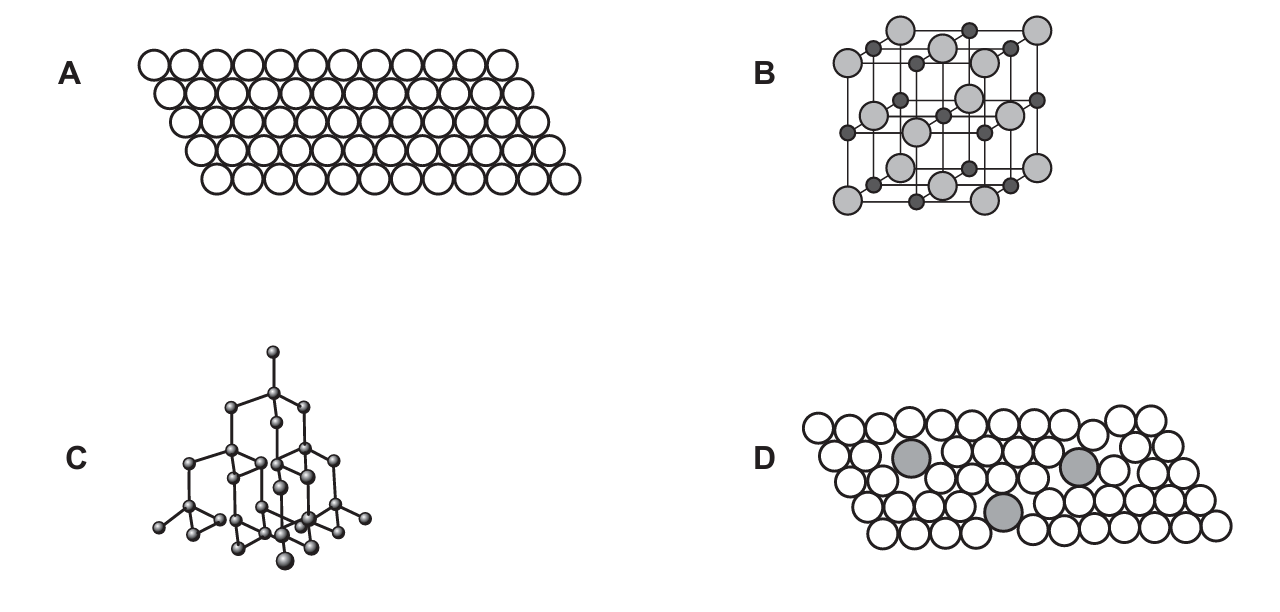
State which diagram shows the structure of brass.
Choose from A, B, C or D.
Explain why copper is a good conductor of electricity.
Most-appropriate topic codes (Cambridge IGCSE Co-ordinated Sciences 0654):
• Topic C3.1 — Formulas (Part (a))
• Topic C6.2 — Rate of reaction (Parts (b)(i) and (b)(iii))
• Topic C12.1 — Experimental design (Part (b)(ii))
• Topic C9.3 — Alloys and their properties (Part (c))
• Topic C2.7 — Metallic bonding (Part (d))
▶️ Answer/Explanation
(a) \(Zn + 2HCl \rightarrow ZnCl_2 + H_2\)
Zinc atoms displace hydrogen from hydrochloric acid to form zinc chloride.
The equation is balanced by matching 2 chlorine and 2 hydrogen atoms on each side.
(b)(i) Experiment 2
The volume of hydrogen produced in experiment 2 rises most slowly and takes longest to reach its final (maximum) volume.
A shallower gradient on a volume/time graph means a slower rate, so the reaction takes the longest to finish.
(b)(ii) Temperature
A lower temperature in experiment 2 gives particles less kinetic energy.
This results in fewer collisions with energy greater than or equal to the activation energy per unit time.
So the reaction proceeds more slowly, matching the shallower curve.
(b)(iii) 0.5 g
Experiment 3 produces about half the final volume of hydrogen compared to experiment 1.
Since the acid volume and concentration are unchanged, zinc is the limiting reactant, so half the mass of zinc (0.5 g) gives half the gas volume.
(c) Diagram D
Brass is an alloy, a mixture of two differently-sized metal atoms (copper and zinc) in the same lattice.
Diagram D shows a regular lattice of copper atoms with occasional larger zinc atoms distributed through it, which is the correct alloy representation.
(d) Copper has a “sea” of delocalised electrons that are free to move.
In metallic bonding, the outer-shell electrons of copper atoms are delocalised and not fixed to one ion.
These free electrons can drift through the metallic lattice when a voltage is applied.
The moving delocalised electrons carry electric charge, making copper a good conductor.