CIE iGCSE Co-Ordinated Science C12.2 Acid-base titrations Exam Style Questions Paper 1
Question
A student adds excess copper oxide powder to warm dilute sulfuric acid.
Aqueous copper sulfate is formed.
Which method is used to remove the unreacted copper oxide?
A. chromatography
B. crystallisation
C. distillation
D. filtration
▶️ Answer/Explanation
Since copper oxide is insoluble, it can be separated from the aqueous copper sulfate solution by filtration, leaving the copper oxide as the residue.
Crystallisation would instead be used afterwards to obtain solid copper sulfate crystals from the filtrate.
✅ Answer: (D)
Question
Hexane and octane are liquid hydrocarbons that mix together.
Which apparatus is used to separate a mixture of these two liquids?

▶️ Answer/Explanation
This apparatus uses a fractionating column to allow repeated evaporation and condensation, separating the liquids according to their boiling points.
✅ Answer: (D)
Question
Magnesium chloride is prepared by reacting an excess of insoluble magnesium oxide with dilute hydrochloric acid.
Which processes are used to obtain pure crystals of magnesium chloride from the reaction mixture?
- distillation
- evaporation
- filtration
A. 1 followed by 2
B. 3 followed by 2
C. 3 followed by 1
D. 1 followed by 3, followed by 2
▶️ Answer/Explanation
The remaining magnesium chloride solution is then evaporated to concentrate it, allowing crystals to form on cooling.
✅ Answer: (B)
Question
An aqueous salt solution contains an insoluble impurity.
Which processes are used to obtain pure salt crystals?
A. distillation then crystallisation
B. distillation then chromatography
C. filtration then crystallisation
D. filtration then chromatography
▶️ Answer/Explanation
The filtrate (pure salt solution) is then evaporated/crystallised to obtain pure salt crystals.
✅ Answer: (C)
Question
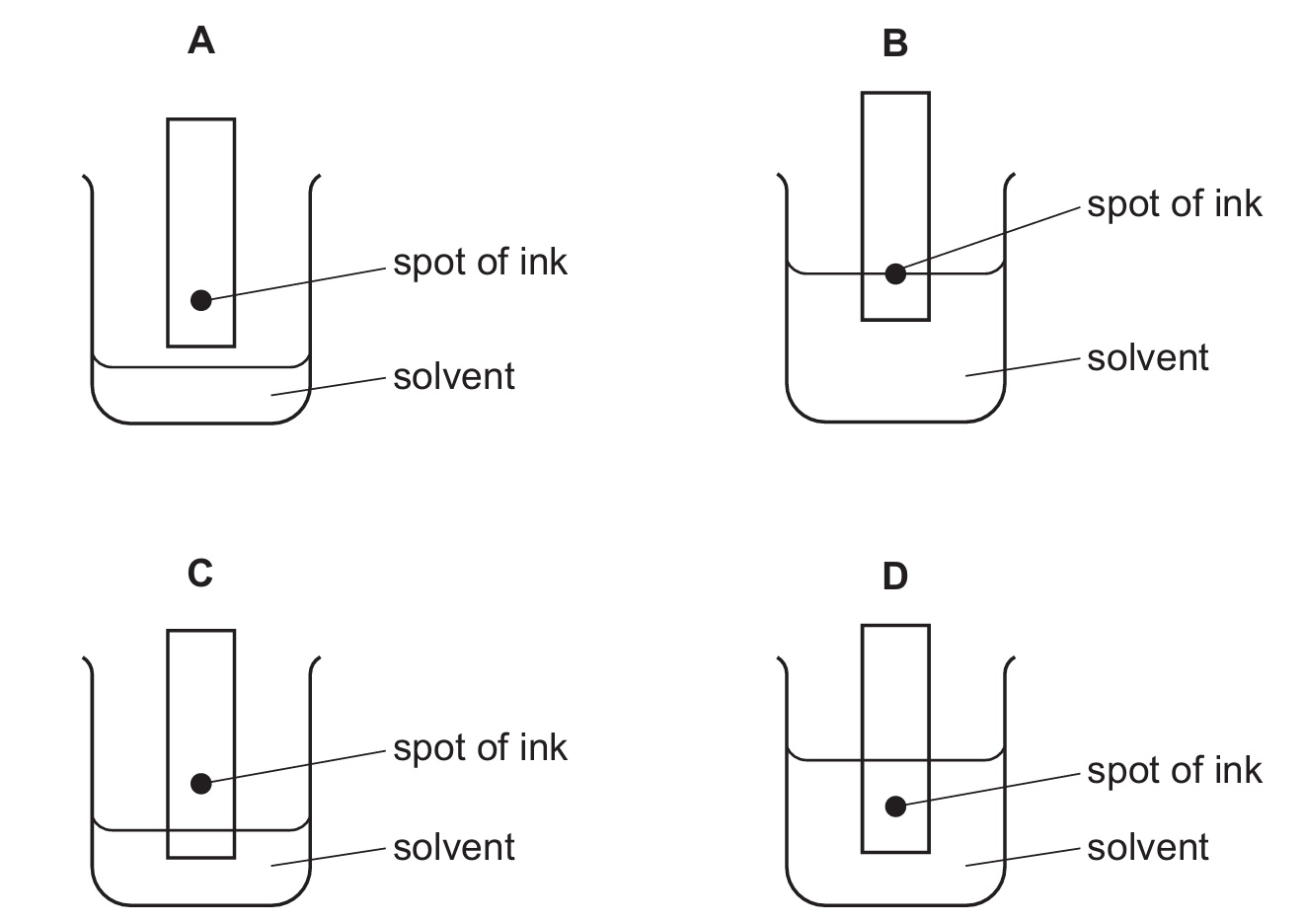
The colours in an ink are separated by chromatography.
Which diagram shows the assembled apparatus?

▶️ Answer/Explanation
The solvent must be in contact with the paper below the spot so that it rises up by capillary action.
Only diagram C shows the spot correctly positioned above the solvent level with the paper standing in the solvent.
✅ Answer: (C)
