
CIE iGCSE Co-Ordinated Science C12.2 Acid-base titrations Exam Style Questions Paper 3
Question
crystallisation decomposition
electrolysis fractional distillation polymerisation
(i) in the treatment of drinking water
(ii) to separate a mixture of dyes
(iii) to extract aluminium from bauxite
(iv) to produce long chain molecules from monomer units.
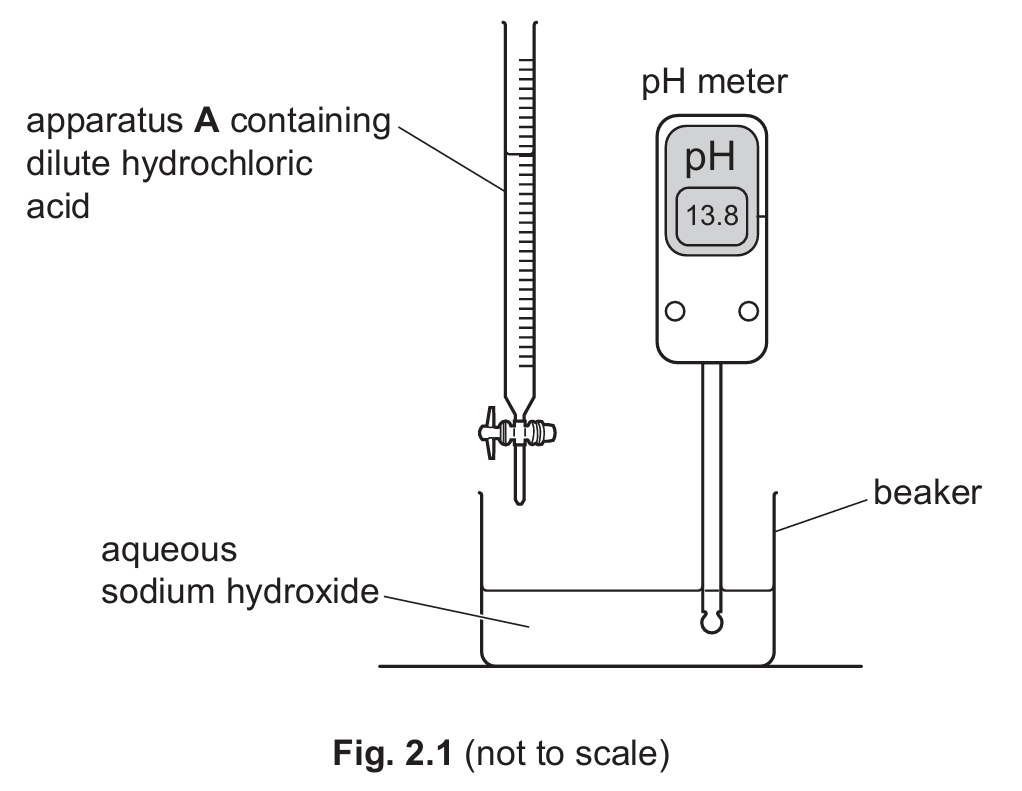
Fig. 2.1 shows apparatus used to investigate the change in pH as the acid is added.
Most-appropriate topic codes (Cambridge IGCSE Co-ordinated Sciences 0654):
• Topic C10.1 — Chemistry of the Environment, Water (Part (a)(i))
• Topic C12.3 — Chromatography (Part (a)(ii))
• Topic C4.1 — Electrolysis (Part (a)(iii))
• Topic C11.7 — Polymers (Part (a)(iv))
• Topic C12.2 — Acid-Base Titrations (Part (b)(i))
• Topic C7.1 — Properties of Acids and Bases (Part (b)(ii), (b)(iii), (c))
▶️ Answer/Explanation
(a)(i) chlorination
Chlorine gas is added to drinking water.
It kills harmful microorganisms, making the water safe to drink.
(a)(ii) chromatography
Chromatography separates components of a mixture based on solubility.
Different dyes travel different distances on the paper, separating the mixture.
(a)(iii) electrolysis
Aluminium is too reactive to be extracted by reduction with carbon.
Molten aluminium oxide (from bauxite) is electrolysed to extract the metal.
(a)(iv) polymerisation
Polymerisation joins many small monomer molecules together.
This forms one long chain molecule called a polymer.
(b)(i) burette
A burette is used to add a measured, variable volume of acid.
It allows precise, controlled addition of the acid drop by drop.
(b)(ii) 7
At the point of exact neutralisation, the solution is neither acidic nor alkaline.
This corresponds to \( \text{pH} = 7 \).
(b)(iii) sodium chloride and water
The reaction is: \( \text{HCl} + \text{NaOH} \rightarrow \text{NaCl} + \text{H}_2\text{O} \).
An acid plus a base always forms a salt and water.
(c) pale blue precipitate
Sodium hydroxide reacts with copper(II) ions in solution.
This forms insoluble copper(II) hydroxide, seen as a pale blue precipitate.