
CIE iGCSE Co-Ordinated Science C12.3 Chromatography Exam Style Questions Paper 3
Question
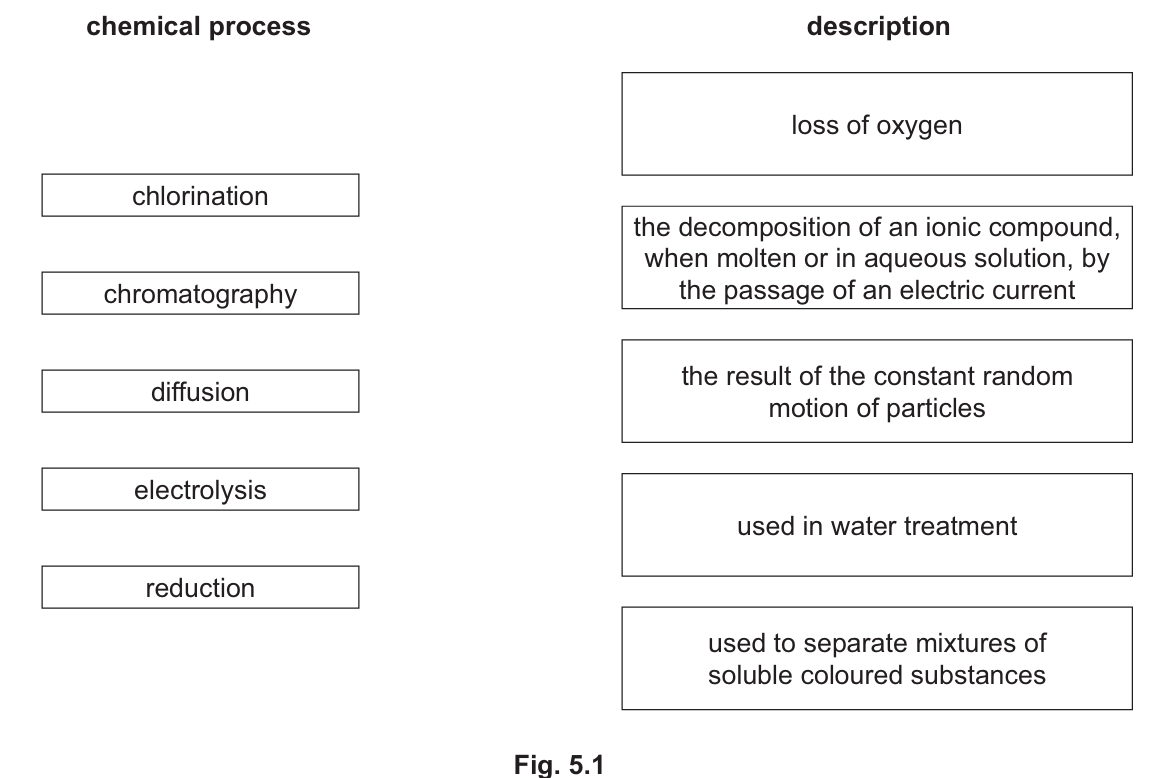
Topic codes:
• Topic C1.2 — Diffusion (Part (a))
• Topic C2.3 — Isotopes (Part (b)(i))
• Topic C3.2 — Relative masses of atoms and molecules (Part (b)(ii))
• Topic C5.1 — Exothermic and endothermic reactions (Part (b)(iii))
• Topic C7.1 — Characteristic properties of acids and bases (Part (b)(iv))
• Topic C8.3 — Group VII properties (Part (b)(v))
• Topic C4.1 — Electrolysis (Part (a))
• Topic C10.2 — Air quality and climate (Part (a))
• Topic C12.3 — Chromatography (Part (a))
▶️ Answer/Explanation
(a) Matching: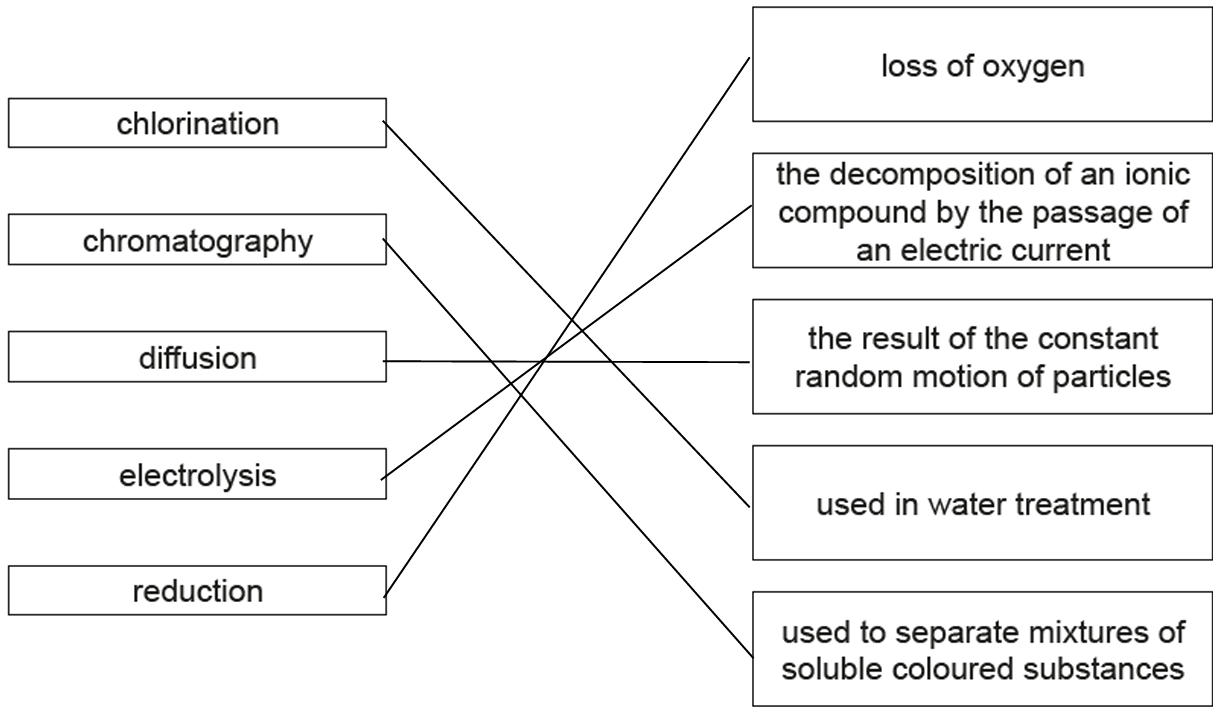
(b)(i) Isotopes are atoms of the same element with the same number of protons but different numbers of neutrons.
Isotopes have the same atomic number (proton number) but different mass numbers (nucleon numbers). They have identical chemical properties because they have the same electronic configuration, but different physical properties due to their different masses.
(b)(ii) The relative atomic mass of chlorine is 35.5 because it is the average mass of the two isotopes, \(^{35}\text{Cl}\) and \(^{37}\text{Cl}\), taking into account their relative abundances.
Chlorine has two naturally occurring isotopes: chlorine-35 and chlorine-37. The average mass is 35.5 because there are approximately three times more chlorine-35 atoms than chlorine-37 atoms.
(b)(iii) The reaction is not endothermic because thermal energy is released to the surroundings.
An endothermic reaction takes in thermal energy from the surroundings, causing a temperature decrease. Since this reaction releases thermal energy (and light), it is exothermic (\(\Delta H\) is negative).
(b)(iv) Acid: (dilute) hydrochloric acid ; Alkali: (aqueous) sodium hydroxide
Sodium chloride can be prepared by neutralisation: \(\text{HCl} + \text{NaOH} \rightarrow \text{NaCl} + \text{H}_2\text{O}\). This is a typical acid-alkali neutralisation reaction producing a salt and water.
(b)(v) The halogens have similar chemical properties because they all have the same number of electrons in their outer shell (seven electrons).
Elements in the same group of the Periodic Table have the same number of outer-shell (valence) electrons, which determines their chemical reactivity. Halogens all have 7 electrons in their outer shell and therefore react similarly by gaining one electron to achieve a stable noble gas configuration.
Question
chromatography, combustion, cracking, electroplating, fermentation, filtration, oxidation, polymerisation, rusting
(i) break down large hydrocarbon alkane molecules into smaller alkene and smaller alkane molecules.
(ii) make ethanol from glucose.
(iii) make long chain molecules from small monomer units.
(iv) separate a mixture of dyes.
(v) cover a metal with a layer of copper.
acid …………………………………………………..
base …………………………………………………..

left, metallic, non-metallic, right
Going from ……………………… to ………………………, the elements change from ……………………… to ……………………… .
Most-appropriate topic codes (Cambridge IGCSE Co-ordinated Sciences 0654):
• Topic C11.5 — Alkenes (Part (a)(i) — cracking)
• Topic C11.6 — Alcohols (Part (a)(ii) — fermentation)
• Topic C11.7 — Polymers (Part (a)(iii) — polymerisation)
• Topic C12.3 — Chromatography (Part (a)(iv))
• Topic C4.1 — Electrolysis (Part (a)(v) — electroplating)
• Topic C7.1 — Characteristic properties of acids and bases (Part (b))
• Topic C2.2 — Atomic structure and the Periodic Table (Part (c))
• Topic C8.1 — Arrangement of elements (Part (d))
▶️ Answer/Explanation
(a)(i) Cracking
Cracking uses heat and a catalyst to break the carbon–carbon bonds in large alkane molecules.
This produces a mixture of smaller, more useful alkane and alkene molecules.
(a)(ii) Fermentation
During fermentation, enzymes in yeast convert glucose into ethanol and carbon dioxide.
The overall word equation is glucose \( \rightarrow \) ethanol + carbon dioxide.
(a)(iii) Polymerisation
Polymerisation is the joining together of many small monomer molecules.
This forms one very long-chain molecule called a polymer.
(a)(iv) Chromatography
In paper chromatography, the dyes dissolve in a solvent and move up the paper at different rates.
This separates the mixture into its individual coloured components.
(a)(v) Electroplating
Electroplating uses electrolysis with a copper anode and the object to be plated as the cathode.
Copper ions in the electrolyte gain electrons at the cathode and are deposited as a thin layer of copper metal.
(b) Acid: (dilute) hydrochloric acid; Base: (aqueous) sodium hydroxide
Sodium chloride is formed by the neutralisation of an acid by a base.
\( \text{HCl} + \text{NaOH} \rightarrow \text{NaCl} + \text{H}_2\text{O} \)
Hydrochloric acid reacts with sodium hydroxide to give salt and water only.
(c) Sodium atom: 2,8,1 ; Sodium ion: 2,8
A neutral sodium atom has 11 electrons arranged in shells as \(2,8,1\).
To form \( \text{Na}^+ \), the atom loses the single outer-shell electron.
This leaves the ion with 10 electrons arranged as \(2,8\), the same stable configuration as neon.
(d) left → right ; metallic → non-metallic
Going from left to right across Period 3, the elements change from metallic (e.g. sodium, magnesium) to non-metallic (e.g. sulfur, chlorine).
This trend reflects the increasing number of outer-shell electrons across the period.