
CIE iGCSE Co-Ordinated Science C12.3 Chromatography Exam Style Questions Paper 4
Question
- the chromatogram the student obtains
- the measurements the student may make.
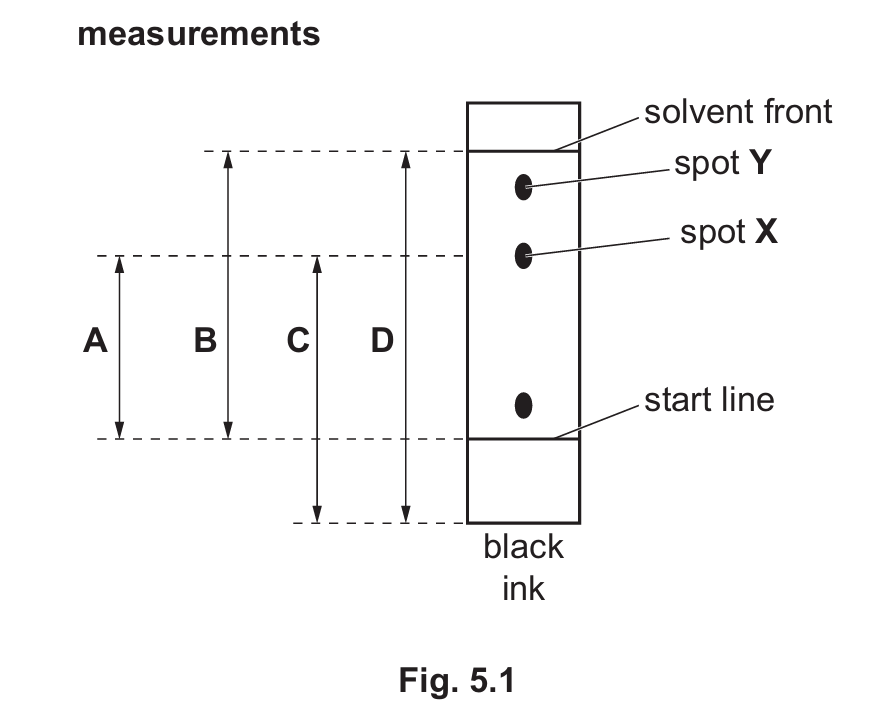
The distance travelled by spot Y is 2.8 cm.
Calculate the distance travelled by the solvent.
Most-appropriate topic codes (Cambridge IGCSE Co-ordinated Sciences 0654):
• Topic C12.3 — Chromatography (Parts (a), (b) & (c))
• Topic C1.1 — Solids, liquids and gases (Part (d))
• Topic C2.5 — Simple molecules and covalent bonds / C2.6 — Giant covalent structures (Part (e))
▶️ Answer/Explanation
(a) Statement: Black ink is an impure substance.
Explanation: The chromatogram shows more than one spot, indicating that the ink contains multiple different substances (components).
(b) Measurements A and B.
\(R_f = \frac{\text{distance travelled by substance}}{\text{distance travelled by solvent}}\).
A is the distance travelled by spot X from the origin, and B is the distance travelled by the solvent front from the origin.
(c) Calculation:
\(R_f = \frac{\text{distance travelled by substance}}{\text{distance travelled by solvent}}\)
\(0.80 = \frac{2.8}{\text{distance travelled by solvent}}\)
Distance travelled by solvent = \(\frac{2.8}{0.80} = 3.5\text{ cm}\)
(d) Separation: Particles in a liquid are slightly further apart than in a solid (but still touching).
Motion: Particles in a liquid move faster than in a solid. They move randomly in a liquid, whereas they vibrate about a fixed position in a solid.
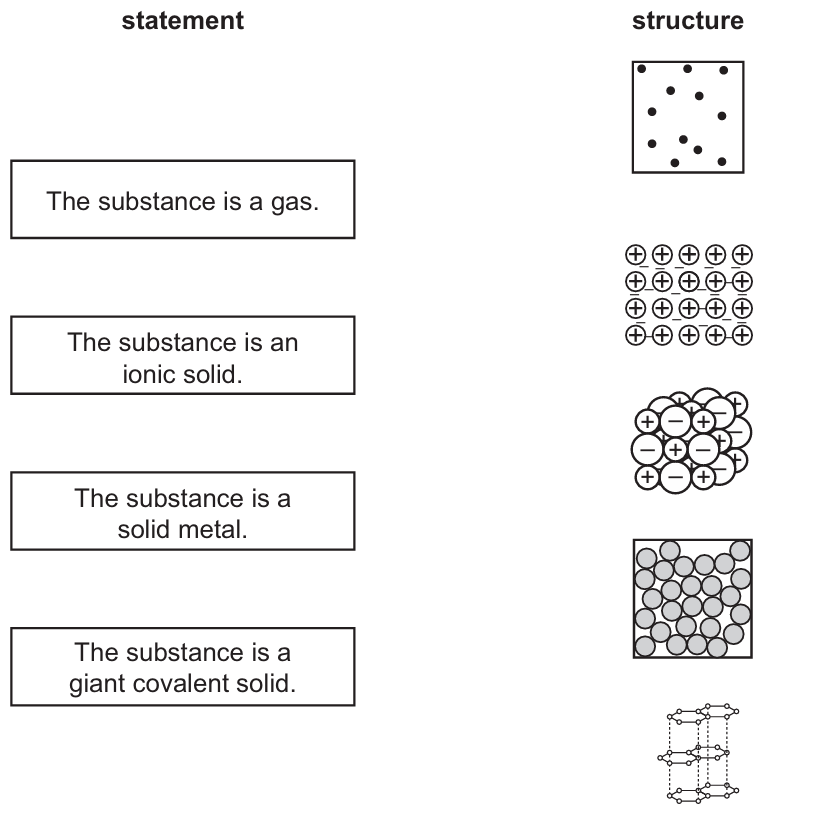
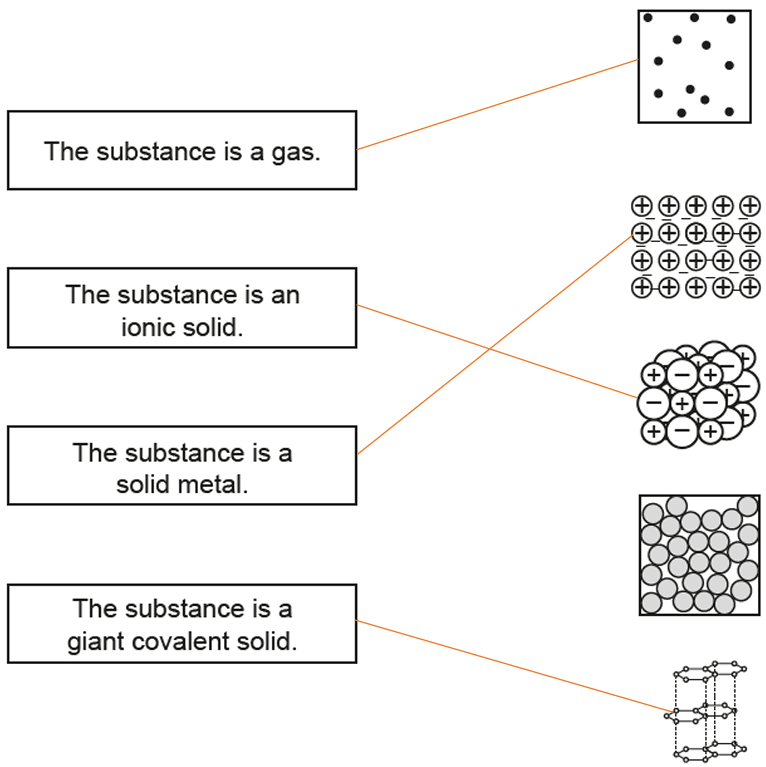
(e) Correct matching:
Question
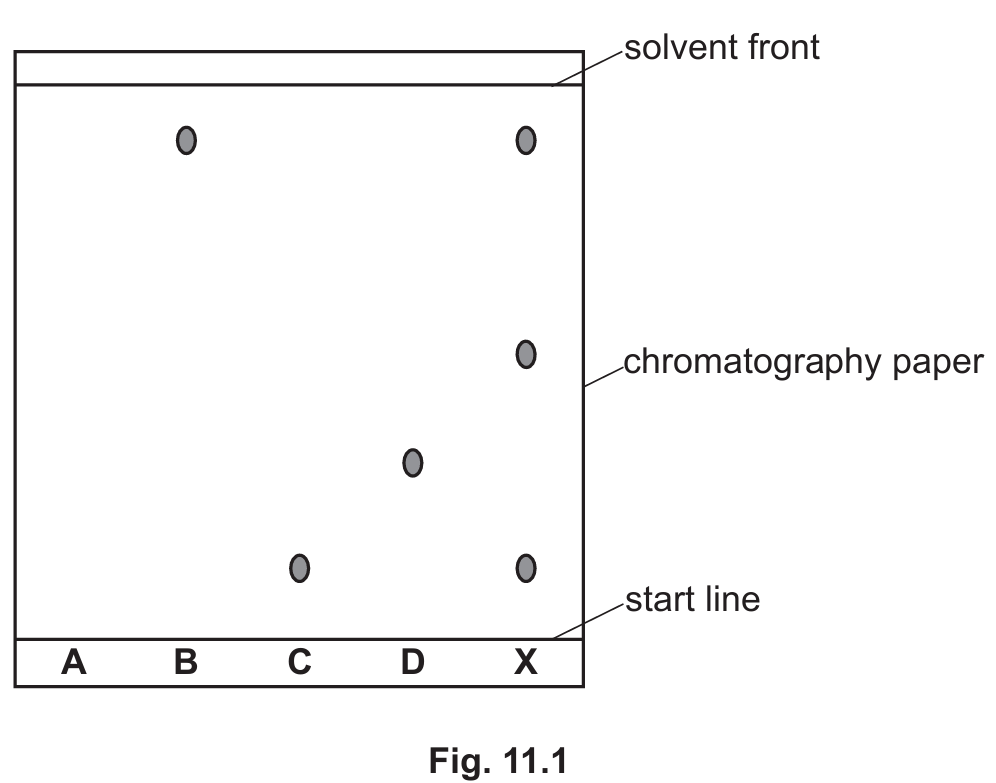
Fig. 11.1 shows the chromatogram produced.
The result for dye A is not shown.
Calculate the concentration of the solution made in mol/dm\(^3\).
The relative molecular mass, \(M_r\), of the food colouring is 486.
Most-appropriate topic codes (Cambridge IGCSE Co-ordinated Sciences 0654, 2025–2027 syllabus):
• Topic C12.3 — Chromatography (Parts (a), (b), and (c))
• Topic C3.3 — The mole and the Avogadro constant (Part (d) — concentration calculation)
▶️ Answer/Explanation
(a) B and C
The spots for X align at the same heights as the spots for dyes B and C, showing X is a mixture containing those two dyes.
(b) 0.90
\( R_f = \dfrac{\text{distance travelled by substance}}{\text{distance travelled by solvent}} = \dfrac{5.4}{6.0} = 0.90 \).
(c) 2.64 cm (or 2.6 cm)
Rearranging the \(R_f\) formula: distance = \(R_f \times\) distance travelled by solvent.
Distance = \(0.44 \times 6.0 = 2.64\) cm.
(d) 0.025 mol/dm³
Moles = \( \dfrac{\text{mass}}{M_r} = \dfrac{2.43}{486} = 0.005 \) mol.
Convert 200 cm³ to dm³: \(0.200\) dm³.
Concentration = \( \dfrac{0.005}{0.200} = 0.025 \) mol/dm³.