Home / iGCSE / Coordinated Sciences / C12.4 Separation and purification Paper 2

CIE iGCSE Co-Ordinated Science C12.4 Separation and purification Exam Style Questions Paper 2

Question

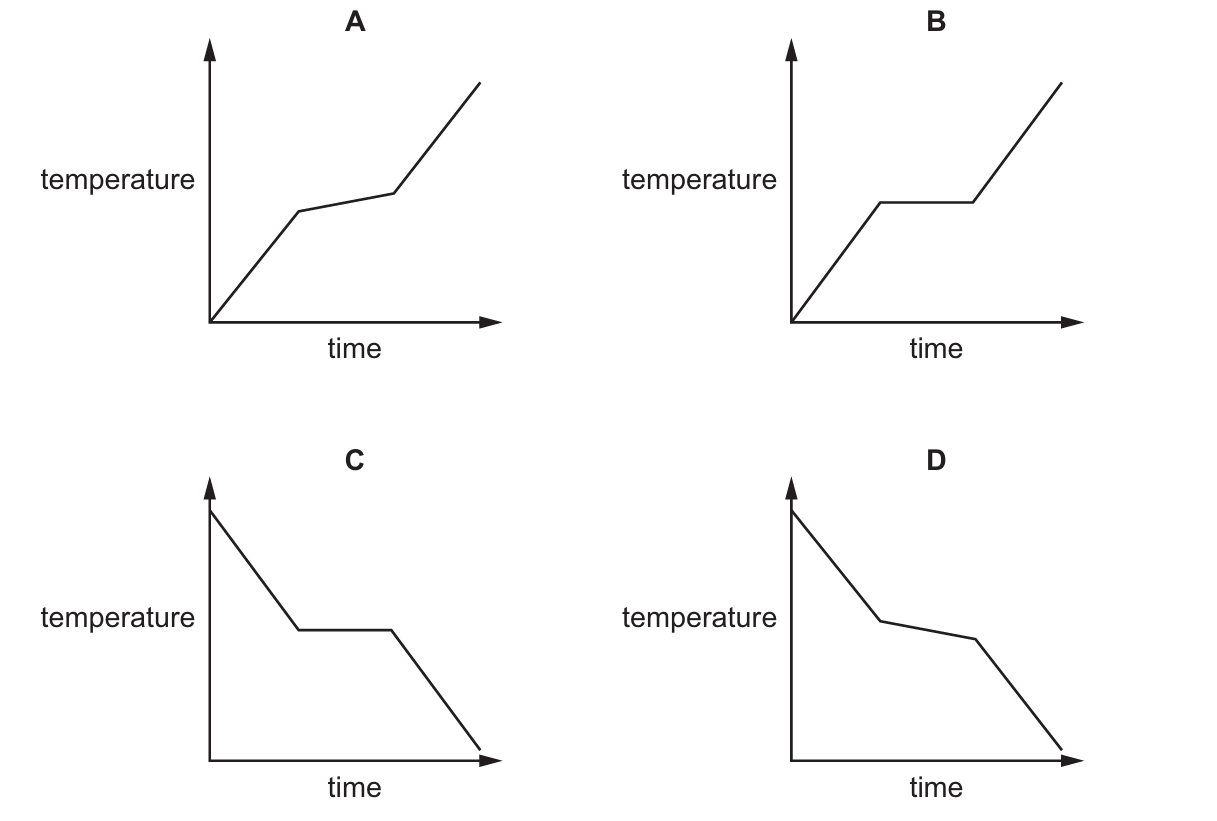
Which graph shows the temperature change when an impure, solid substance is heated?

▶️ Answer/Explanation
An impure solid melts over a range of temperatures rather than at a sharp point. The graph should show a gradual increase in temperature during melting, not a flat horizontal line. Among the options, graph A shows this gradual slope, so it is correct.
Answer: (A)

Question

A sample of water contains two useful substances, insoluble chalk and a soluble salt.

Which two processes are used to individually separate the insoluble chalk from the soluble salt and from the water?

A. distillation and chromatography
B. distillation and crystallisation
C. filtration and chromatography
D. filtration and crystallisation

▶️ Answer/Explanation
Filtration separates the insoluble solid chalk from the liquid, leaving a filtrate containing the dissolved salt and water.
Crystallisation is then used to separate the dissolved soluble salt from the water by evaporating the solvent.
Answer: (D)

Question

An aqueous salt solution contains an insoluble impurity.

Which processes are used to obtain pure salt crystals?

A. distillation then crystallisation
B. distillation then chromatography
C. filtration then crystallisation
D. filtration then chromatography

▶️ Answer/Explanation
Filtration separates the insoluble impurity from the salt solution via \(\text{mixture} \rightarrow \text{residue} + \text{filtrate}\).
The filtrate is then evaporated/cooled through crystallisation to grow pure salt crystals from solution.
Answer: (C)

Question

Hexane and octane are liquid hydrocarbons that mix together.

Which apparatus is used to separate a mixture of these two liquids?

▶️ Answer/Explanation
Hexane and octane are miscible liquids with different boiling points, so they must be separated by fractional distillation.
This requires a fractionating column fitted above the flask, allowing vapours to separate as they condense at different heights — shown in apparatus D.
Answer: (D)

Question

A mixture of solid sulfur and solid sodium chloride is added to water and stirred.

Sulfur is insoluble in water. Sodium chloride is soluble in water.

Which processes are used to obtain pure sodium chloride from the mixture?

A. distillation then chromatography
B. distillation then crystallisation
C. filtration then chromatography
D. filtration then crystallisation

▶️ Answer/Explanation
Filtration first separates the insoluble solid sulfur from the sodium chloride solution, since sulfur cannot pass through the filter paper.
The filtrate, a sodium chloride solution, is then heated to evaporate water until saturated, and cooled to allow crystals of sodium chloride to form — this is crystallisation.
Distillation and chromatography are not needed here, since the goal is to recover a dissolved solid, not to separate a liquid mixture or coloured substances.
Answer: (D)
Scroll to Top