
CIE iGCSE Co-Ordinated Science C12.4 Separation and purification Exam Style Questions Paper 3
Question
Topic codes:
• Topic C3.1 — Formulas (Part (a)(i) & (a)(ii))
• Topic C6.2 — Rate of reaction (Part (b)(i), (b)(ii), (b)(iv) & (c))
• Topic C12.4 — Separation and purification (Part (b)(iii))
• Topic C1.1 — Solids, liquids and gases (Part (c))
▶️ Answer/Explanation
(a)(i) 3 different elements
Calcium carbonate (CaCO₃) contains three different elements: calcium (Ca), carbon (C), and oxygen (O).
(a)(ii) 5 atoms
The formula CaCO₃ shows 1 calcium atom, 1 carbon atom, and 3 oxygen atoms. Total atoms = 1 + 1 + 3 = 5.
(b)(i) Stopwatch / timer / clock
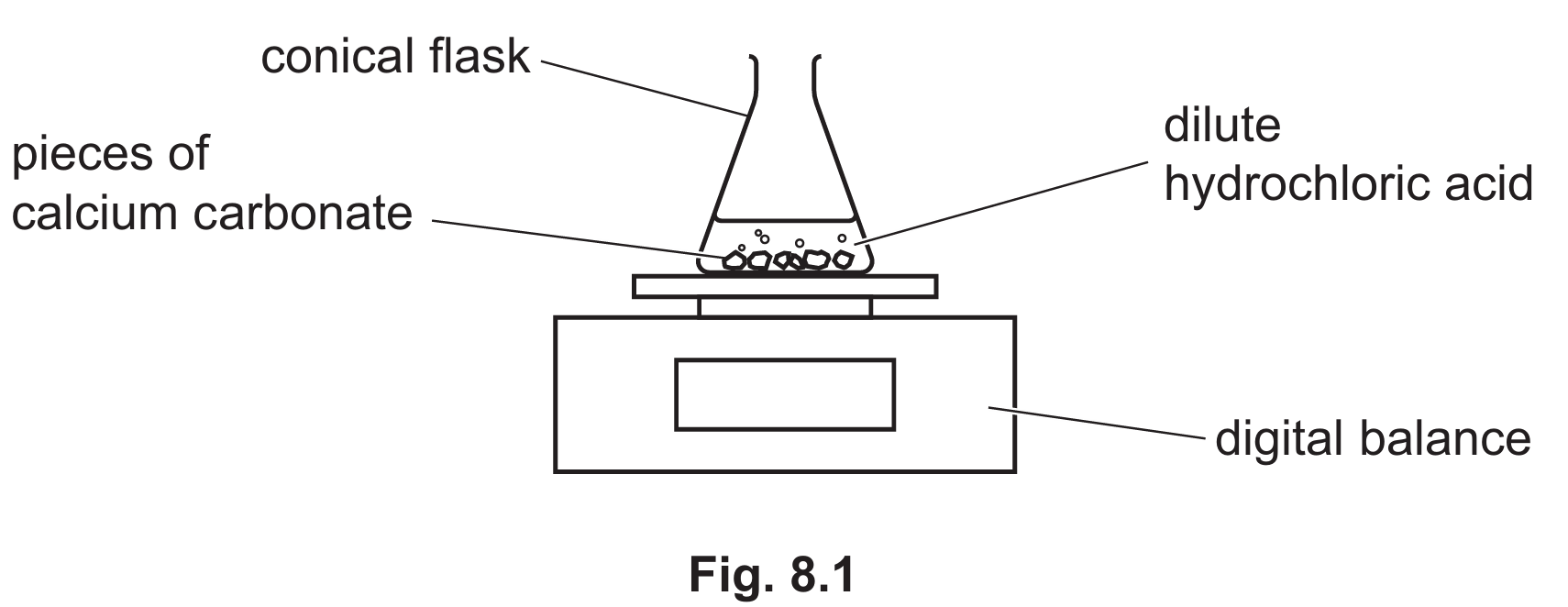
To investigate the rate of reaction, the student needs to measure the time taken for the reaction to proceed. A stopwatch, timer, or clock is required to record time intervals.
(b)(ii) Carbon dioxide gas is lost from the conical flask.
The reaction produces carbon dioxide gas, which escapes from the open flask into the atmosphere. This loss of gas causes the total mass of the flask and its contents to decrease.
(b)(iii) Filtration
Filtration is used to separate an insoluble solid (unreacted calcium carbonate) from a liquid (calcium chloride solution). The solid remains on the filter paper as residue, and the solution passes through as filtrate.
(b)(iv) Two changes to increase the rate of reaction:
- Increase concentration of the acid — more acid particles per unit volume lead to more frequent collisions with calcium carbonate particles.
- Increase temperature of the acid — particles have more kinetic energy, leading to more frequent and more energetic collisions.
- Increase surface area of calcium carbonate — using powder instead of lumps exposes more particles to the acid, increasing collision frequency.
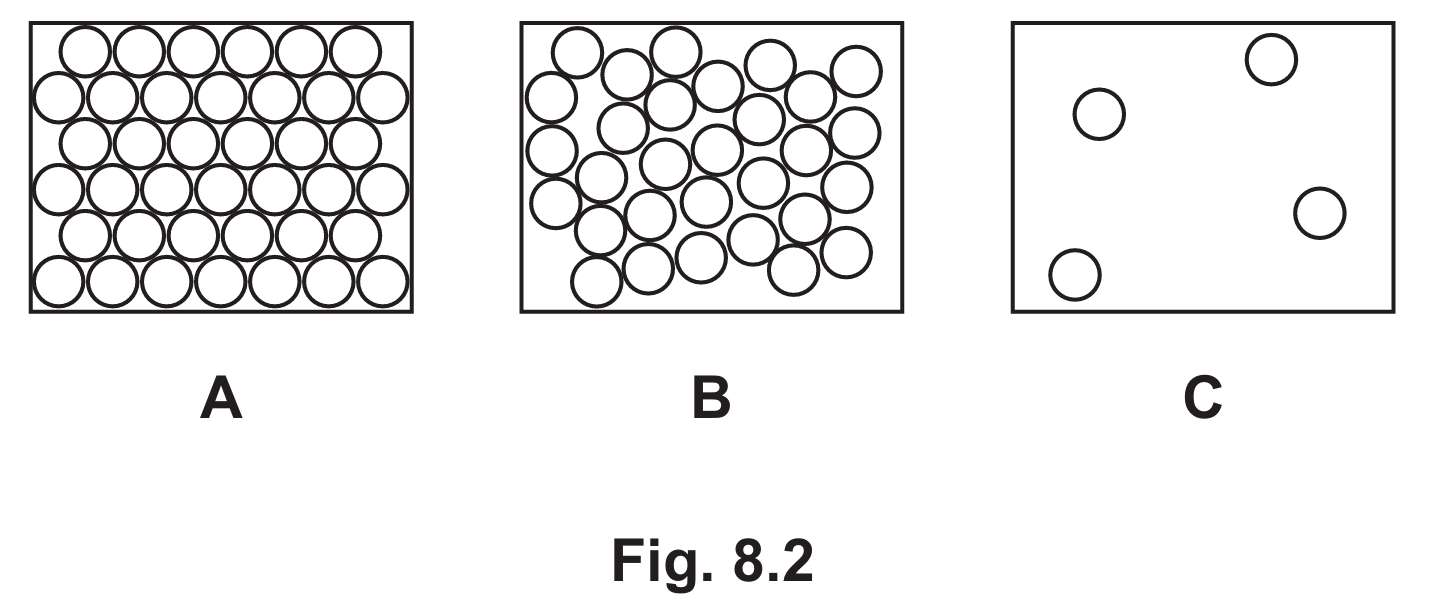
(c) A represents solid calcium carbonate because particles are touching and have a regular arrangement.
In a solid, particles are closely packed in a fixed, regular lattice structure. The strong forces between particles keep them in fixed positions, giving solids a definite shape and volume.
C represents carbon dioxide gas because particles are widely spaced and have a random arrangement.
In a gas, particles are far apart with no regular arrangement. They move rapidly and randomly in all directions, filling the available space. The weak forces between particles allow them to move freely.
Question
Most-appropriate topic codes (Cambridge IGCSE Co-ordinated Sciences 0654):
• Topic C11.3 — Fuels (Part (a), (b))
• Topic C11.1 — Formulas and terminology (Part (c)(i), (c)(ii), (c)(iii), (c)(iv))
• Topic C11.4 — Alkanes (Part (c)(v))
• Topic C12.4 — Separation and purification (Part (b)(i), (b)(ii))
▶️ Answer/Explanation
(a)(i) Coal
Coal is a fossil fuel formed from the remains of ancient plants. Along with natural gas and petroleum, it is one of the three main fossil fuels.
(a)(ii) Methane
Natural gas is primarily composed of methane (CH₄), which makes up about 70–90% of its volume.
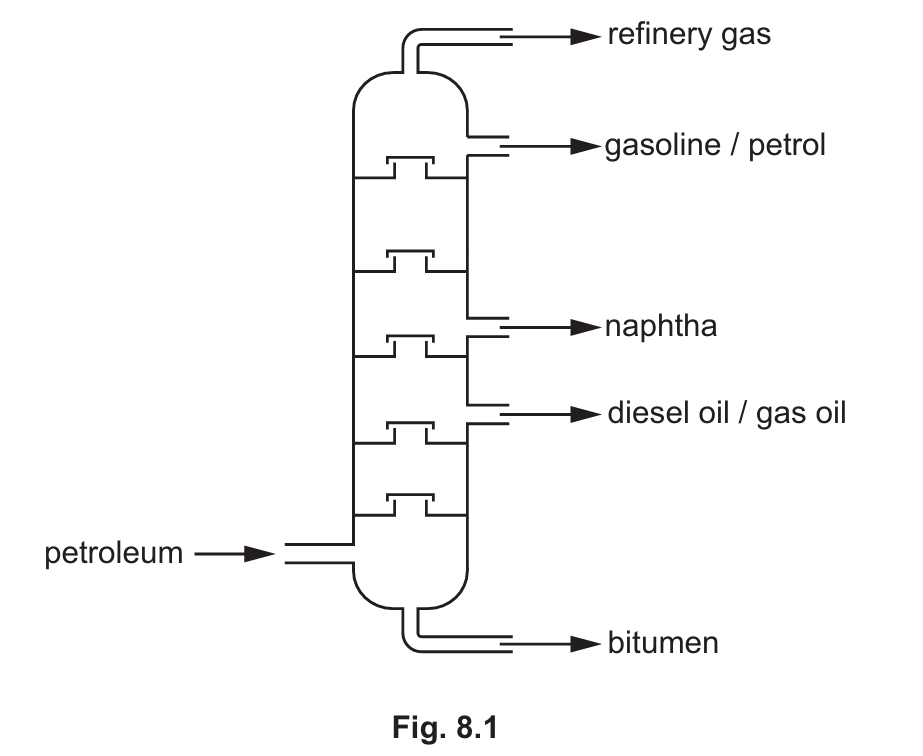
(b)(i) Fractional distillation
Fractional distillation is the process used to separate petroleum into different fractions based on their boiling points.
(b)(ii) No new substances are made / It is a separation process.
Fractional distillation is a physical change because it only separates the components of petroleum based on their boiling points. No chemical bonds are broken or formed, and no new compounds are created.
(b)(iii) Road surfaces / making roads
Bitumen is the thickest fraction obtained from petroleum distillation and is commonly used for surfacing roads and making roofing materials.
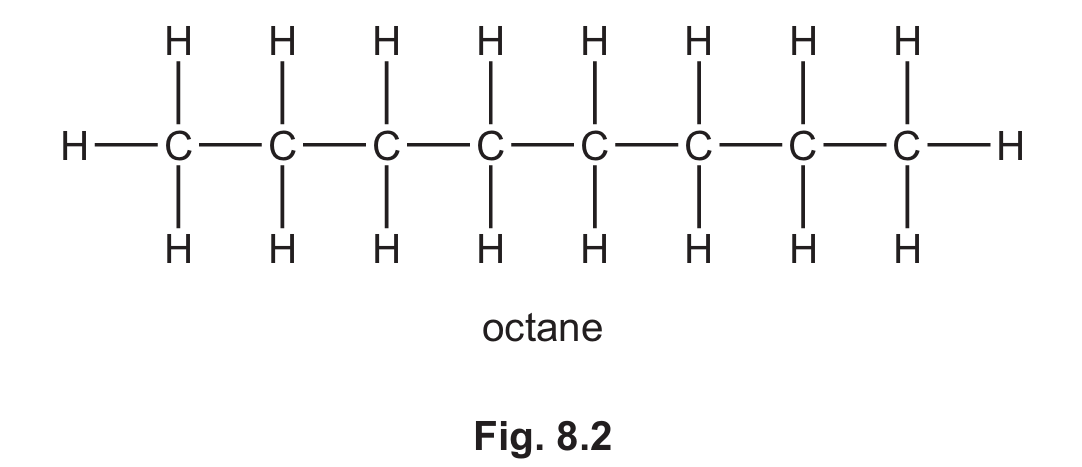
(c)(i) Octane is a hydrocarbon because it contains carbon and hydrogen atoms only.
Hydrocarbons are compounds that consist entirely of carbon and hydrogen atoms. Octane’s structure shows only carbon and hydrogen atoms bonded together.
(c)(ii) C₈H₁₈
Octane has 8 carbon atoms and 18 hydrogen atoms. The general formula for alkanes is CₙH₂ₙ₊₂, so for n=8, the formula is C₈H₁₈.
(c)(iii) Covalent bonding
Octane contains covalent bonds between its carbon and hydrogen atoms. These bonds are formed by sharing pairs of electrons between non-metal atoms.
(c)(iv) Octane contains only C–C single bonds / does not contain a C=C double bond.
Saturated hydrocarbons contain only single bonds between carbon atoms. Octane has all single bonds, making it saturated. Alkanes are saturated hydrocarbons.
(c)(v) carbon dioxide and water
Complete combustion of any hydrocarbon in excess oxygen produces carbon dioxide (CO₂) and water (H₂O) as the only products.