Home / iGCSE / Coordinated Sciences / C12.5 Identification of ions and gases Paper 2

CIE iGCSE Co-Ordinated Science C12.5 Identification of ions and gases Exam Style Questions Paper 2

Question

Substance X is mixed with aqueous sodium hydroxide. A green precipitate is produced.

Which metal ion is present in X?

A. Cu2+
B. Fe2+
C. Fe3+
D. Zn2+

▶️ Answer/Explanation
Adding aqueous sodium hydroxide to a solution of metal ions precipitates the corresponding insoluble metal hydroxide.
Iron(II) hydroxide, \(\text{Fe(OH)}_2\), is characteristically a green precipitate.
Copper(II), iron(III), and zinc hydroxides instead give blue, red-brown, and white precipitates respectively, so none of these match.
Answer: (B)

Question

When dilute sodium hydroxide is added to aqueous iron(II) sulfate, insoluble iron(II) hydroxide and aqueous sodium sulfate are formed.

What is the ionic equation for this reaction?

A. \(Fe^{2+}(aq) + 2OH^-(aq) \rightarrow Fe(OH)_2(s)\)
B. \(Fe^{2+}(aq) + SO_4^{2-}(aq) + 2Na^+(aq) + 2OH^-(aq) \rightarrow Fe(OH)_2(s) + 2Na^+(aq) + SO_4^{2-}(aq)\)
C. \(FeSO_4(aq) + 2NaOH(aq) \rightarrow Fe(OH)_2(s) + Na_2SO_4(aq)\)
D. \(SO_4^{2-}(aq) + 2Na^+(aq) \rightarrow Na_2SO_4(aq)\)

▶️ Answer/Explanation
A correct ionic equation removes spectator ions (\(Na^+\) and \(SO_4^{2-}\)) that do not take part in forming the precipitate.
Only \(Fe^{2+}\) and \(OH^-\) combine to form the insoluble precipitate \(Fe(OH)_2\).
This gives \(Fe^{2+}(aq) + 2OH^-(aq) \rightarrow Fe(OH)_2(s)\).
Answer: (A)

Question

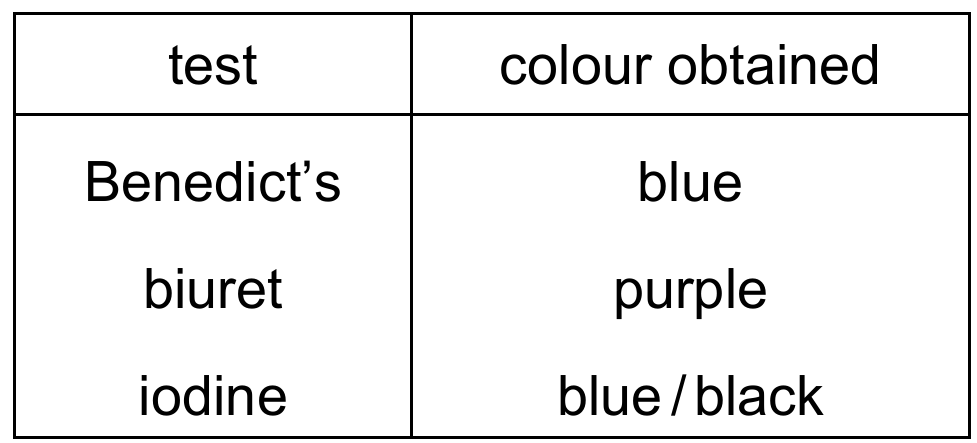
A colourless liquid gives the test results shown.

Which nutrients are in the colourless liquid?

A. protein, reducing sugar and starch
B. protein and reducing sugar only
C. protein and starch only
D. protein only

▶️ Answer/Explanation
A purple biuret result confirms protein is present.
A blue (not brick-red) Benedict’s result shows no reducing sugar is present.
A blue/black iodine result confirms starch is present.
Answer: (C)

Question

A piece of damp blue litmus paper is put in a test-tube of a gas. The litmus paper turns red and then changes to white.

What is the gas?

A. ammonia
B. carbon dioxide
C. chlorine
D. oxygen

▶️ Answer/Explanation
Chlorine gas dissolves in the moisture on the litmus paper to form an acidic solution, which turns the blue litmus red.
Chlorine then bleaches the litmus paper, turning it white.
Ammonia turns damp red litmus blue (not blue litmus red), and CO₂ and oxygen do not bleach litmus at all.
Answer: (C)

Question

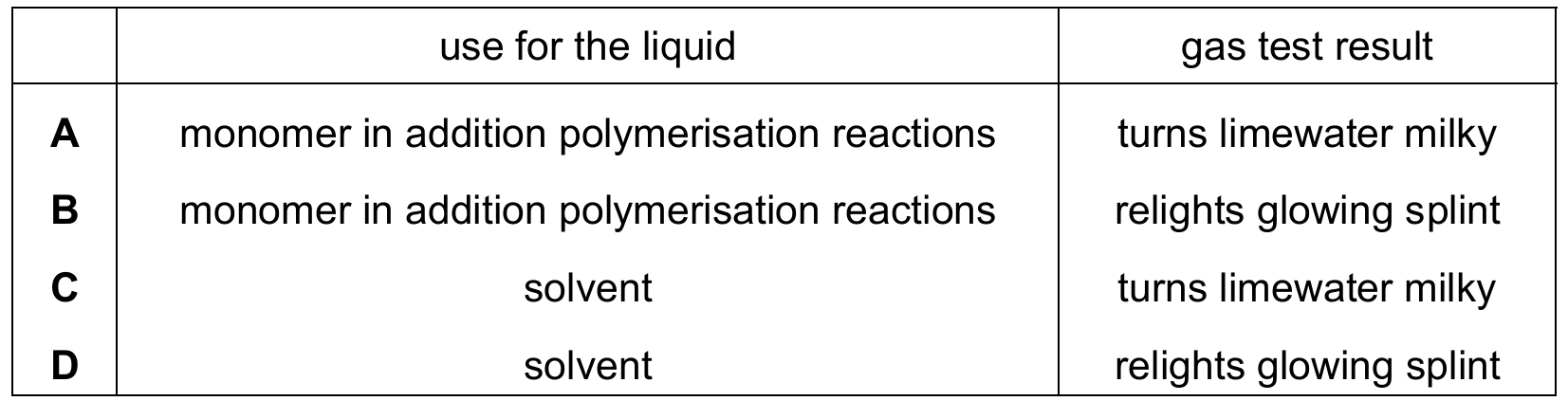
During fermentation, an organic liquid and a colourless gas are produced.

Which row identifies a use for the liquid and describes the result of a test on the colourless gas?

▶️ Answer/Explanation
Fermentation of glucose produces ethanol (the organic liquid) and carbon dioxide gas.
Ethanol is widely used as a solvent, not as a monomer for addition polymerisation.
Carbon dioxide gas turns limewater milky, which is the standard test for this gas.
Answer: (C)
Scroll to Top