
CIE iGCSE Co-Ordinated Science C2.1 Elements, compounds and mixtures Exam Style Questions Paper 4
Question
Most-appropriate topic codes (Cambridge IGCSE Co-ordinated Sciences 0654):
• Topic C2.1 — Elements, compounds and mixtures
• Topic C8.2 — Group I properties
• Topic C2.4 — Ions and ionic bonds
▶️ Answer/Explanation
(a)
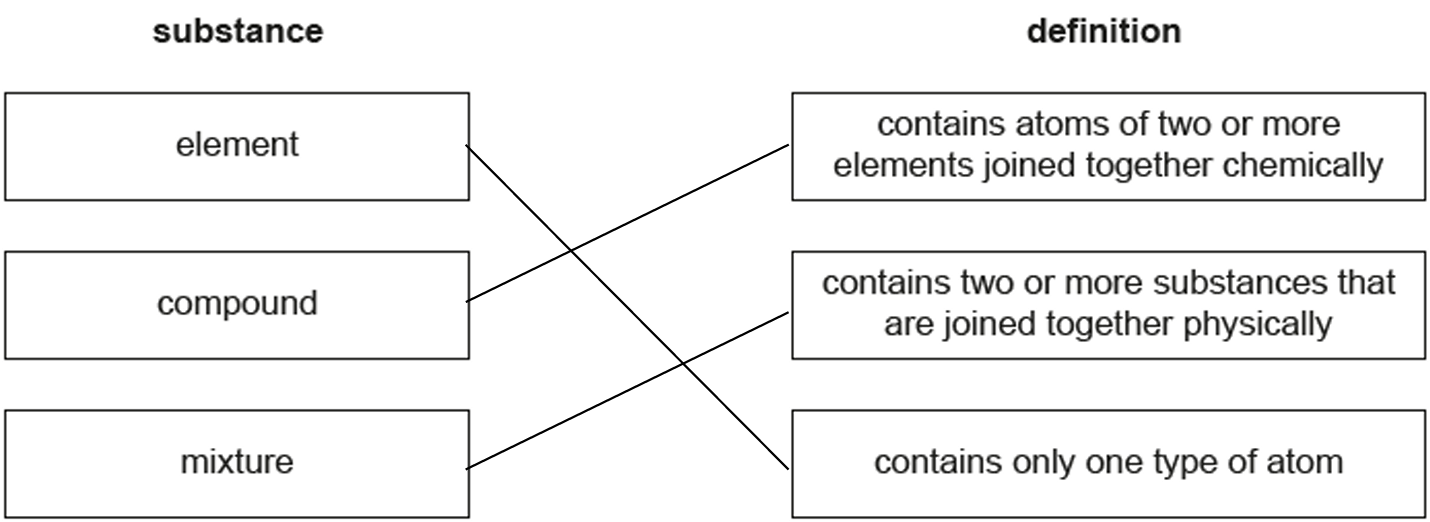
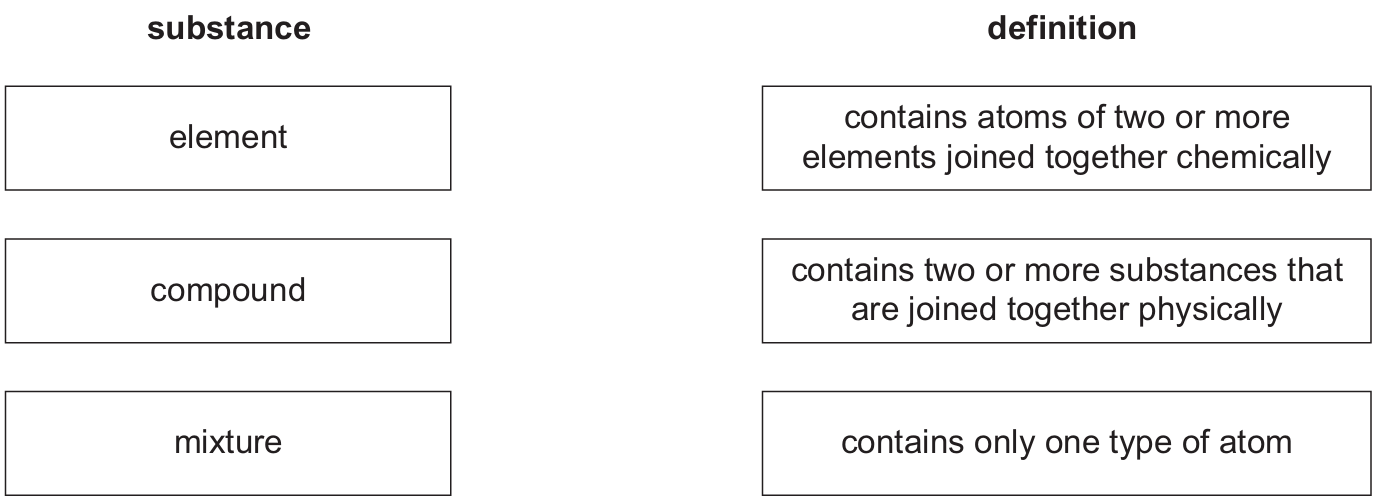
Elements consist of one type of atom only. Compounds are formed by chemical bonds between atoms of different elements. Mixtures are physical combinations of substances that can be separated by physical methods.
(b)
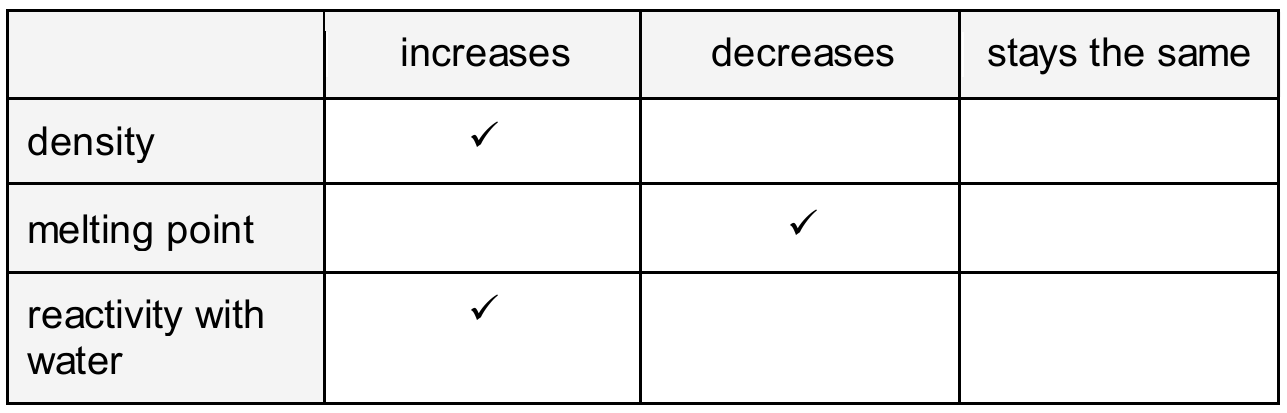
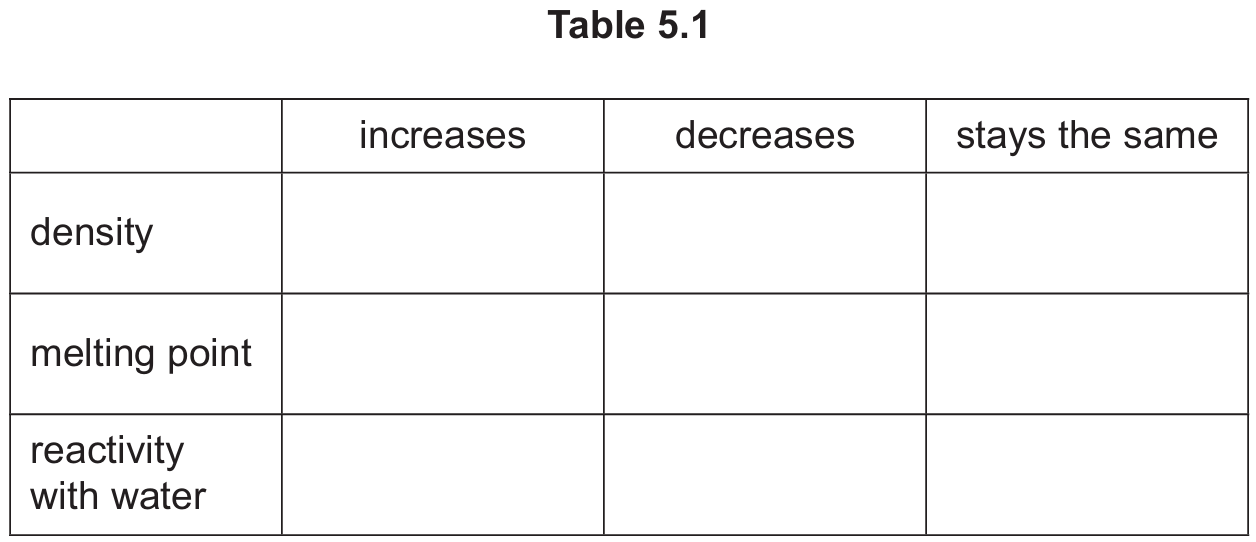
As you go down Group I, the atoms become larger with more electron shells. The outer electron is further from the nucleus and more easily lost, increasing reactivity. Melting point decreases because weaker metallic bonds form between larger ions.
(c)
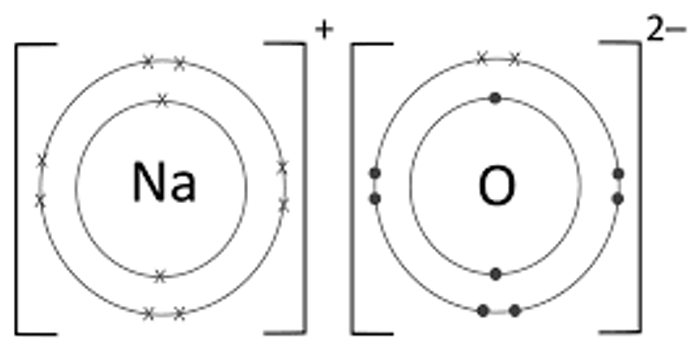
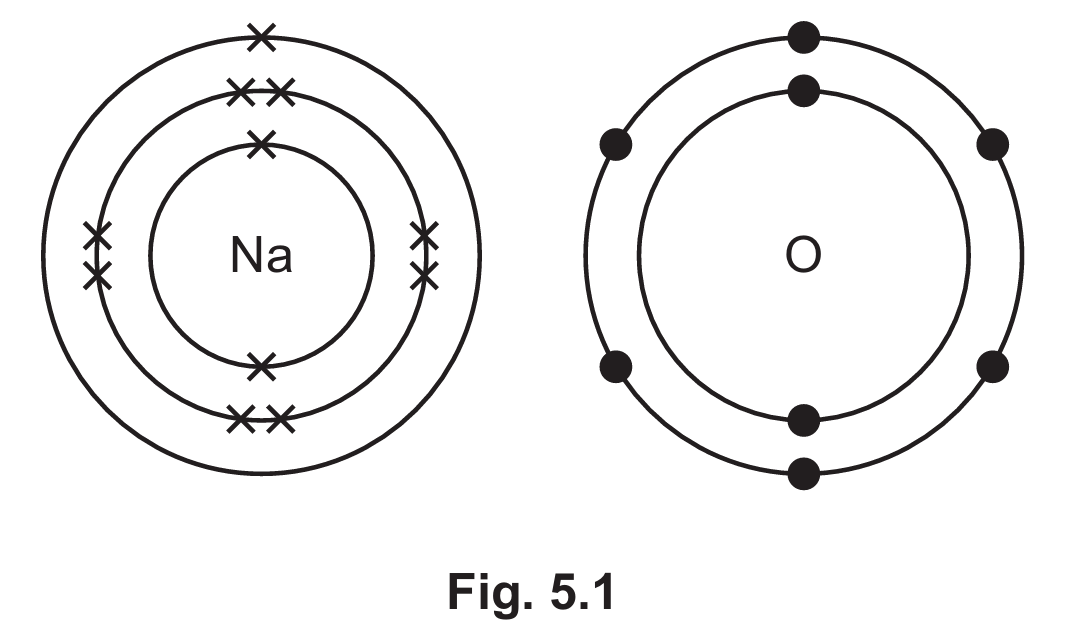
Sodium loses its outer electron to achieve a stable electronic configuration of (2,8), forming a positive ion. Oxygen gains two electrons to achieve (2,8), forming a negative ion.
(d) idea that conduction depends on movement of ions ; ions cannot move in the solid state but can move in the molten state
In solid ionic compounds, ions are held in fixed positions within the giant lattice structure. When molten, the lattice breaks down and ions become free to move, allowing electrical conduction.
Question
Most-appropriate topic codes (Cambridge IGCSE Co-ordinated Sciences 0654):
• Topic C2.2 — Atomic structure and the Periodic Table (Part a)
• Topic C2.4 — Ions and ionic bonds (Parts b & c)
• Topic C2.1 — Elements, compounds and mixtures (Part d)
• Topic C2.3 — Isotopes (Part e)
▶️ Answer/Explanation
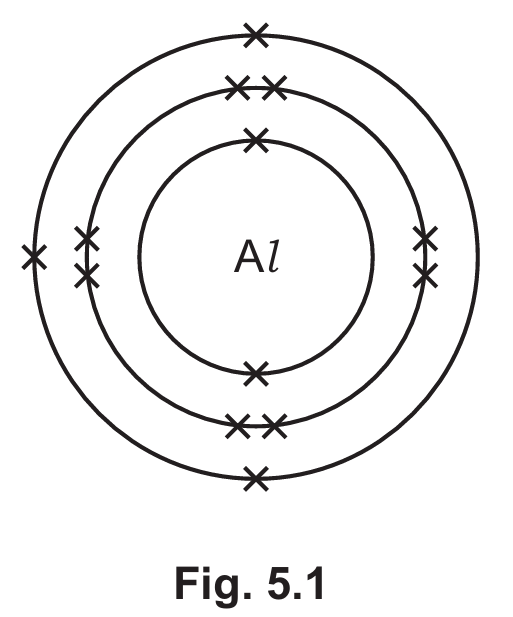
(a) Fig. 5.1 shows aluminium has 3 occupied electron shells:
The electronic configuration of aluminium is 2,8,3, meaning it has three electron shells. The period number in the Periodic Table corresponds to the number of occupied electron shells. Since aluminium has three occupied shells, it belongs to period 3.
(b) Formation of an aluminium ion, Al\(^{3+}\):
An aluminium atom has three electrons in its outermost (valence) shell. To achieve a stable noble gas electronic configuration (like neon, 2,8), it loses these three outermost electrons. This results in the formation of a positively charged aluminium ion, Al\(^{3+}\), with an electronic configuration of 2,8.
(c)(i) Complete the sentence about ionic bonds:
An ionic bond is a strong electrostatic attraction between oppositely charged ions.
(c)(ii) Correct property of ionic compounds:
✓ high melting point
Ionic compounds have high melting points because of the strong electrostatic forces of attraction between oppositely charged ions in the giant ionic lattice. These strong bonds require a large amount of thermal energy to overcome, resulting in high melting and boiling temperatures.
(d) Difference between an element and a compound:
Element: A substance that contains only one type of atom. All the atoms have the same number of protons (atomic number) and cannot be broken down into simpler substances by chemical means.
Compound: A substance made up of two or more different elements that are chemically joined together in fixed proportions. Compounds can be broken down into their constituent elements by chemical reactions.
(e) Why \(^{37}_{17}\text{Cl}\) and \(^{35}_{17}\text{Cl}\) are isotopes:
Isotopes are atoms of the same element that have the same number of protons but different numbers of neutrons. Both chlorine isotopes have an atomic number of 17, meaning they both have 17 protons. However, \(^{37}_{17}\text{Cl}\) has 20 neutrons (37 − 17 = 20) while \(^{35}_{17}\text{Cl}\) has 18 neutrons (35 − 17 = 18). Since they have the same proton number but different neutron numbers, they are isotopes of chlorine.