Home / iGCSE / Coordinated Sciences / C2.2 Atomic structure and the Periodic Table Paper 2

CIE iGCSE Co-Ordinated Science C2.2 Atomic structure and the Periodic Table Exam Style Questions Paper 2

Question

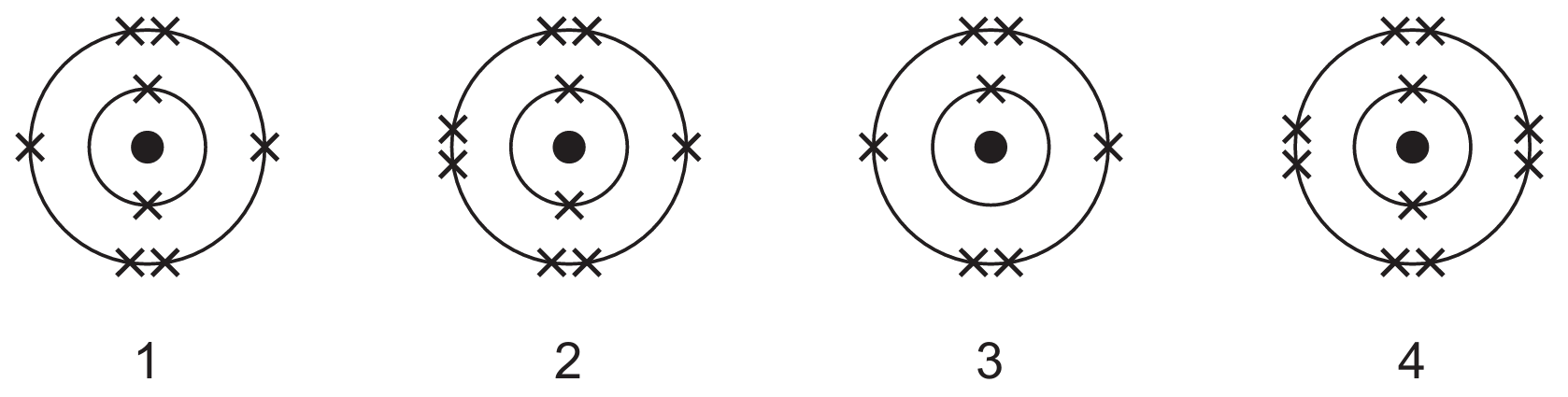
The electronic configurations of four particles are shown. 

Which diagrams represent the electronic configurations of a Group VI atom and its ion?

A. 1 and 2
B. 1 and 4
C. 2 and 3
D. 3 and 4

▶️ Answer/Explanation
A Group VI atom has 6 electrons in its outer shell (e.g., 2,6). Its ion gains 2 electrons to achieve a full outer shell (2,8). Diagram 1 shows 2,6 (atom) and diagram 4 shows 2,8 (ion). So the pair is 1 and 4.
Answer: (B)

Question

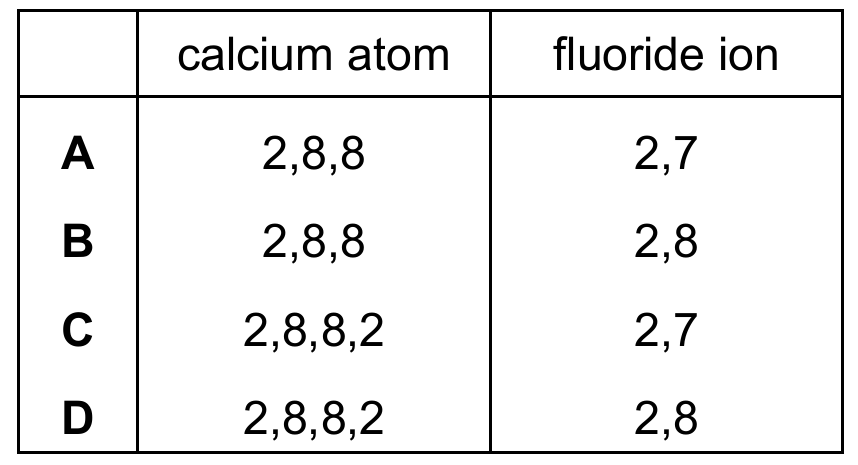
Which row shows the electronic configuration of a calcium atom and of a fluoride ion?

▶️ Answer/Explanation
Calcium has atomic number 20, so its electronic configuration is 2,8,8,2. Fluorine has atomic number 9, so a fluoride ion (F⁻) has gained one electron to have 10 electrons, giving it the configuration 2,8. This matches option D.
Answer: (D)

Question

P is in Group II of the Periodic Table.

Q is a non-metallic element.

P reacts with Q to form an ionic compound, P₃Q₂.

What is the charge on the element Q ion in P₃Q₂?

A. 1–
B. 2–
C. 3–
D. 4–

▶️ Answer/Explanation
P is in Group II, so it forms a 2+ ion by losing two electrons. The compound formula P₃Q₂ shows that three P ions combine with two Q ions. The total positive charge is \(3 \times 2+ = 6+\). For the compound to be neutral, the two Q ions must have a total charge of 6–, so each Q ion has a charge of 3–.
Answer: (C)

Question

Which electronic structure belongs to a non-metallic element?

A. 2
B. 2,2
C. 2,8,2
D. 2,8,8,2

▶️ Answer/Explanation
Electronic structure 2 corresponds to helium (He, atomic number 2), which is a noble gas — a non-metal. Structures 2,2 = beryllium (metal), 2,8,2 = magnesium (metal), and 2,8,8,2 = calcium (metal).
All of options B, C, and D have 2 electrons in their outermost shell (Group II), placing them firmly in the metallic block; only helium with just 2 electrons in one shell is a non-metal.
Answer: (A)

Question

Which particle has the same number of electrons in its outer shell as an atom of sodium, \(^{23}_{11}\mathrm{Na}\)?

A. \(^{23}_{11}\mathrm{Na}^{+}\)
B. \(^{23}_{11}\mathrm{Na}^{-}\)
C. \(^{24}_{11}\mathrm{Na}\)
D. \(^{24}_{12}\mathrm{Na}^{2+}\)

▶️ Answer/Explanation
Sodium (Na, Z=11) has electronic configuration 2,8,1, so it has 1 outer shell electron. The \(^{24}_{12}\mathrm{Mg}^{2+}\) ion has lost its 2 outer electrons, leaving configuration 2,8, with zero outer electrons, matching sodium’s outer electron count.
Answer: (C) (\(^{24}_{11}\mathrm{Na}\) is an isotope of sodium with the same electron configuration.)
Scroll to Top