Home / iGCSE / Coordinated Sciences / C2.3 Isotopes Paper 2

CIE iGCSE Co-Ordinated Science C2.3 Isotopes Exam Style Questions Paper 2

Question

Which statement explains why isotopes of an element have the same chemical properties?

A. They have the same atomic mass.
B. They have the same number of neutrons.
C. They have the same electronic configuration.
D. They have the same density.

▶️ Answer/Explanation
Isotopes are atoms of the same element that have the same number of protons but different numbers of neutrons. Since chemical properties depend on the number and arrangement of electrons, and isotopes have the same electronic configuration, they react in the same way. The difference in neutron number only affects mass and physical properties.
Answer: (C)

Question

Which statement about isotopes of the same element is correct?

A. They have the same number of protons but different number of electrons.
B. They have the same number of protons but different number of neutrons.
C. They have the same number of neutrons but different number of electrons.
D. They have the same number of neutrons but different number of protons.

▶️ Answer/Explanation
Isotopes are atoms of the same element, so they must have the same number of protons (and electrons, if neutral).
They differ in mass number because they have different numbers of neutrons in the nucleus.
Answer: (B)

Question

X and Y are isotopes of the same element.

Which statement about X and Y is correct?

A. They have the same nucleon number but different numbers of protons.
B. They have the same number of neutrons but different numbers of electrons.
C. They have the same atomic number but different numbers of electrons.
D. They have the same number of protons but different numbers of neutrons.

▶️ Answer/Explanation
Isotopes are atoms of the same element, so by definition they have the same number of protons (same atomic number).
Isotopes differ in the number of neutrons in the nucleus, which changes their nucleon (mass) number.
Since the number of protons is unchanged, the number of electrons is also the same, ruling out B and C.
Answer: (D)

Question

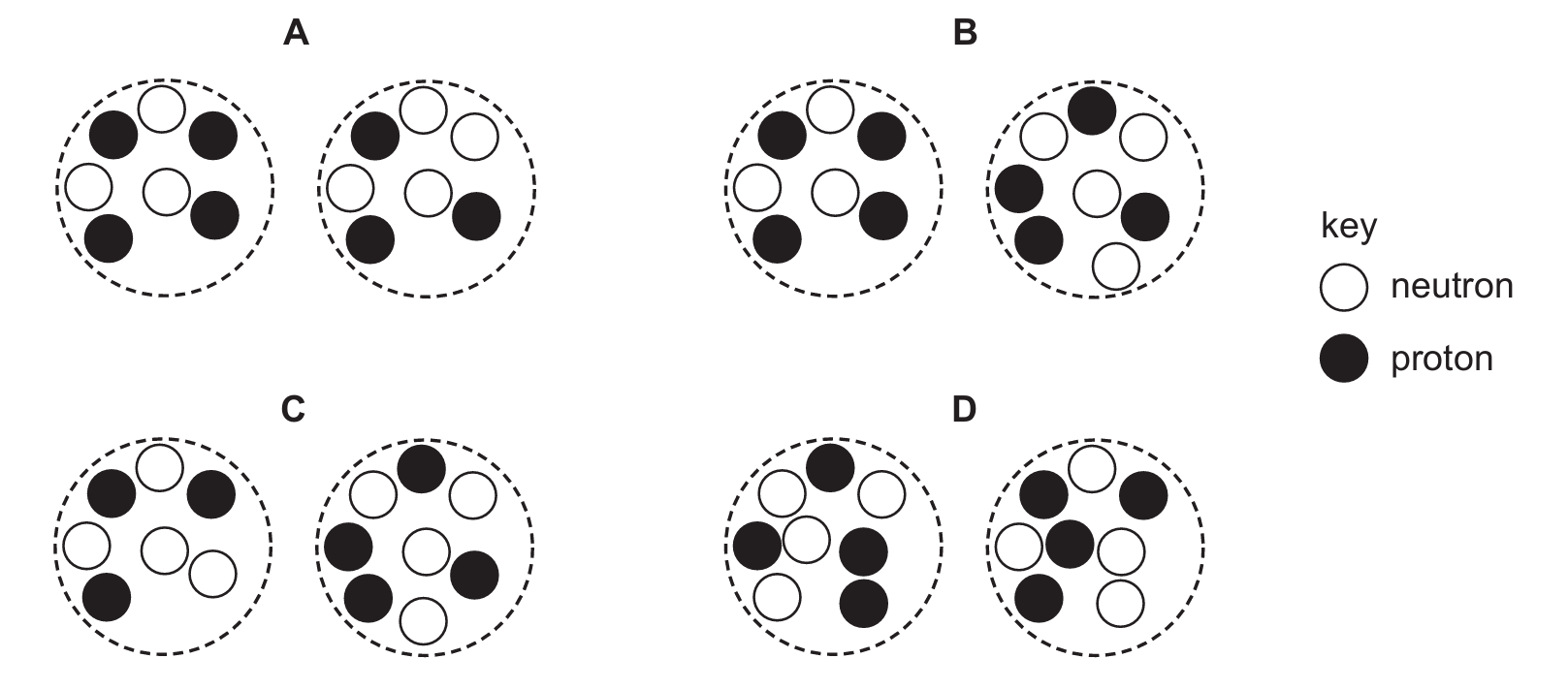
The diagrams represent pairs of nuclei of some atoms.

Which pair shows nuclei of different isotopes of the same element?

▶️ Answer/Explanation
Isotopes are atoms of the same element, meaning they must have the same number of protons, but they have different numbers of neutrons.
This means the correct pair of nuclei must show an equal number of protons in both nuclei, while the number of neutrons differs between them.
Checking each option against the key for protons and neutrons, the pair with matching proton counts but differing neutron counts is option B.
Answer: (B)

Question

The symbols representing four different particles are shown.

\(^{1}_{1}\mathrm{P}\) \(^{2}_{1}\mathrm{Q}^{-}\) \(^{2}_{1}\mathrm{R}\) \(^{3}_{1}\mathrm{S}^{+}\)

Which particles have the same chemical properties?

A. \(^{1}_{1}\mathrm{P}\) and \(^{2}_{1}\mathrm{R}\) only
B. \(^{2}_{1}\mathrm{Q}^{-}\) and \(^{3}_{1}\mathrm{S}^{+}\) only
C. \(^{2}_{1}\mathrm{Q}^{-}\) and \(^{2}_{1}\mathrm{R}\) only
D. \(^{1}_{1}\mathrm{P}\), \(^{2}_{1}\mathrm{Q}^{-}\), \(^{2}_{1}\mathrm{R}\) and \(^{3}_{1}\mathrm{S}^{+}\)

▶️ Answer/Explanation
Chemical properties are determined by the number of electrons (and thus the electronic configuration), which is equal to the proton number in a neutral atom. \(^{1}\mathrm{P}\) has 1 proton and is neutral, so it is hydrogen-1. \(^{2}\mathrm{R}\) has 2 nucleons and is neutral; it has 1 proton and 1 neutron, making it deuterium (hydrogen-2). Both are isotopes of hydrogen with the same number of protons and electrons, so they have identical chemical properties. The other particles have different proton numbers.
Answer: (A)
Scroll to Top