
CIE iGCSE Co-Ordinated Science C2.3 Isotopes Exam Style Questions Paper 3
Question
Most-appropriate topic codes (Cambridge IGCSE Co-ordinated Sciences 0654):
• Topic C11.4 — Alkanes (Part (a)(i), (a)(ii), (a)(iii) & (a)(iv))
• Topic C3.2 — Relative masses of atoms and molecules (Part (b))
• Topic C2.3 — Covalent bonding (Part (c))
• Topic C9.1 — Fossil fuels (Part (d))
• Topic C2.1 — Elements, compounds and mixtures (Part (e))
▶️ Answer/Explanation
(a)(i)
methane + oxygen $\rightarrow$ carbon dioxide + water
Complete combustion requires a plentiful supply of oxygen and converts all the carbon in the hydrocarbon to carbon dioxide and all the hydrogen to water. The balanced symbol equation is $\text{CH}_4 + 2\text{O}_2 \rightarrow \text{CO}_2 + 2\text{H}_2\text{O}$, confirming a 1:2 molar ratio of methane to oxygen.
(a)(ii)
carbon monoxide (also accept: carbon / soot)
Incomplete combustion occurs when the oxygen supply is limited, preventing full oxidation of the carbon atoms. Carbon monoxide ($\text{CO}$) is a colourless, odourless, and highly toxic gas produced as a result, making it a serious health hazard in poorly ventilated spaces such as rooms with gas appliances.
(a)(iii)
Methane contains only single covalent bonds between carbon and hydrogen atoms; there are no carbon-carbon double or triple bonds.
A saturated hydrocarbon is one in which every carbon atom forms the maximum number of single bonds with other atoms, leaving no possibility for addition reactions. Because methane has only one carbon atom bonded to four hydrogen atoms by single bonds, it meets the definition of a saturated compound.
(a)(iv)
orange / brown to colourless
Bromine water is orange-brown in colour due to dissolved bromine molecules. When mixed with an unsaturated hydrocarbon, bromine adds across the carbon-carbon double bond in an addition reaction, consuming the bromine and removing its colour. A saturated hydrocarbon would leave the orange colour unchanged since it cannot undergo this reaction.
(b)
$M_r = A_r(\text{C}) + 4 \times A_r(\text{H})$
$M_r = 12 + (4 \times 1)$
$\boxed{M_r = 16}$
Relative molecular mass is found by adding together the relative atomic masses of all atoms present in one molecule. Methane contains one carbon atom ($A_r = 12$) and four hydrogen atoms ($A_r = 1$ each), giving a total of 16.
(c)
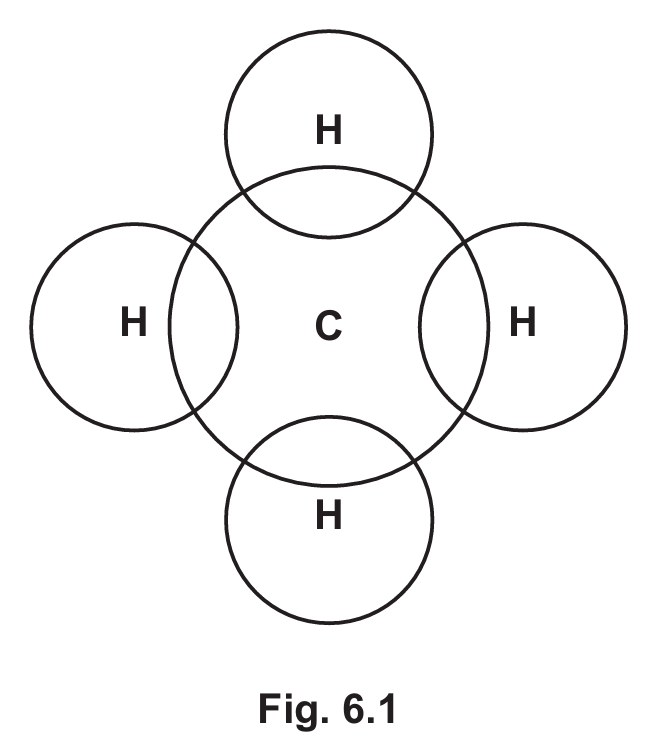
The completed diagram shows the carbon atom at the centre with four pairs of shared electrons, one pair bonded to each of the four surrounding hydrogen atoms. Each hydrogen contributes one electron (shown as a cross) and carbon contributes one electron (shown as a dot) to each shared pair. All four bonds are single covalent bonds, giving carbon a full outer shell of 8 electrons and each hydrogen a full shell of 2 electrons.
(d)
coal (also accept: crude oil / petroleum)
Fossil fuels are non-renewable energy sources formed over millions of years from the remains of ancient organisms buried under heat and pressure. Coal, crude oil, and natural gas are the three main fossil fuels; burning them releases carbon dioxide, contributing to the greenhouse effect and global warming.
(e)
Carbon is an element because it contains only one type of atom.
Methane is a compound because it contains two or more different types of atoms that are chemically combined.
An element cannot be broken down into simpler substances by chemical means, whereas a compound can be decomposed into its constituent elements. Methane contains carbon and hydrogen atoms bonded together in a fixed ratio of $1:4$, which is characteristic of a pure compound.
Question
Topic codes:
• Topic C1.2 — Diffusion (Part (a))
• Topic C2.3 — Isotopes (Part (b)(i))
• Topic C3.2 — Relative masses of atoms and molecules (Part (b)(ii))
• Topic C5.1 — Exothermic and endothermic reactions (Part (b)(iii))
• Topic C7.1 — Characteristic properties of acids and bases (Part (b)(iv))
• Topic C8.3 — Group VII properties (Part (b)(v))
• Topic C4.1 — Electrolysis (Part (a))
• Topic C10.2 — Air quality and climate (Part (a))
• Topic C12.3 — Chromatography (Part (a))
▶️ Answer/Explanation
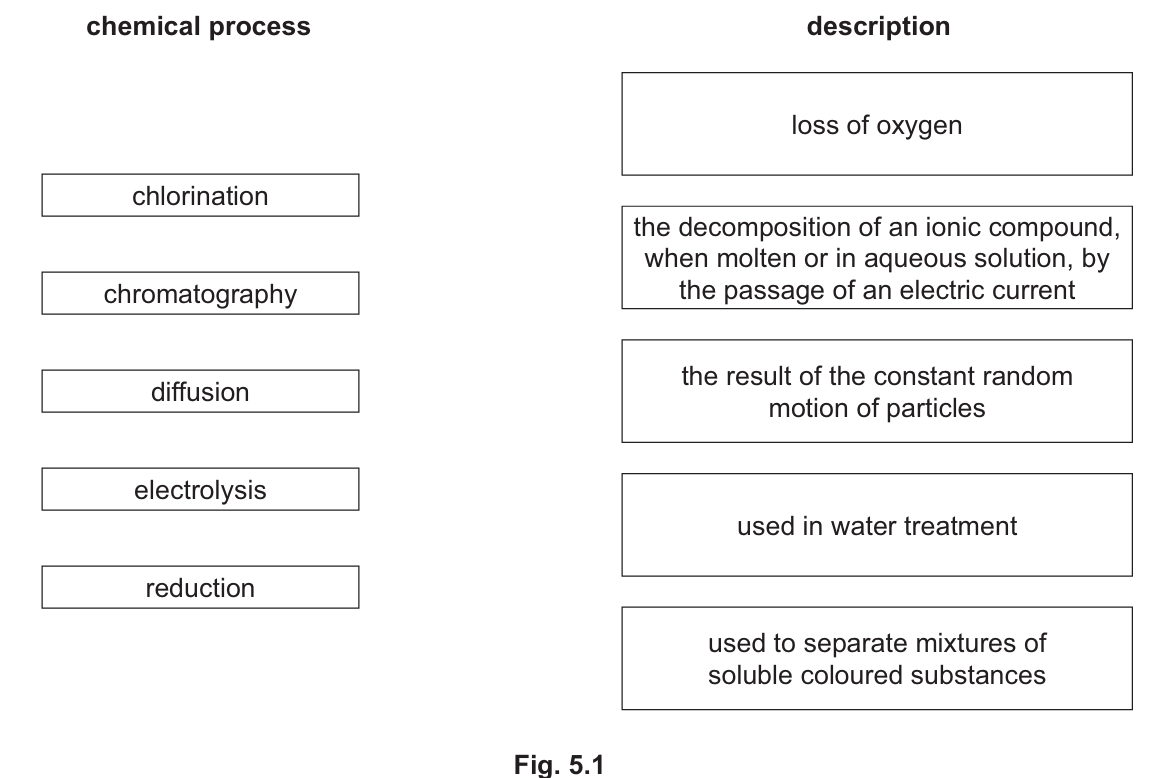
(a) Matching: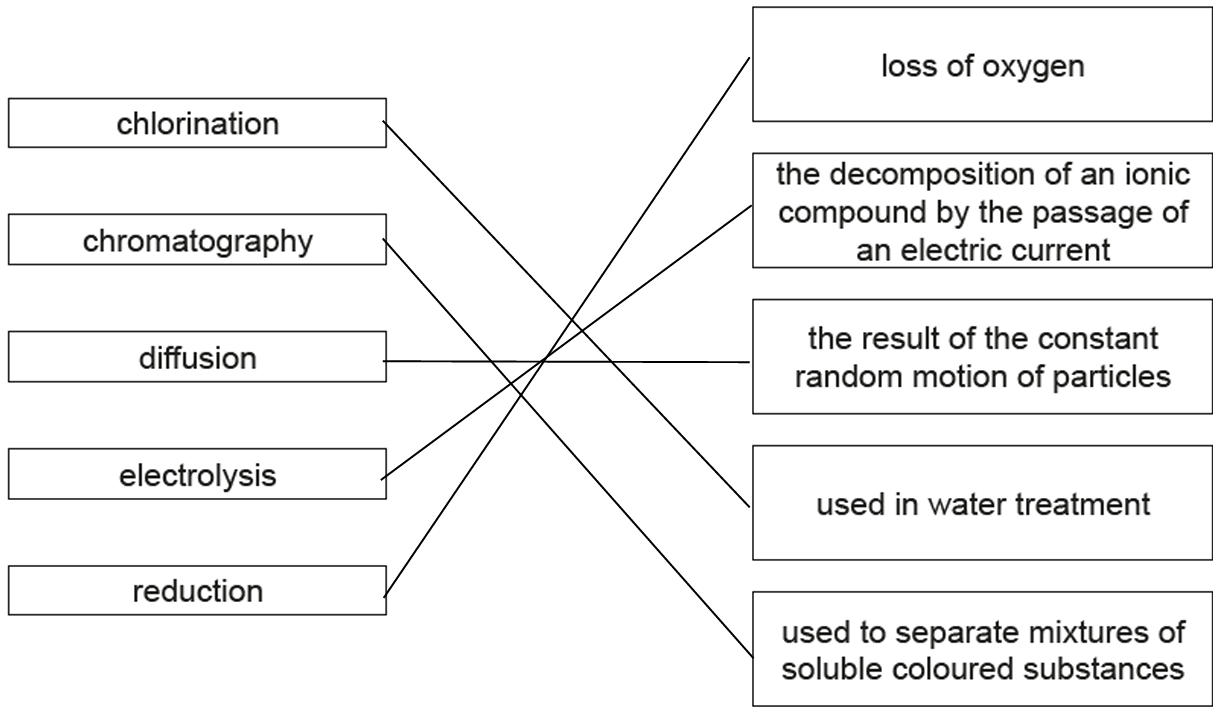
(b)(i) Isotopes are atoms of the same element with the same number of protons but different numbers of neutrons.
Isotopes have the same atomic number (proton number) but different mass numbers (nucleon numbers). They have identical chemical properties because they have the same electronic configuration, but different physical properties due to their different masses.
(b)(ii) The relative atomic mass of chlorine is 35.5 because it is the average mass of the two isotopes, \(^{35}\text{Cl}\) and \(^{37}\text{Cl}\), taking into account their relative abundances.
Chlorine has two naturally occurring isotopes: chlorine-35 and chlorine-37. The average mass is 35.5 because there are approximately three times more chlorine-35 atoms than chlorine-37 atoms.
(b)(iii) The reaction is not endothermic because thermal energy is released to the surroundings.
An endothermic reaction takes in thermal energy from the surroundings, causing a temperature decrease. Since this reaction releases thermal energy (and light), it is exothermic (\(\Delta H\) is negative).
(b)(iv) Acid: (dilute) hydrochloric acid ; Alkali: (aqueous) sodium hydroxide
Sodium chloride can be prepared by neutralisation: \(\text{HCl} + \text{NaOH} \rightarrow \text{NaCl} + \text{H}_2\text{O}\). This is a typical acid-alkali neutralisation reaction producing a salt and water.
(b)(v) The halogens have similar chemical properties because they all have the same number of electrons in their outer shell (seven electrons).
Elements in the same group of the Periodic Table have the same number of outer-shell (valence) electrons, which determines their chemical reactivity. Halogens all have 7 electrons in their outer shell and therefore react similarly by gaining one electron to achieve a stable noble gas configuration.