
CIE iGCSE Co-Ordinated Science C2.3 Isotopes Exam Style Questions Paper 4
Question

Most-appropriate topic codes (Cambridge IGCSE Co-ordinated Sciences 0654):
• Topic C2.2 — Atomic structure (Part (a) & (b))
• Topic C2.3 — Isotopes (Part (c))
• Topic C2.5 — Covalent bonds / Dot-and-cross diagrams (Part (d))
• Topic C2.4 — Ionic bonds / C2.5 — Covalent bonds / Intermolecular forces (Part (e))
▶️ Answer/Explanation
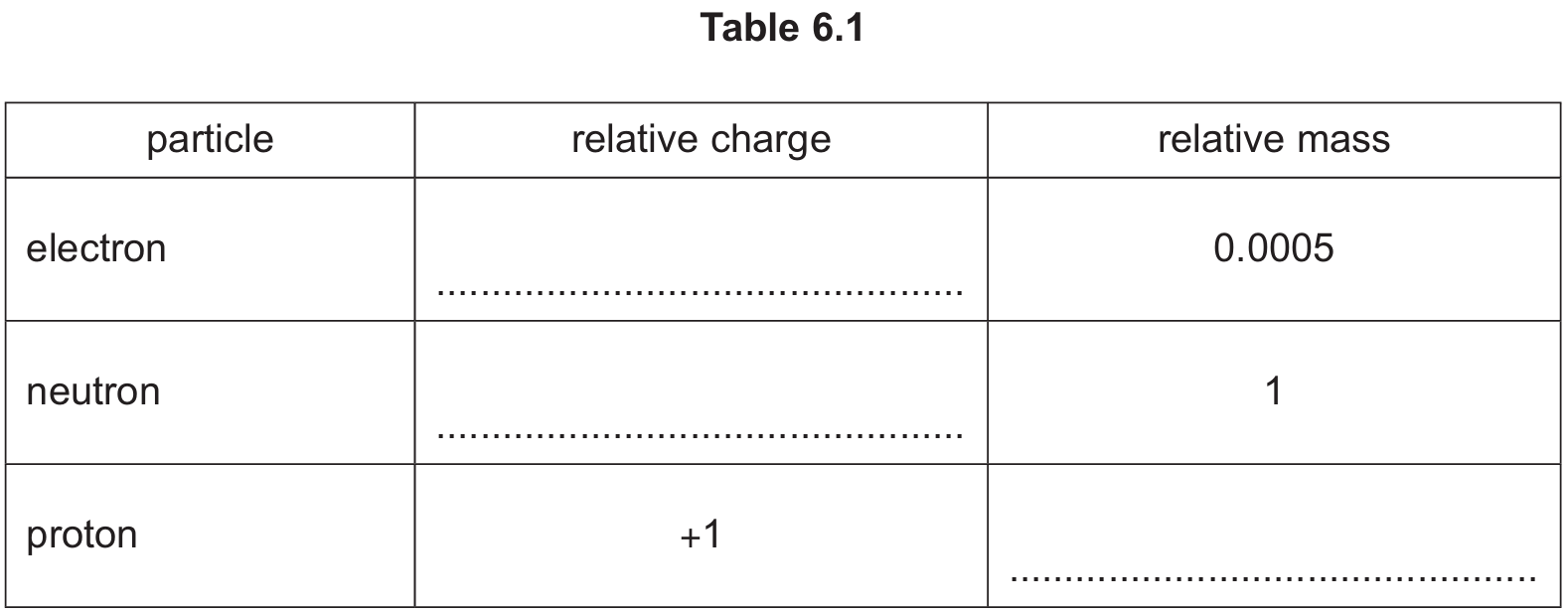
(a) Table 6.1 completed:
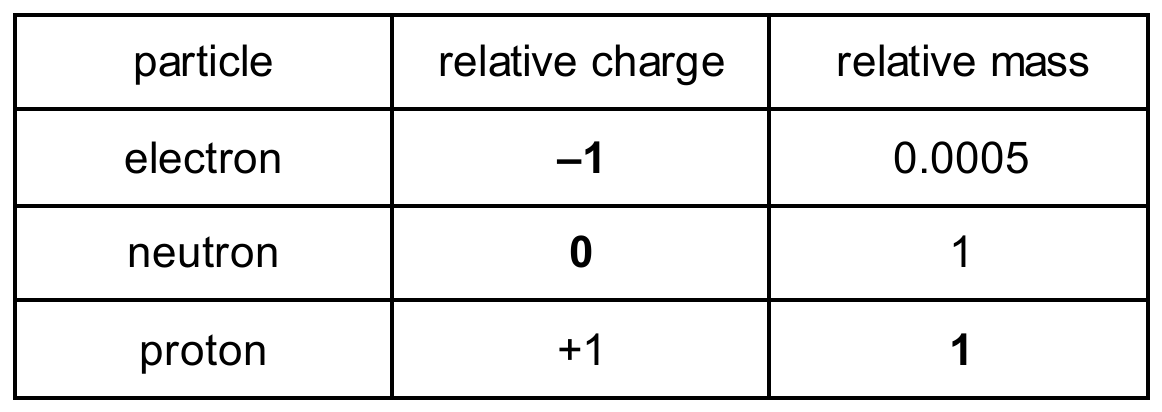
Electrons have a relative charge of -1 and negligible mass; neutrons are neutral; protons have a charge of +1 and a relative mass of 1.
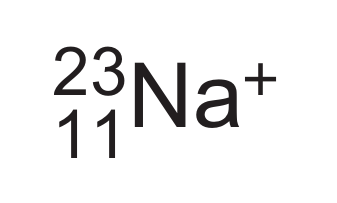
(b) 10 electrons and 12 neutrons.
Sodium has 11 protons (atomic number 11). The ion Na⁺ has lost one electron, so it has 10 electrons. The mass number 23 means 23 − 11 = 12 neutrons.
(c) \( ^{35}_{18}\text{Cl} \) is not an isotope of chlorine because it has 18 protons instead of 17.
Isotopes of the same element have the same proton number but different neutron numbers. The symbol with 18 protons is actually an isotope of argon, not chlorine.
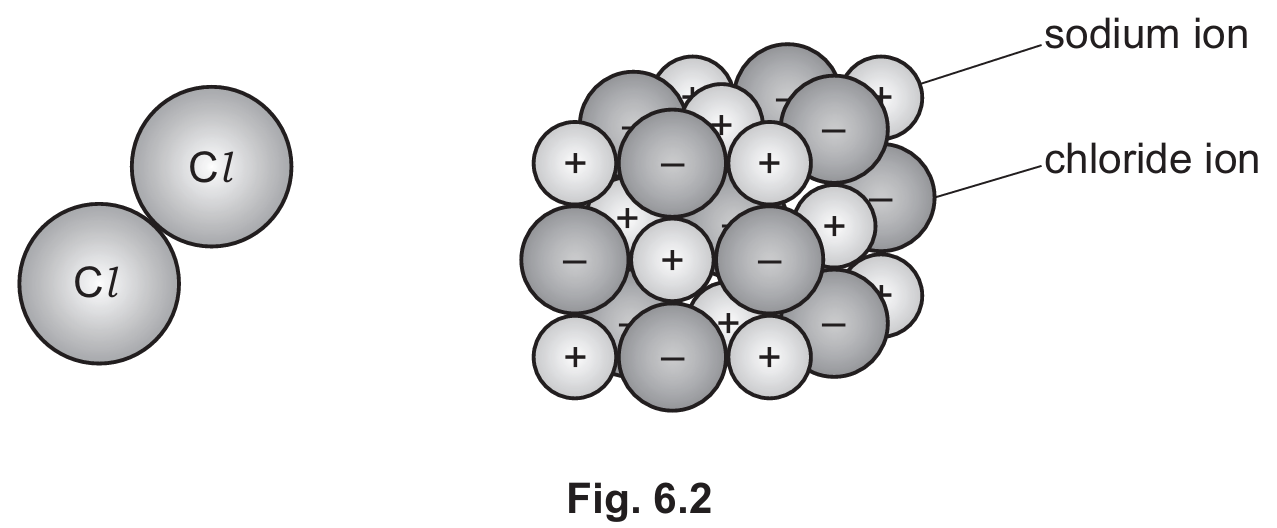
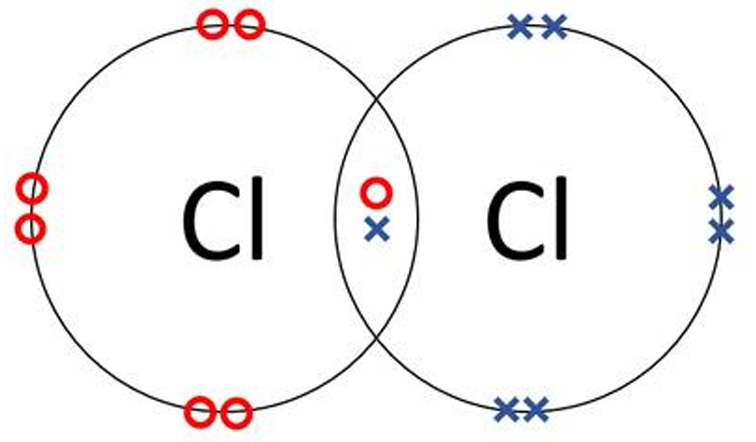
(d) Dot-and-cross diagram for Cl₂: Two chlorine atoms each contribute one unpaired electron to form a shared pair (covalent bond). Each chlorine atom has three lone pairs of electrons around it.
Cl : Cl (with each Cl having three additional pairs of dots/crosses)
Each chlorine atom has 7 outer electrons; they share one pair to achieve a full outer shell of 8 electrons (stable octet).
(e) Chlorine is covalent with weak intermolecular forces between molecules, so little energy is needed to separate them, making it a gas.
Sodium chloride is ionic with strong electrostatic forces between oppositely charged ions throughout a giant lattice, requiring much more energy to overcome, making it a solid.
In covalent chlorine, the molecules are held together by weak van der Waals forces. In ionic sodium chloride, strong ionic bonds hold the lattice together, giving it a high melting point.
Question
Classify magnesium oxide.
Explain your answer.
Determine the electronic configuration of a magnesium atom.
Describe the similarity and the difference between the three isotopes.
The boiling point is 102 °C.
Describe how the student knows that the sea water is not pure water.
Most-appropriate topic codes (Cambridge IGCSE Co-ordinated Sciences 0654):
• Topic C2.4 — Ions and ionic bonds (Part (a))
• Topic C7.2 — Oxides (Part (b))
• Topic C2.2 — Atomic structure and the Periodic Table (Part (c))
• Topic C2.3 — Isotopes (Part (d))
• Topic C3.2 — Relative masses of atoms and molecules / C3.3 — The mole and the Avogadro constant (Part (e))
• Topic C10.1 — Water (Part (f))
▶️ Answer/Explanation
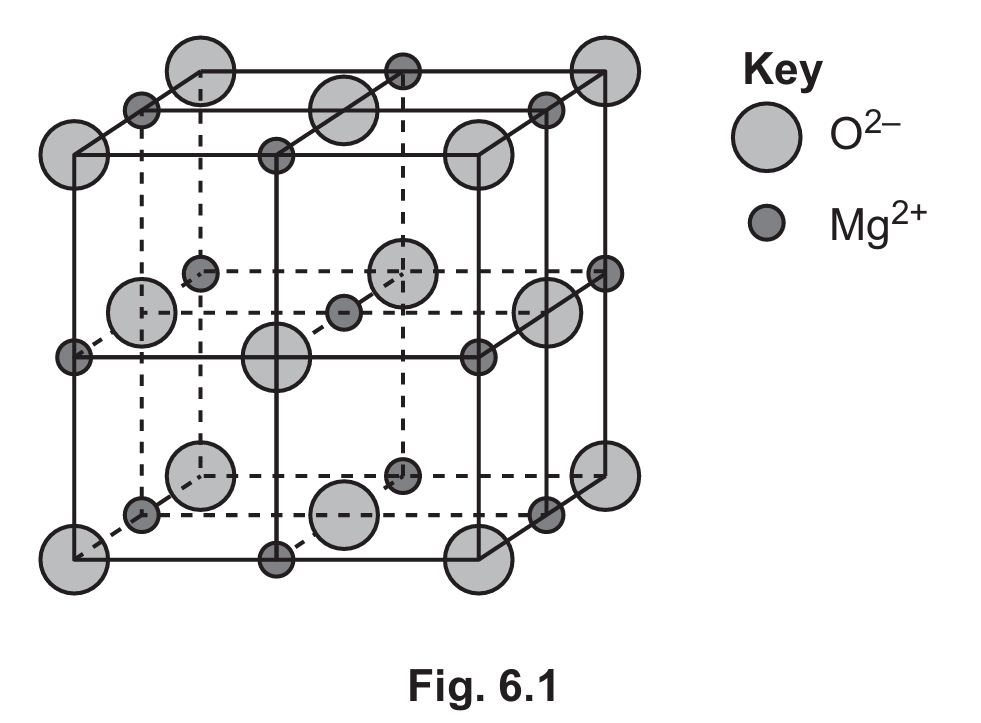
(a) Formula = MgO.
The diagram shows equal numbers of Mg²⁺ and O²⁻ ions in a 1:1 ratio. The charges balance (+2 and -2), so the formula is MgO.
(b) Classification: Basic oxide.
Explanation: Magnesium is a metal. Metal oxides react with acids to form salts and water. Magnesium oxide is a basic oxide because it neutralises acids.
(c) Electronic configuration = 2.8.2.
Magnesium has 12 protons/electrons. The first shell holds 2, the second holds 8, and the remaining 2 electrons go into the third shell.
(d) Similarity: Same number of protons (atomic number = 12).
Difference: Different number of neutrons / different mass numbers (24, 25, 26).
(e) Calculation:
\(M_r\) of MgSO₄ = 26 + 32 + (4 × 16) = 122
\(\text{moles} = \frac{\text{mass}}{M_r} = \frac{3.05}{122} = 0.025\text{ mol}\)
Note: The \(^{26}\text{Mg}\) isotope has mass number 26, so the relative atomic mass used for Mg is 26 in this calculation.
(f) Pure water boils at 100°C at standard atmospheric pressure.
The sea water sample boils at 102°C, which is higher than 100°C. This elevation in boiling point indicates the presence of dissolved impurities (salts), so the water is not pure.