CIE iGCSE Co-Ordinated Science C2.5 Simple molecules and covalent bonds Exam Style Questions Paper 4
Question

Most-appropriate topic codes (Cambridge IGCSE Co-ordinated Sciences 0654):
• Topic C2.2 — Atomic structure (Part (a) & (b))
• Topic C2.3 — Isotopes (Part (c))
• Topic C2.5 — Covalent bonds / Dot-and-cross diagrams (Part (d))
• Topic C2.4 — Ionic bonds / C2.5 — Covalent bonds / Intermolecular forces (Part (e))
▶️ Answer/Explanation
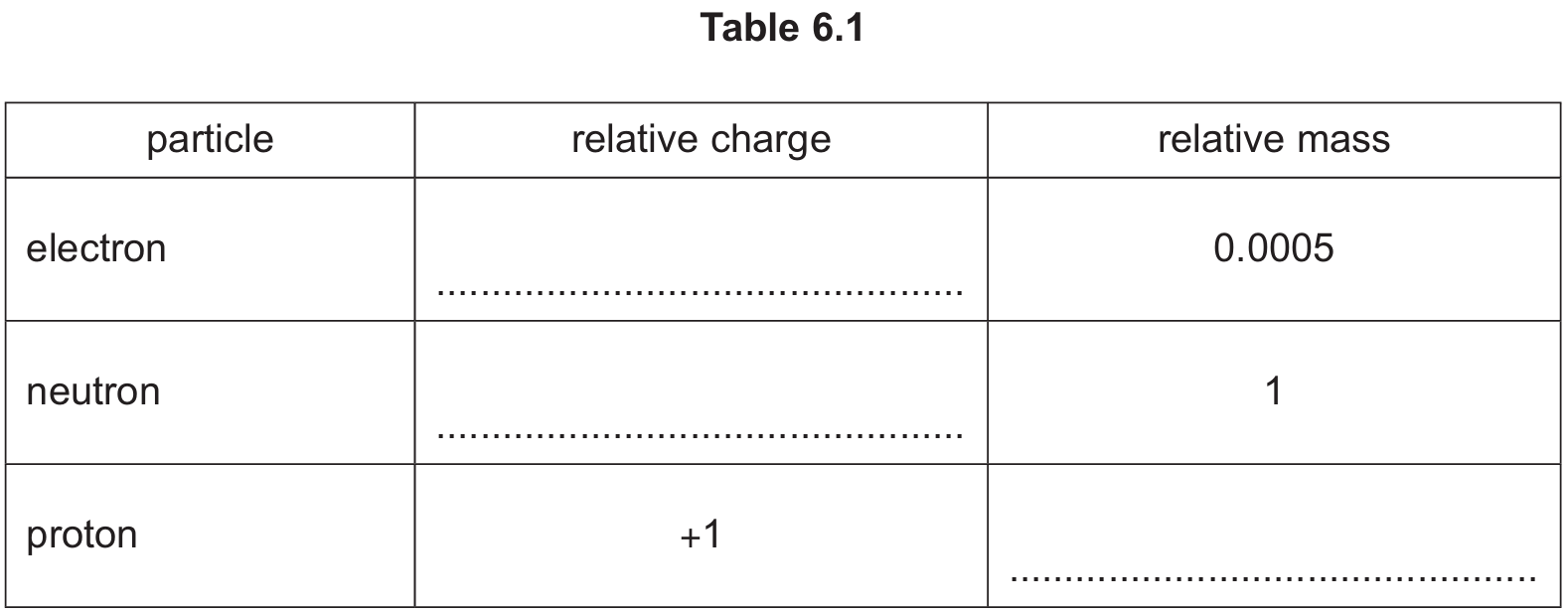
(a) Table 6.1 completed:
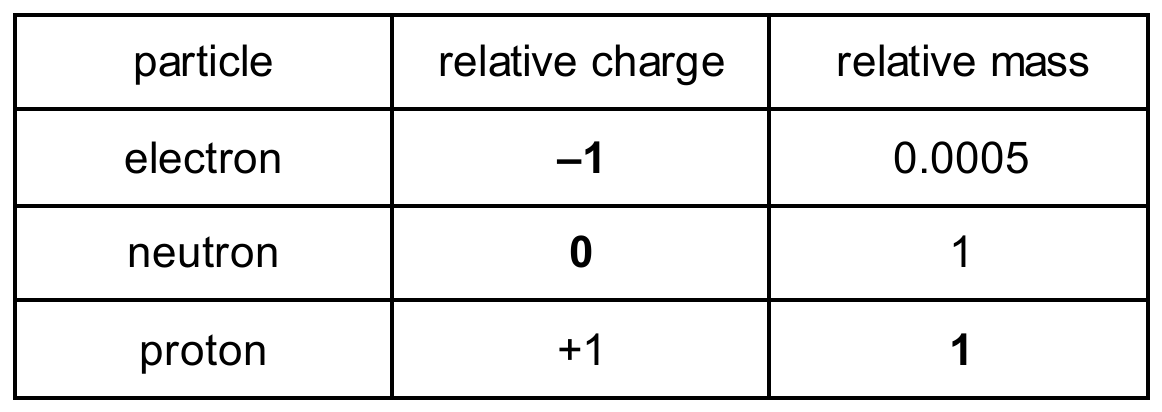
Electrons have a relative charge of -1 and negligible mass; neutrons are neutral; protons have a charge of +1 and a relative mass of 1.
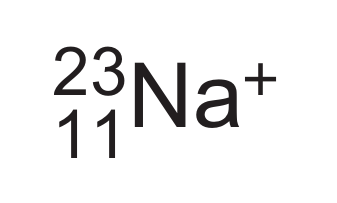
(b) 10 electrons and 12 neutrons.
Sodium has 11 protons (atomic number 11). The ion Na⁺ has lost one electron, so it has 10 electrons. The mass number 23 means 23 − 11 = 12 neutrons.
(c) \( ^{35}_{18}\text{Cl} \) is not an isotope of chlorine because it has 18 protons instead of 17.
Isotopes of the same element have the same proton number but different neutron numbers. The symbol with 18 protons is actually an isotope of argon, not chlorine.
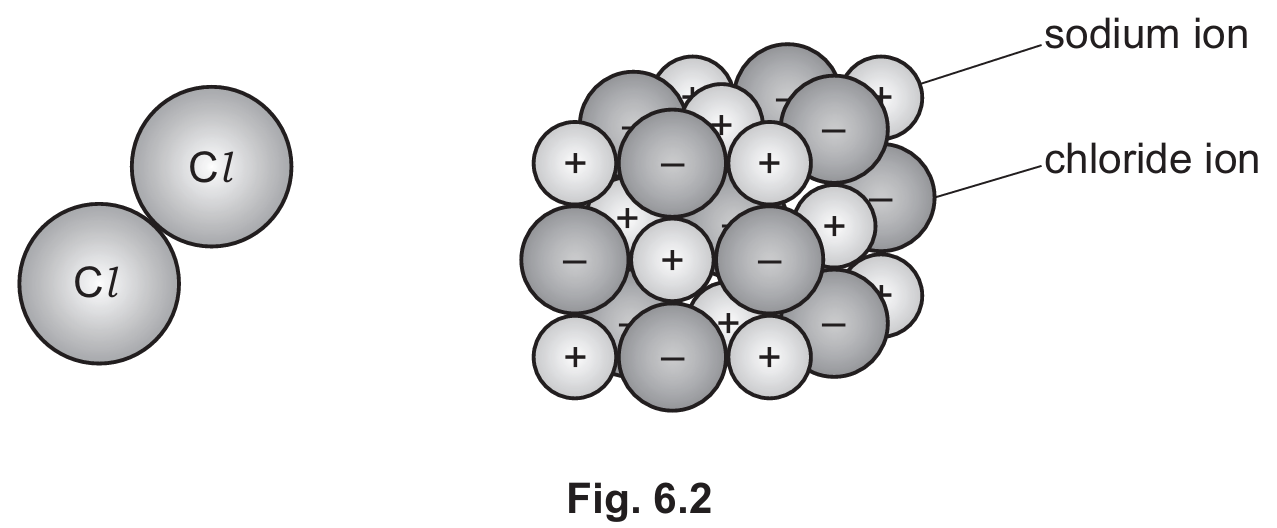
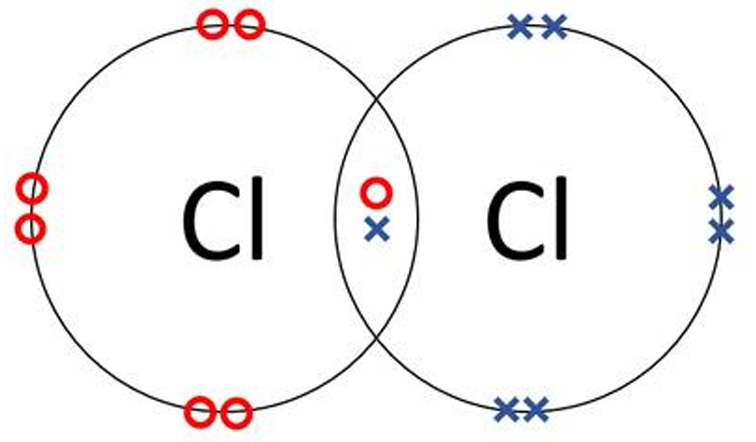
(d) Dot-and-cross diagram for Cl₂: Two chlorine atoms each contribute one unpaired electron to form a shared pair (covalent bond). Each chlorine atom has three lone pairs of electrons around it.
Cl : Cl (with each Cl having three additional pairs of dots/crosses)
Each chlorine atom has 7 outer electrons; they share one pair to achieve a full outer shell of 8 electrons (stable octet).
(e) Chlorine is covalent with weak intermolecular forces between molecules, so little energy is needed to separate them, making it a gas.
Sodium chloride is ionic with strong electrostatic forces between oppositely charged ions throughout a giant lattice, requiring much more energy to overcome, making it a solid.
In covalent chlorine, the molecules are held together by weak van der Waals forces. In ionic sodium chloride, strong ionic bonds hold the lattice together, giving it a high melting point.
Question
Construct the balanced symbol equation for the reaction.
Most-appropriate topic codes (Cambridge IGCSE Co-ordinated Sciences 0654):
• Topic C11.2 — Naming organic compounds (Part (a)(i) & (a)(ii))
• Topic C11.6 — Alcohols (Part (a)(iii) & (b))
• Topic C11.7 — Polymers (Part (a)(iv))
• Topic C3.3 — The mole and the Avogadro constant / Stoichiometry (Part (c))
• Topic C2.5 — Simple molecules and covalent bonds (Part (d))
▶️ Answer/Explanation
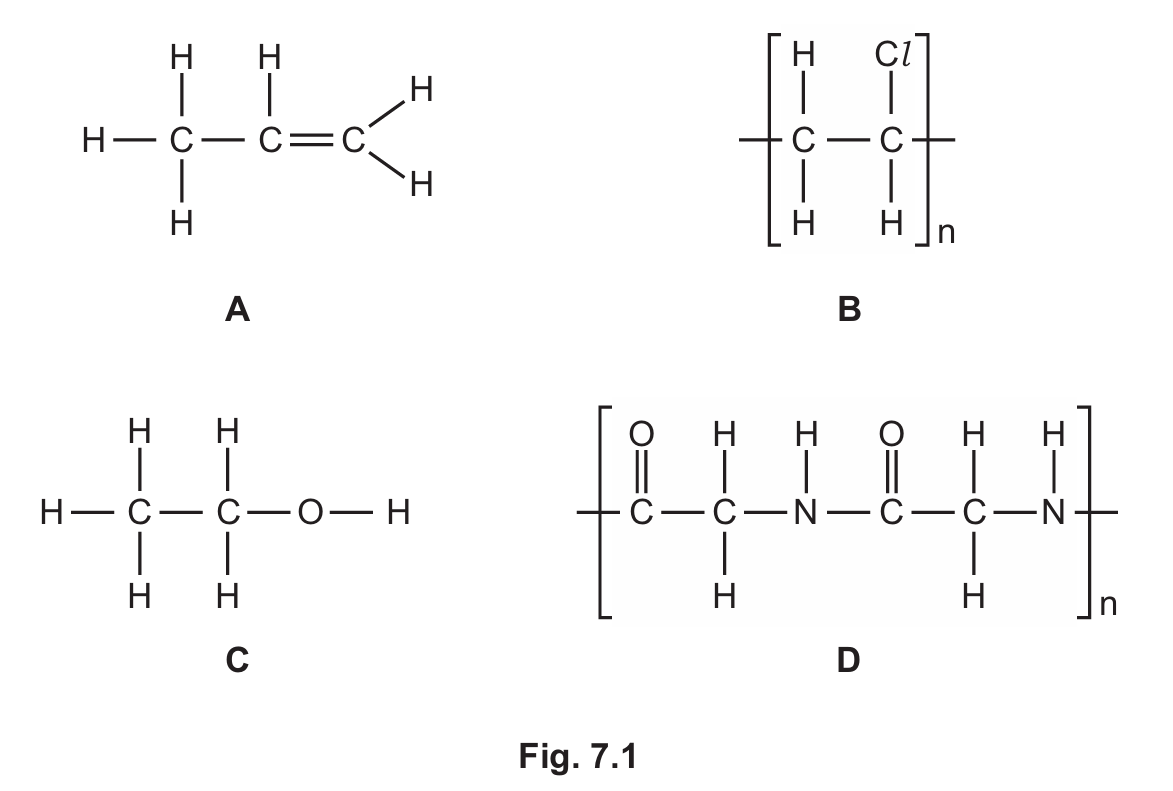
(a)(i) A is a hydrocarbon.
A hydrocarbon is a compound that contains only hydrogen and carbon atoms. Compound A (propene) contains only C and H atoms.
(a)(ii) A is propene.
Propene has the formula \(\text{C}_3\text{H}_6\) and contains a carbon-carbon double bond. Compound A shows this structure.
(a)(iii) C is made from the reaction of ethene with steam in the presence of an acid catalyst.
Ethene reacts with steam (hydration) in the presence of an acid catalyst to produce ethanol (\(\text{C}_2\text{H}_5\text{OH}\)), which is compound C.
(a)(iv) D is made in a condensation polymerisation reaction.
Compound D shows a repeating unit characteristic of a condensation polymer (such as nylon or a polyester).
(b) Balanced equation for complete combustion of ethanol:
\(\text{C}_2\text{H}_5\text{OH} + 3\text{O}_2 \rightarrow 2\text{CO}_2 + 3\text{H}_2\text{O}\)
(c) Limiting reactant calculation:
\(M_r\) of \(\text{C}_4\text{H}_8 = (4 \times 12) + (8 \times 1) = 48 + 8 = 56\)
Moles of \(\text{C}_4\text{H}_8 = \frac{11.2}{56} = 0.2\) mol
\(M_r\) of \(\text{H}_2 = 2 \times 1 = 2\)
Moles of \(\text{H}_2 = \frac{0.6}{2} = 0.3\) mol
\(\text{C}_4\text{H}_8\) is the limiting reactant because 0.2 mol is less than the 0.3 mol of \(\text{H}_2\).
The reaction requires a 1:1 mole ratio of \(\text{C}_4\text{H}_8\) to \(\text{H}_2\). Since there are fewer moles of \(\text{C}_4\text{H}_8\) (0.2 mol) than \(\text{H}_2\) (0.3 mol), \(\text{C}_4\text{H}_8\) is the limiting reactant and will be used up first.
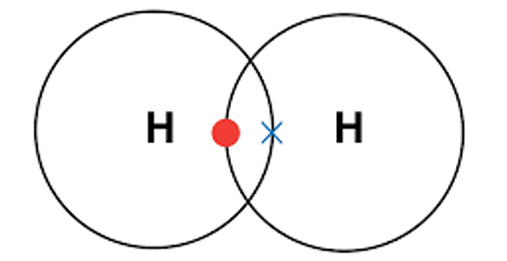
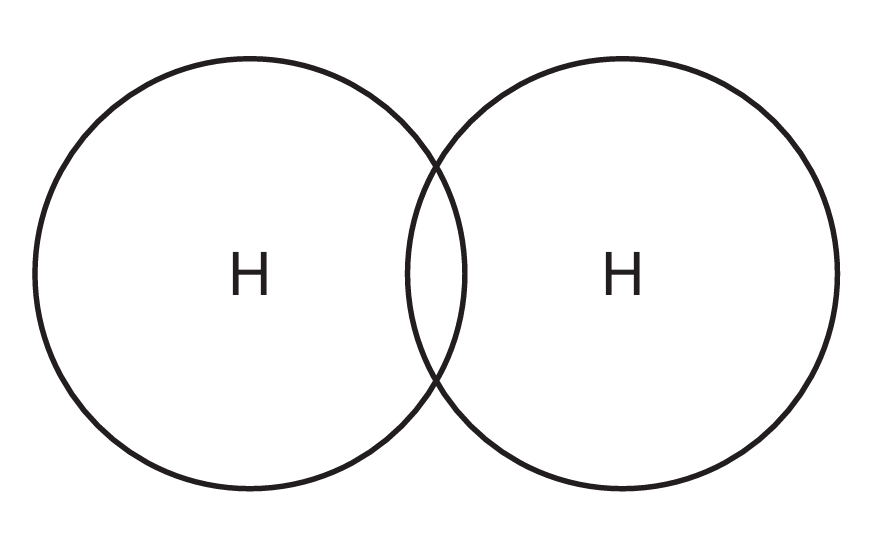
(d) Dot-and-cross diagram for hydrogen molecule (\(\text{H}_2\)):
Each hydrogen atom has one electron in its outer shell. Two hydrogen atoms share a pair of electrons to achieve a stable electron configuration (like helium). The shared pair represents a single covalent bond.