
CIE iGCSE Co-Ordinated Science C2.6 Giant covalent structures Exam Style Questions Paper 3
Question
Most-appropriate topic codes (Cambridge IGCSE Co-ordinated Sciences 0654):
• Topic C6.3 — Redox (Part (a)(i))
• Topic C5.1 — Exothermic and endothermic reactions (Part (a)(ii))
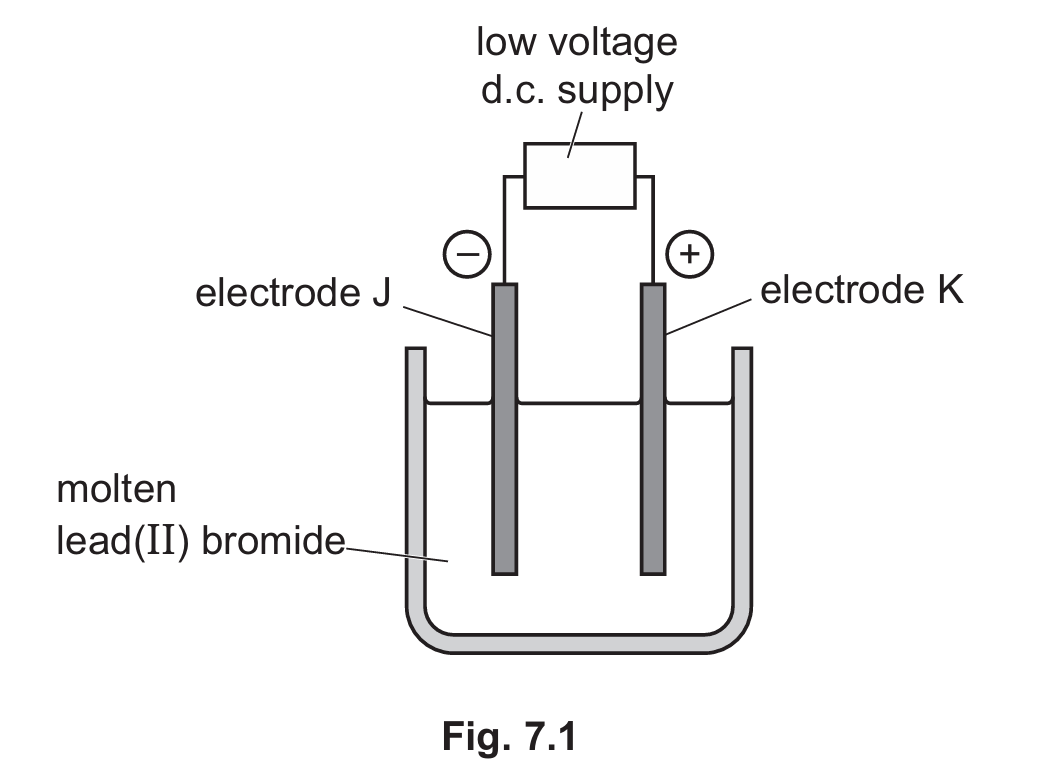
• Topic C4.1 — Electrolysis (Part (b)(i), (b)(ii), (b)(iii) & (b)(iv))
• Topic C2.6 — Giant covalent structures (Part (b)(i))
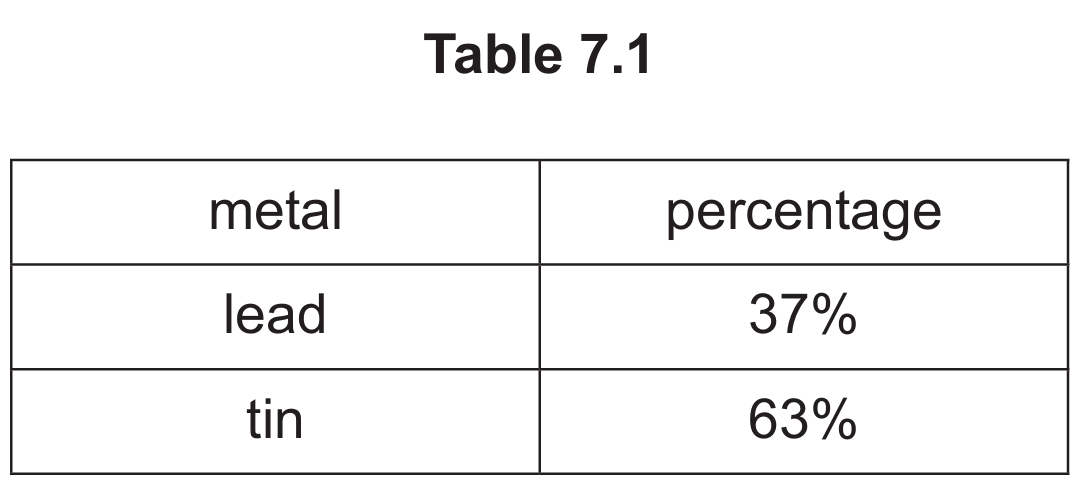
• Topic C9.3 — Alloys and their properties (Part (c)(i) & (c)(ii))
• Topic C12.5 — Qualitative analysis (Part (d)(ii))
▶️ Answer/Explanation
(a)(i)
• Carbon gains oxygen (forming $\text{CO}_2$) — this is oxidation.
• Lead oxide loses oxygen (forming $\text{Pb}$) — this is reduction.
Both processes occur simultaneously in the same reaction, making it a redox reaction. Carbon is more reactive than lead, so it displaces lead from its oxide by taking the oxygen away from it.
(a)(ii)
An endothermic reaction takes in (absorbs) thermal energy from the surroundings.
As a result, the temperature of the surroundings decreases during the reaction. The products end up at a higher energy level than the reactants, and the energy difference is supplied by the environment rather than released into it.
(b)(i)
diamond
Diamond is an allotrope of carbon in which each carbon atom is covalently bonded to four others in a rigid three-dimensional tetrahedral lattice. This giant covalent structure gives diamond its exceptional hardness and very high melting point, contrasting with graphite’s layered structure where carbon atoms bond to only three neighbours.
(b)(ii)
negative electrode J = cathode
positive electrode K = anode
In electrolysis, the cathode is always the negative electrode and the anode is always the positive electrode. Positive ions (cations) migrate toward the cathode, while negative ions (anions) migrate toward the anode to complete the circuit through the electrolyte.
(b)(iii)
electrode J (cathode) product = lead
electrode K (anode) product = bromine
At the cathode, $\text{Pb}^{2+}$ ions gain two electrons and are reduced to lead metal: $\text{Pb}^{2+} + 2e^- \rightarrow \text{Pb}$. At the anode, $\text{Br}^-$ ions lose electrons and are oxidised to bromine: $2\text{Br}^- \rightarrow \text{Br}_2 + 2e^-$. Bromine appears as reddish-brown fumes at the anode.
(b)(iv)
Ions are fixed in position in the solid and can no longer move freely, so they cannot carry charge through the electrolyte.
Electrolysis requires mobile ions to conduct electricity through the liquid. When lead bromide solidifies, the ions become locked in a rigid lattice structure and lose their ability to migrate toward the electrodes, stopping the flow of charge and ending the electrolysis.
(c)(i)
An alloy is a mixture of a metal with one or more other elements.
Alloys are made to improve properties such as hardness, strength, or corrosion resistance compared to the pure metal. The atoms of the added element disrupt the regular arrangement of the metal lattice, making it harder for layers to slide over each other and increasing the overall strength.
(c)(ii)
• Mass of lead $= 4\,\text{kg} \times \dfrac{37}{100}$
• Mass of lead $= 4 \times 0.37$
• $\boxed{\text{Mass of lead} = 1.48\,\text{kg}}$
Since solder is 37% lead by mass, multiplying the total mass of solder (4 kg) by 0.37 gives the mass of lead present. The answer is 1.48 kg, which may be rounded to 1.5 kg to 2 significant figures.
(d)(i)
lead(II) chloride ($\text{PbCl}_2$)
When lead reacts with dilute hydrochloric acid, the lead displaces hydrogen to form lead(II) chloride: $\text{Pb} + 2\text{HCl} \rightarrow \text{PbCl}_2 + \text{H}_2$. Lead(II) chloride is a white solid that is sparingly soluble in cold water, and its formation on the surface of the lead gradually slows the reaction down.
(d)(ii)
Test: Introduce a burning (lighted) wooden splint into a sample of the gas.
Positive result: The gas ignites with a distinctive squeaky “pop” sound.
Hydrogen is highly flammable and reacts rapidly with atmospheric oxygen when ignited, producing water in a small explosion: $2\text{H}_2 + \text{O}_2 \rightarrow 2\text{H}_2\text{O}$. The sudden energy release creates the characteristic pop that confirms the presence of hydrogen gas.
Question
Most-appropriate topic codes (Cambridge IGCSE Co-ordinated Sciences 0654):
• Topic C3.2 — Relative masses of atoms and molecules (Part (a))
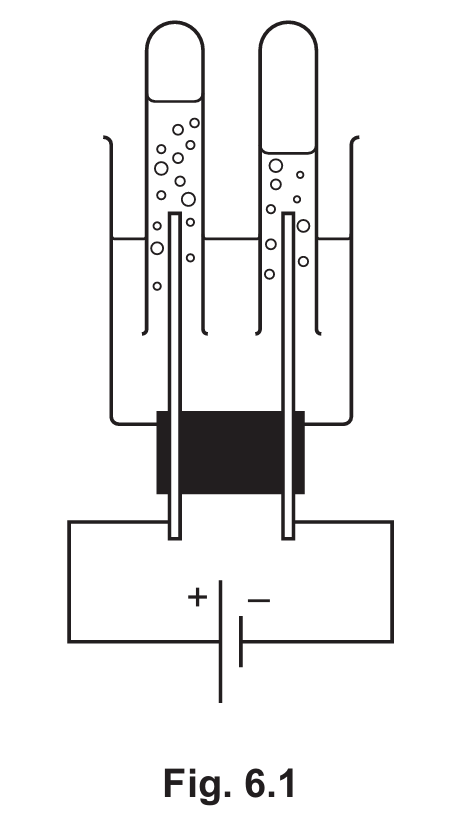
• Topic C4.1 — Electrolysis (Part (b))
• Topic C2.6 — Giant covalent structures (Part (b)(iv))
• Topic C7.1 — The characteristic properties of acids and bases (Part (c))
▶️ Answer/Explanation
(a) \(M_r = 98\)
\(M_r = (2 \times 1) + 32 + (4 \times 16) = 2 + 32 + 64 = 98\)
The relative molecular mass is the sum of the relative atomic masses of all atoms in the molecule.
(b)(i) Anode: positive electrode (connected to positive terminal); Cathode: negative electrode (connected to negative terminal)
In electrolysis, the anode is the positive electrode where oxidation occurs, and the cathode is the negative electrode where reduction occurs.
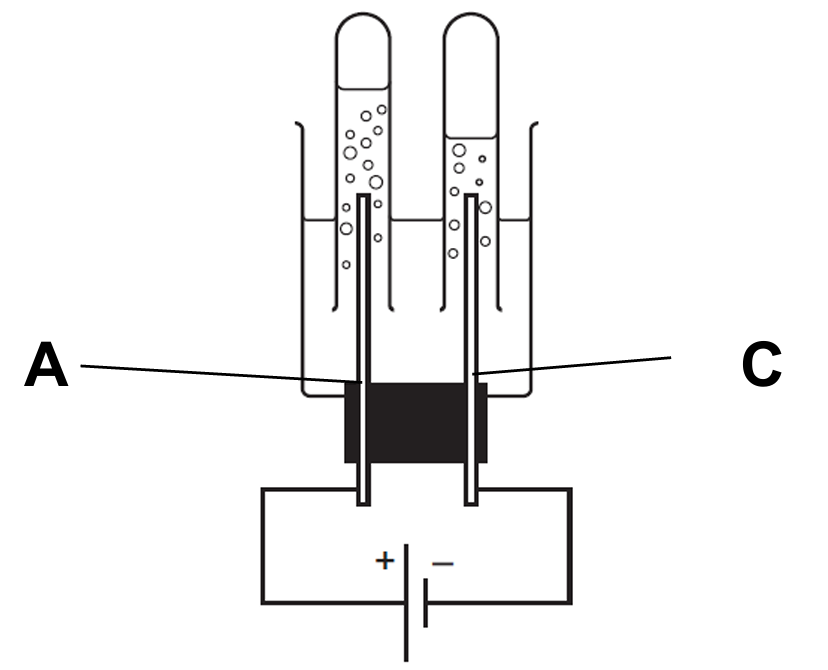
(b)(ii) Electrolyte: the dilute sulfuric acid solution
The electrolyte is the liquid that conducts electricity and undergoes electrolysis. Here it is the dilute sulfuric acid which contains ions.
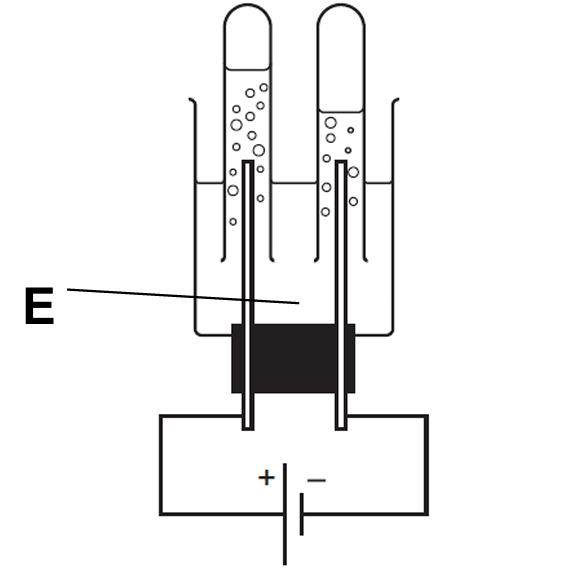
(b)(iii) anode: oxygen ; cathode: hydrogen
In the electrolysis of dilute sulfuric acid, water is decomposed. At the anode, hydroxide ions are discharged to form oxygen gas. At the cathode, hydrogen ions are discharged to form hydrogen gas.
(b)(iv) Diamond
Diamond is another giant covalent structure formed entirely of carbon atoms. In diamond, each carbon atom is bonded to four others in a rigid tetrahedral structure, making it very hard.
(c)(i) Blue litmus indicator: goes red ; Methyl orange indicator: goes red
Acids turn blue litmus paper red and turn methyl orange indicator red (or pink).
(c)(ii) pH = 1–6 (any value between 1 and 6 inclusive)
Dilute sulfuric acid is a strong acid with a pH below 7. A value between 1 and 6 is acceptable depending on the concentration.
(c)(iii) 1. salt ; 2. water
Neutralisation is the reaction between an acid and a base (alkali) to produce a salt and water only. For example: \(H_2SO_4 + 2NaOH \rightarrow Na_2SO_4 + 2H_2O\).