
CIE iGCSE Co-Ordinated Science C2.7 Metallic bonding Exam Style Questions Paper 3
Question
melting physical reacting resistance voltage
The electrolyte is made either by dissolving a compound in water or by ……………… it.
Electrolysis is an example of a ………………. change.
Each beaker contains aqueous solutions of different compounds.
All of the electrodes are inert.


Protons and electrons are electrically charged particles.
Use ideas about the charges on the particles in your answer.
Your answer should include:
- how a potassium ion is formed
- why it has a charge of +1.
Most-appropriate topic codes (Cambridge IGCSE Co-ordinated Sciences 0654):
• Topic C4.1 — Electrolysis (Parts (a), (b), (c)(i)–(iii))
• Topic C2.7 — Metallic bonding (Parts (d)(i), (d)(ii))
▶️ Answer/Explanation
(a) Bauxite
Aluminium is extracted from its ore, bauxite, using electrolysis.
Bauxite mainly contains aluminium oxide.
Electrolysis is needed because aluminium is too reactive to be extracted by reduction with carbon.
(b) current; melting; chemical
In electrolysis, an electric current passes through the electrolyte.
The electrolyte is formed either by dissolving a compound in water or by melting it.
Electrolysis involves breaking down a compound into its elements, so it is a chemical change.
(c)(i) Sodium chloride (or other correct compound)
Apparatus Q produces hydrogen gas at the cathode and chlorine gas at the anode.
This pattern of products is typical of the electrolysis of concentrated aqueous sodium chloride (brine).
Any compound that produces hydrogen and chlorine as products would also be acceptable.
(c)(ii) The liquid does not contain free ions
The ammeter reading in apparatus R is 0.0 A, showing no current flows.
This means the dissolved compound is not ionic, or the solution does not contain free-moving ions.
Without free ions, the solution cannot conduct electricity or be electrolysed.
(c)(iii) Sulfuric acid (or other correct acid)
Apparatus S produces hydrogen gas at the cathode and oxygen gas at the anode.
This is the typical result of electrolysing a dilute aqueous acid, since water is being decomposed.
Dilute sulfuric acid is a standard example that gives this pair of products.
(d)(i)
Protons carry a positive charge and electrons carry a negative charge.
In a neutral atom, the number of protons equals the number of electrons.
These equal and opposite charges cancel out, so the atom has no overall charge.
(d)(ii)
A potassium ion forms when a potassium atom loses one electron.
Before losing the electron, the atom has equal numbers of protons and electrons and is neutral.
After losing one electron, there is one more proton than electrons, giving the ion an overall charge of +1.
Question
The sentences about chlorine are either correct or incorrect.
For each sentence, write a tick (✓) if it is correct or a cross (✗) if it is incorrect.

During the reaction, a sodium atom transfers one electron to a chlorine atom.
Describe a test she can do to identify whether the solid is sodium chloride or potassium chloride.
Include the results she can expect.
Most-appropriate topic codes (Cambridge IGCSE Co-ordinated Sciences 0654):
• Topic C8.3 — Group VII properties (Parts (a)(i), (a)(ii))
• Topic C2.2 — Atomic structure and the Periodic Table (Part (b))
• Topic C2.7 — Metallic bonding (Parts (c)(i), (c)(ii))
• Topic C12.5 — Identification of ions and gases (Part (d))
▶️ Answer/Explanation
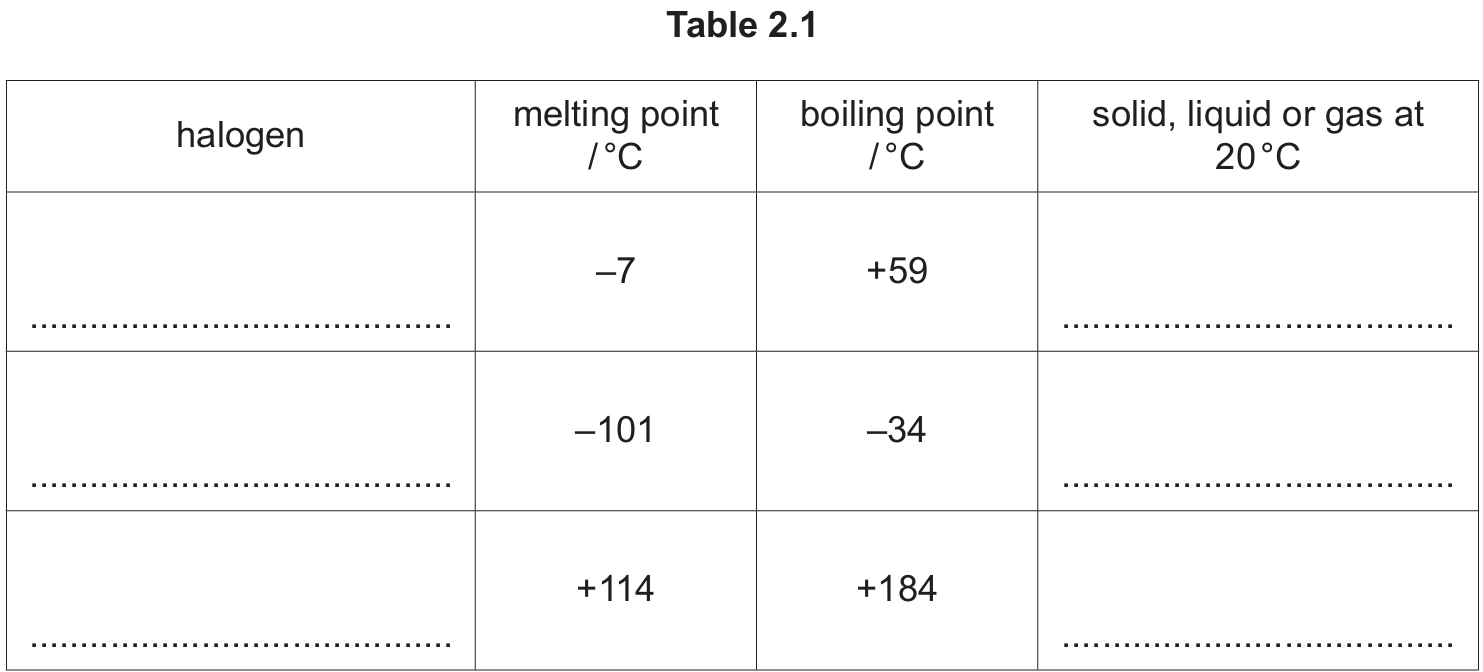
(a)(i) chlorine — gas; bromine — liquid; iodine — solid
At \( 20\,^\circ\text{C} \), a substance is a gas if this temperature is above its boiling point.
It is a liquid if \( 20\,^\circ\text{C} \) lies between the melting and boiling points.
Chlorine (b.p. \( +59\,^\circ\text{C} \)) is a gas, bromine (m.p. \( -7\,^\circ\text{C} \), b.p. \( +59\,^\circ\text{C} \)) is a liquid, and iodine (m.p. \( +114\,^\circ\text{C} \)) is a solid.
(a)(ii) Colour becomes darker going down the group.
Chlorine is a pale green/yellow-green gas.
Bromine is a red-brown liquid.
Iodine is a grey-black solid, so colour intensity increases down Group VII.
(b) ✓, ✗, ✓, ✗, ✓ (in the order given)
Protons are located in the nucleus, so statement 1 is correct.
Nucleon number \( = \) protons \( + \) neutrons \( = 17 + 18 = 35 \), not 18, so statement 2 is incorrect.
A chlorine molecule, \( \text{Cl}_2 \), contains two atoms each with 17 protons, giving \( 2 \times 17 = 34 \) protons in total, so statement 3 is correct.
Not all chlorine atoms contain 18 neutrons, since chlorine has isotopes with differing neutron numbers, so statement 4 is incorrect.
All chlorine atoms contain 17 protons, since this is what defines the element, so statement 5 is correct.
(c)(i) Ionic bonding
A sodium atom loses one electron to become a positively charged ion, \( \text{Na}^+ \).
A chlorine atom gains that electron to become a negatively charged ion, \( \text{Cl}^- \).
The bond formed by this electron transfer between a metal and a non-metal is called an ionic bond.
(c)(ii) Oppositely charged ions attract strongly.
Sodium ions, \( \text{Na}^+ \), carry a positive charge and chloride ions, \( \text{Cl}^- \), carry a negative charge.
Opposite charges attract each other by strong electrostatic forces.
This strong electrostatic attraction holds the ions tightly together in the lattice.
(d) Flame test
A sample of the solid is held in a hot Bunsen flame using a clean flame-test wire.
Sodium chloride produces a yellow flame.
Potassium chloride produces a lilac flame, allowing the two solids to be distinguished.