Home / iGCSE / Coordinated Sciences / C3.1 Formulas Paper 1 |IITIAN ACADEMY

CIE iGCSE Co-Ordinated Science C3.1 Formulas Exam Style Questions Paper 1

Question

Magnesium hydroxide contains twice as many atoms of both oxygen and hydrogen than atoms of magnesium.

What is the formula of magnesium hydroxide?

A. MgOH
B. MgO\(_2\)H\(_2\)
C. Mg(OH)\(_2\)
D. Mg\(_2\)(OH)

▶️ Answer/Explanation

Magnesium hydroxide is an ionic compound consisting of magnesium ions (\( \text{Mg}^{2+} \)) and hydroxide ions (\( \text{OH}^- \)).

To balance the charges:

  • Magnesium has a charge of \( 2+ \) (it loses two electrons to achieve a noble gas configuration).
  • The hydroxide ion has a charge of \( 1- \) (it consists of one oxygen atom and one hydrogen atom with a single negative charge).

To form a neutral compound, the total positive charge must equal the total negative charge. Therefore, two hydroxide ions (\( 2 \times 1- = 2- \)) are needed to balance one magnesium ion (\( 2+ \)).

This gives the formula \( \text{Mg(OH)}_2 \). The brackets are used to show that there are two hydroxide groups. This formula also correctly shows that there are twice as many oxygen and hydrogen atoms than magnesium atoms (1 Mg : 2 O : 2 H).

Option A (MgOH) would have equal numbers of atoms, not twice as many. Option B (MgO\(_2\)H\(_2\)) shows the correct ratio but is incorrectly written — the correct notation is \( \text{Mg(OH)}_2 \). Option D (Mg\(_2\)(OH)) has twice as many magnesium atoms.

Answer: (C)

Question

Which oxides of nitrogen have the same ratio of nitrogen atoms to oxygen atoms?

  1. \(N_2O\)
  2. \(NO\)
  3. \(NO_2\)
  4. \(N_2O_4\)

A. 1 and 2
B. 1 and 3
C. 2 and 4
D. 3 and 4

▶️ Answer/Explanation
\(NO_2\) has a nitrogen to oxygen ratio of \(1:2\).
\(N_2O_4\) simplifies to the same ratio, \(1:2\), when divided by 2.
\(N_2O\) has a ratio of \(2:1\) and \(NO\) has a ratio of \(1:1\), so neither matches.
Answer: (D)

Question

Which equation represents the reaction between aluminium and oxygen?

A. \(2Al + 3O \rightarrow Al_2O_3\)
B. \(Al_2 + 3O \rightarrow Al_2O_3\)
C. \(2Al_2 + 3O_2 \rightarrow 2Al_2O_3\)
D. \(4Al + 3O_2 \rightarrow 2Al_2O_3\)

▶️ Answer/Explanation
Oxygen gas exists as the diatomic molecule \(O_2\), so it must be written as \(O_2\), not as a single \(O\) atom.
Aluminium exists as single atoms \(Al\), not as \(Al_2\), so its formula on the reactant side must be \(Al\).
Balancing \(4Al + 3O_2 \rightarrow 2Al_2O_3\) gives equal numbers of Al (4) and O (6) atoms on both sides.
Answer: (D)

Question

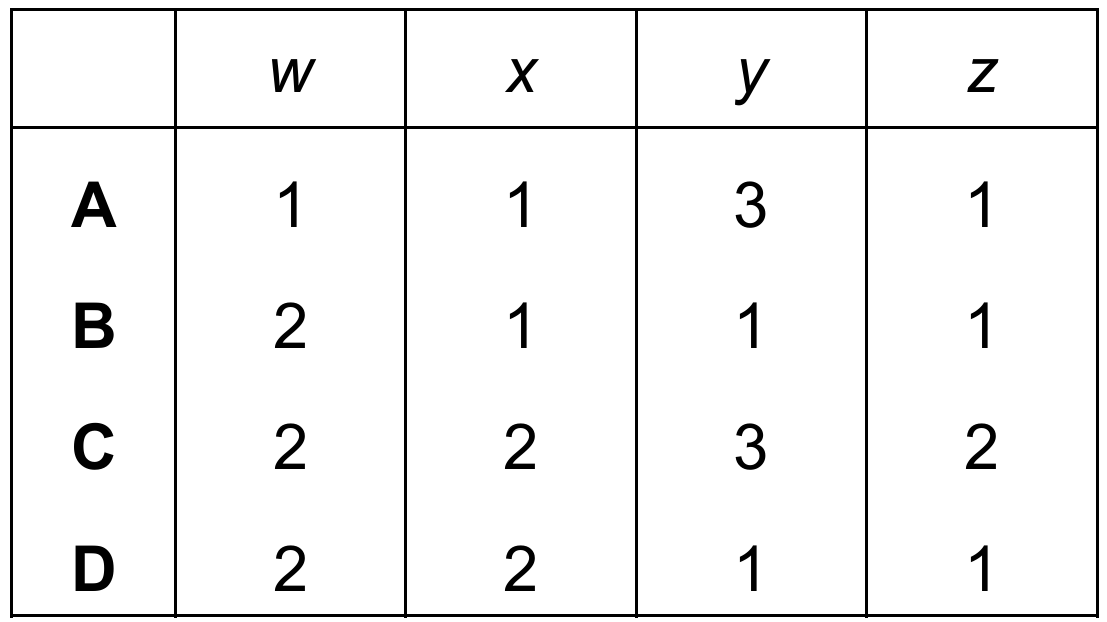
Dilute hydrochloric acid reacts with sodium carbonate to form sodium chloride, carbon dioxide and water.

The equation for the reaction is shown.

\( w\text{HCl} + \text{Na}_2\text{CO}_3 \rightarrow x\text{NaCl} + y\text{CO}_2 + z\text{H}_2\text{O} \)

What are the values of w, x, y and z?

▶️ Answer/Explanation
The balanced equation is \( 2\text{HCl} + \text{Na}_2\text{CO}_3 \rightarrow 2\text{NaCl} + \text{CO}_2 + \text{H}_2\text{O} \).
Two HCl are needed to supply the two Na atoms as NaCl, giving \(w = 2\) and \(x = 2\).
One carbon dioxide and one water are produced, so \(y = 1\) and \(z = 1\).
Answer: (D)

Question

When solid zinc carbonate is heated, a different solid and a gas are formed. Which type of change occurs?

A. chemical
B. exothermic
C. physical
D. separation

▶️ Answer/Explanation
Heating zinc carbonate produces zinc oxide, a new solid, and carbon dioxide gas: \(\text{ZnCO}_3 \rightarrow \text{ZnO} + \text{CO}_2\).
Since new substances with different chemical properties are formed, this is a chemical change (thermal decomposition), which is endothermic, not exothermic.
Answer: (A)
Scroll to Top