Home / iGCSE / Coordinated Sciences / C3.1 Formulas Paper 2

CIE iGCSE Co-Ordinated Science C3.1 Formulas Exam Style Questions Paper 2

Question

Which symbol equation is not balanced?

A. \(C_3H_8 + 5O_2 \rightarrow 3CO_2 + 4H_2O\)
B. \(Fe_3O_4 + 2H_2 \rightarrow 3Fe + 2H_2O\)
C. \(Mg(OH)_2 + 2HCl \rightarrow MgCl_2 + 2H_2O\)
D. \(2Na + 2H_2O \rightarrow 2NaOH + H_2\)

▶️ Answer/Explanation
In equation B, the left side has \(4\) oxygen atoms (from \(Fe_3O_4\)) but the right side shows only \(2\) oxygen atoms (in \(2H_2O\)).
Since \(4 \neq 2\), oxygen atoms are not conserved, so this equation is not correctly balanced.
Answer: (B)

Question

Sodium phosphate, \(Na_3PO_4\), contains sodium ions, \(Na^+\).

Aluminium sulfate, \(Al_2(SO_4)_3\), contains sulfate ions, \(SO_4^{2-}\).

What is the formula of aluminium phosphate?

A. \(AlPO_4\)
B. \(Al(PO_4)_2\)
C. \(Al_2(PO_4)_3\)
D. \(Al_3(PO_4)_2\)

▶️ Answer/Explanation
From \(Na_3PO_4\), the phosphate ion must have a charge of \(3-\), giving \(PO_4^{3-}\).
From \(Al_2(SO_4)_3\), balancing charges shows the aluminium ion is \(Al^{3+}\).
Combining \(Al^{3+}\) with \(PO_4^{3-}\) requires a 1:1 ratio, since the charges already balance, giving \(AlPO_4\).
Answer: (A)

Question

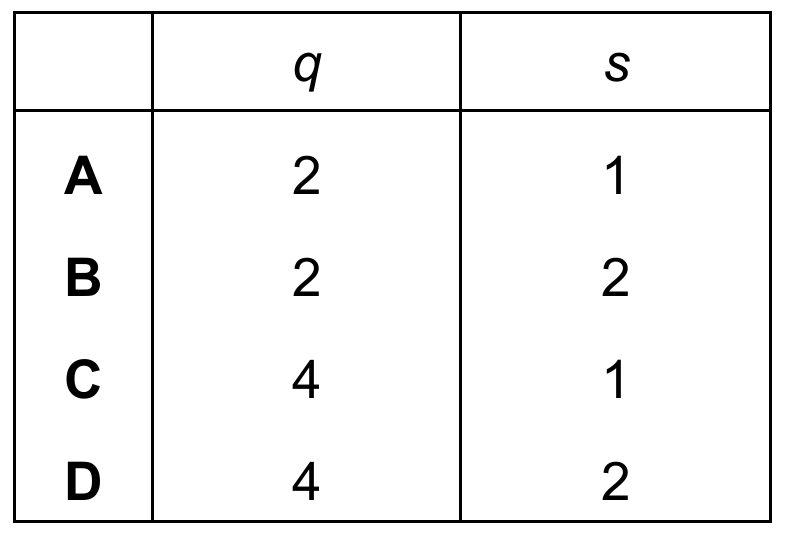
Copper reacts with dilute nitric acid to form copper(II) nitrate, nitrogen dioxide and water. The equation for the reaction is shown.

\(\mathrm{Cu(s)} + q\mathrm{HNO_3(aq)} \rightarrow \mathrm{Cu(NO_3)_2(aq)} + s\mathrm{NO_2(g)} + t\mathrm{H_2O(l)}\)

Which row shows the numerical values of \(q\) and \(s\)?

▶️ Answer/Explanation
To balance the equation: Cu is balanced (1 each). On the right, there are 2 nitrate groups in Cu(NO₃)₂ and s nitrate groups in NO₂, requiring q = s + 2 for nitrogen. For oxygen: left has 3q, right has 6 + 2s + t. For hydrogen: left has q, right has 2t, so q = 2t. Testing values, q = 4, s = 2, t = 2 balances the equation: Cu + 4HNO₃ → Cu(NO₃)₂ + 2NO₂ + 2H₂O.
Answer: (D)

Question

The equation for the reaction of sodium with water is shown.

                       2Na(s) + 2H2O(l)  → 2NaOH(aq) + H2(g)

Which mass of sodium produces 30 cm3 of hydrogen?

(A) 0.0288 g             (B) 0.0575 g            (C) 28.8 g               (D) 57.5 g

▶️Answer/Explanation

Ans: B

Question

The equation for the combustion of magnesium is shown.

                                 2Mg + O2 → MgO

What is the mass of magnesium oxide formed from 12 g of magnesium?
(A) 20g              (B) 24g                    (C) 40g                  (D) 80g

▶️Answer/Explanation

Ans : BA

Scroll to Top