
CIE iGCSE Co-Ordinated Science C3.2 Relative masses of atoms and molecules Exam Style Questions Paper 3
Question
Most-appropriate topic codes (Cambridge IGCSE Coordinated Sciences 0654):
• Topic C11.4 — Alkanes (Part (a))
• Topic C11.2 — Naming organic compounds (Part (b))
• Topic C3.2 — Relative masses of atoms and molecules (Part (c))
• Topic C10.1 — Water (Part (d)(i))
• Topic C10.1 — Water (Part (d)(ii))
• Topic C10.2 — Air quality and climate (Part (d)(iii))
▶️ Answer/Explanation
(a) single and double
Alkanes have only single C-C bonds, so they are saturated (cannot add more atoms). Alkenes have at least one C=C double bond, making them unsaturated and able to undergo addition reactions.
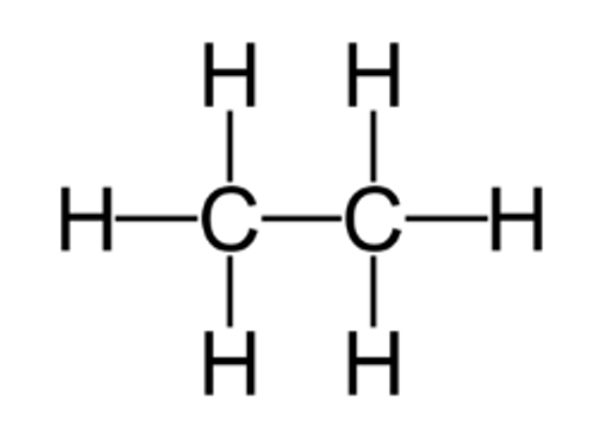
(b) Displayed formula of ethane with C-C single bond and all C-H bonds correct
Ethane (C₂H₆) has two carbon atoms joined by a single bond, with each carbon bonded to three hydrogen atoms. The displayed formula shows all atoms and bonds.
(c) 24 + 6 or 2 × 12 + 6 × 1; 30
Mᵣ of C₂H₆ = (2 × 12) + (6 × 1) = 24 + 6 = 30. Relative molecular mass is the sum of the relative atomic masses of all atoms in the molecule.
(d)(i) blue; (to) pink
Anhydrous cobalt(II) chloride is blue. When water is present, it turns pink as it forms hydrated cobalt(II) chloride. This is a positive test for water.
(d)(ii) pure water boils at 100°C; impurities increase boiling point
Pure water has a boiling point of 100°C at standard atmospheric pressure. The observed boiling point of 102°C is higher than 100°C, indicating the presence of impurities that elevate the boiling point.
(d)(iii) planting trees / planting plants; CO₂ removed by trees / CO₂ removed by plants
OR decreasing use of fossil fuels; less CO₂ produced (during combustion)
OR increasing use of renewables; no CO₂ produced
Plants absorb CO₂ during photosynthesis, reducing atmospheric CO₂. Reducing fossil fuel use decreases CO₂ emissions at source.
Question
Most-appropriate topic codes (Cambridge IGCSE Co-ordinated Sciences 0654):
• Topic C11.4 — Alkanes (Part (a)(i), (a)(ii), (a)(iii) & (a)(iv))
• Topic C3.2 — Relative masses of atoms and molecules (Part (b))
• Topic C2.3 — Covalent bonding (Part (c))
• Topic C9.1 — Fossil fuels (Part (d))
• Topic C2.1 — Elements, compounds and mixtures (Part (e))
▶️ Answer/Explanation
(a)(i)
methane + oxygen $\rightarrow$ carbon dioxide + water
Complete combustion requires a plentiful supply of oxygen and converts all the carbon in the hydrocarbon to carbon dioxide and all the hydrogen to water. The balanced symbol equation is $\text{CH}_4 + 2\text{O}_2 \rightarrow \text{CO}_2 + 2\text{H}_2\text{O}$, confirming a 1:2 molar ratio of methane to oxygen.
(a)(ii)
carbon monoxide (also accept: carbon / soot)
Incomplete combustion occurs when the oxygen supply is limited, preventing full oxidation of the carbon atoms. Carbon monoxide ($\text{CO}$) is a colourless, odourless, and highly toxic gas produced as a result, making it a serious health hazard in poorly ventilated spaces such as rooms with gas appliances.
(a)(iii)
Methane contains only single covalent bonds between carbon and hydrogen atoms; there are no carbon-carbon double or triple bonds.
A saturated hydrocarbon is one in which every carbon atom forms the maximum number of single bonds with other atoms, leaving no possibility for addition reactions. Because methane has only one carbon atom bonded to four hydrogen atoms by single bonds, it meets the definition of a saturated compound.
(a)(iv)
orange / brown to colourless
Bromine water is orange-brown in colour due to dissolved bromine molecules. When mixed with an unsaturated hydrocarbon, bromine adds across the carbon-carbon double bond in an addition reaction, consuming the bromine and removing its colour. A saturated hydrocarbon would leave the orange colour unchanged since it cannot undergo this reaction.
(b)
$M_r = A_r(\text{C}) + 4 \times A_r(\text{H})$
$M_r = 12 + (4 \times 1)$
$\boxed{M_r = 16}$
Relative molecular mass is found by adding together the relative atomic masses of all atoms present in one molecule. Methane contains one carbon atom ($A_r = 12$) and four hydrogen atoms ($A_r = 1$ each), giving a total of 16.
(c)
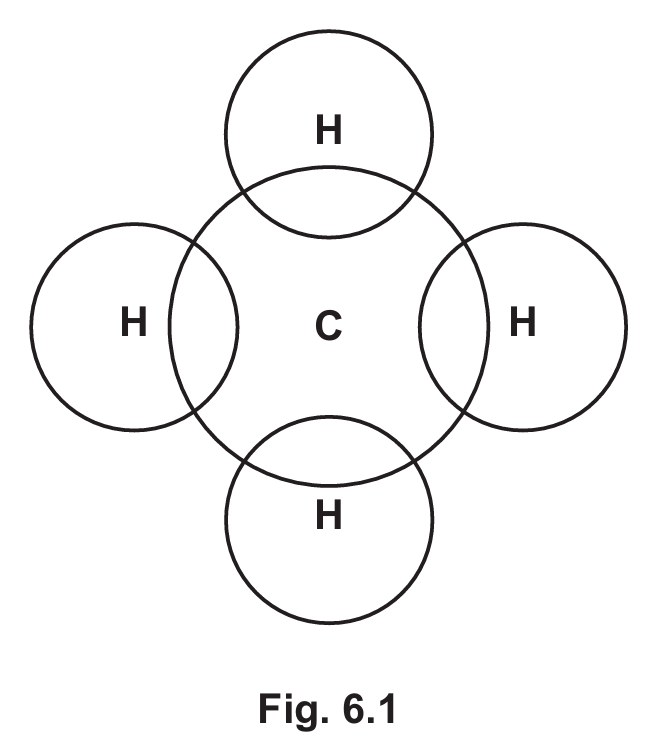
The completed diagram shows the carbon atom at the centre with four pairs of shared electrons, one pair bonded to each of the four surrounding hydrogen atoms. Each hydrogen contributes one electron (shown as a cross) and carbon contributes one electron (shown as a dot) to each shared pair. All four bonds are single covalent bonds, giving carbon a full outer shell of 8 electrons and each hydrogen a full shell of 2 electrons.
(d)
coal (also accept: crude oil / petroleum)
Fossil fuels are non-renewable energy sources formed over millions of years from the remains of ancient organisms buried under heat and pressure. Coal, crude oil, and natural gas are the three main fossil fuels; burning them releases carbon dioxide, contributing to the greenhouse effect and global warming.
(e)
Carbon is an element because it contains only one type of atom.
Methane is a compound because it contains two or more different types of atoms that are chemically combined.
An element cannot be broken down into simpler substances by chemical means, whereas a compound can be decomposed into its constituent elements. Methane contains carbon and hydrogen atoms bonded together in a fixed ratio of $1:4$, which is characteristic of a pure compound.