
CIE iGCSE Co-Ordinated Science C3.3 The mole and the Avogadro constant Exam Style Questions Paper 3
Question

State the term used to describe a chemical reaction that releases thermal energy.


Describe one difference and one similarity in the observations made.
There is no reaction between the hydrochloric acid and copper.
Copper(II) oxide reacts and dissolves in the acid.
Most-appropriate topic codes (Cambridge IGCSE Co-ordinated Sciences 0654):
• Topic C5.1 — Exothermic and endothermic reactions (Part (a)(i))
• Topic C3.3 — The mole and the Avogadro constant (Part (a)(ii))
• Topic C9.1 — Properties of metals (Part (b))
• Topic C9.4 — Reactivity series (Parts (c) and (d))
• Topic C9.5 — Corrosion of metals (Part (e))
▶️ Answer/Explanation
(a)(i) Exothermic
An exothermic reaction releases thermal energy to the surroundings.
The surrounding temperature rises as a result.
The formation of magnesium oxide from magnesium and oxygen releases heat, so it is exothermic.
(a)(ii) \(2Mg + O_2 \rightarrow 2MgO\)
Two magnesium atoms react with one oxygen molecule (\(O_2\)) to give two formula units of magnesium oxide.
Balancing ensures the number of Mg and O atoms is equal on both sides.
This satisfies the law of conservation of mass.
(b) Magnesium is malleable and is a good conductor of electricity
Malleability means the metal can be hammered or shaped without breaking.
Good electrical conductivity means it allows current to flow through it easily.
Other correct properties include high melting point and good thermal conductivity.
(c)(i) Difference: gas is released with magnesium but not with magnesium oxide. Similarity: both solids react and dissolve to form a soluble product
Magnesium reacts with hydrochloric acid to produce hydrogen gas, seen as bubbling/fizzing.
Magnesium oxide reacts without producing any gas.
In both cases the solid disappears as it dissolves, forming a colourless solution.
(c)(ii) Magnesium chloride, \(MgCl_2\)
Magnesium reacting with hydrochloric acid forms magnesium chloride and hydrogen gas.
Magnesium oxide reacting with hydrochloric acid forms magnesium chloride and water.
Magnesium chloride is therefore the common product in both reactions.
(d)(i) Copper is less reactive than hydrogen
In the reactivity series, copper lies below hydrogen.
A metal must be more reactive than hydrogen to displace it from an acid.
Since copper cannot do this, no reaction occurs.
(d)(ii) Coloured
Copper(II) oxide reacts with hydrochloric acid to form copper(II) chloride solution.
Copper is a transition metal, and its compounds/ions in solution are typically coloured.
The resulting solution is blue/green rather than colourless.
(e)(i) Water (or water vapour)
Rusting of iron requires both oxygen and water to be present.
If either is absent, rusting cannot take place.
This is why dry conditions or oxygen-free conditions prevent rusting.
(e)(ii) Paint
Paint forms a barrier layer over the surface of the iron.
This barrier keeps oxygen and water away from the metal.
Other acceptable answers include grease, oil, or plastic coating.
(e)(iii) Making it into an alloy, such as stainless steel
Alloying iron with elements such as chromium and nickel produces stainless steel.
This method protects the metal without needing an external barrier.
Sacrificial protection (e.g. galvanising with zinc) is another acceptable non-barrier method.
Question


- the chemical symbols of the elements
- all of the outer shell electrons

- types of bonding
- boiling points
Calculate the concentration of potassium chloride, in \( \text{g}/\text{dm}^3 \), in this aqueous solution.
Describe a test that she can use to show whether or not the water in the beaker contains any chloride ions.
Most-appropriate topic codes (Cambridge IGCSE Co-ordinated Sciences 0654):
• Topic C10.1 — Water (Part (a))
• Topic C3.3 — The mole and the Avogadro constant (Parts (b)(i), (b)(ii), (d)(ii))
• Topic C2.5 — Simple molecules and covalent bonds (Part (c))
• Topic C12.4 — Separation and purification (Part (d)(i))
• Topic C12.5 — Identification of ions and gases (Part (d)(iii))
▶️ Answer/Explanation
(a) Test: anhydrous copper(II) sulfate. Result: turns from white to blue.
A small amount of the liquid is added to white anhydrous copper(II) sulfate.
If the liquid is water, the white solid turns blue.
(Anhydrous cobalt(II) chloride, turning from blue to pink, is an accepted alternative test.)
(b)(i) The atoms are not balanced on both sides of the equation.
The left-hand side, \( \text{H}_2 + \text{O}_2 \), has 2 oxygen atoms.
The right-hand side, \( \text{H}_2\text{O} \), has only 1 oxygen atom.
Since the number of oxygen atoms differs, the equation is not balanced.
(b)(ii) \( 2\text{H}_2 + \text{O}_2 \rightarrow 2\text{H}_2\text{O} \)
Placing a coefficient of 2 in front of both \( \text{H}_2 \) and \( \text{H}_2\text{O} \) gives 4 hydrogen atoms and 2 oxygen atoms on each side.
The equation is now balanced.
(c) Dot-and-cross diagram of \( \text{H}_2\text{O} \)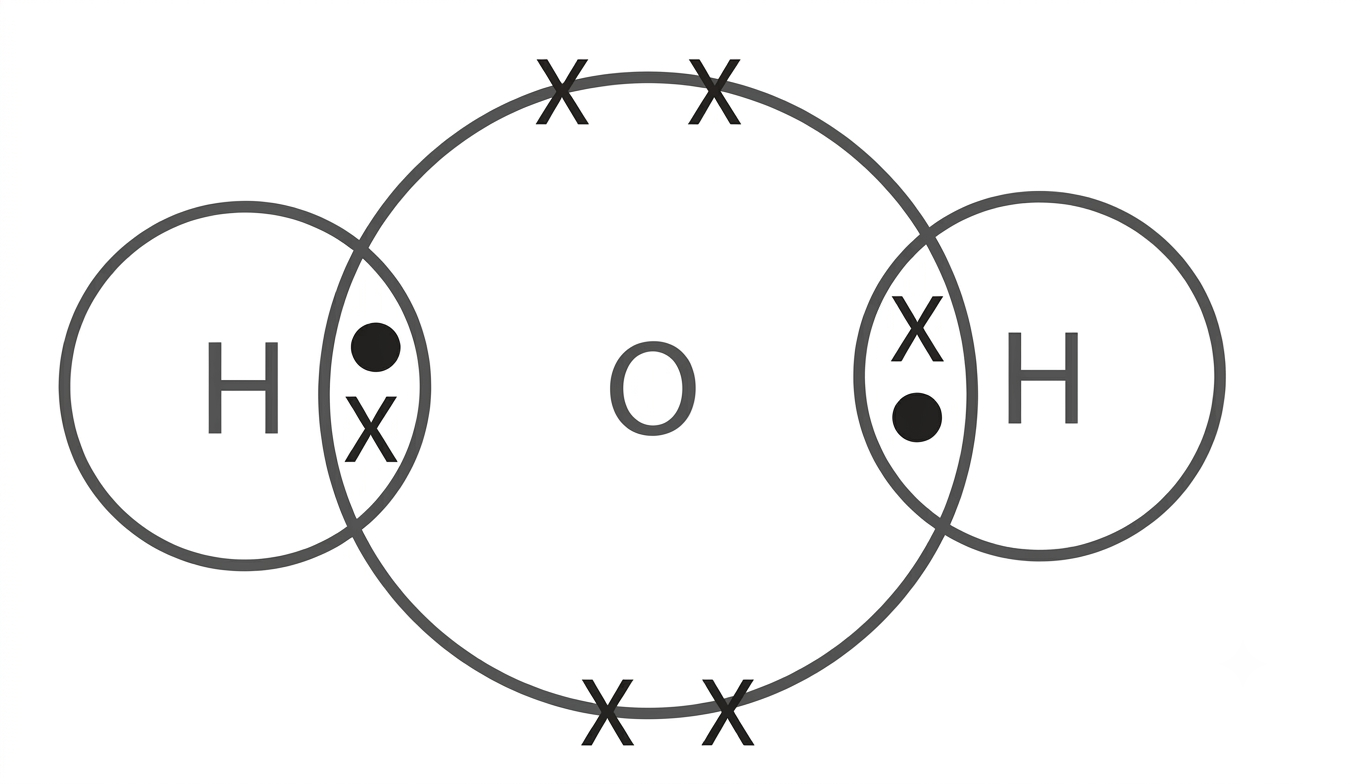
Each hydrogen atom shares its single electron with one of the oxygen atom’s outer-shell electrons, forming a covalent bond.
The oxygen atom keeps its two remaining outer-shell electron pairs as lone pairs.
This gives oxygen a full outer shell of 8 electrons and each hydrogen atom a full outer shell of 2 electrons.
(d)(i) Water has a low boiling point; potassium chloride does not boil at this temperature.
Water is a simple covalent (molecular) compound with weak intermolecular forces, giving it a low boiling point of \( 100\,^\circ\text{C} \).
Potassium chloride is an ionic compound with a giant ionic lattice, held together by strong electrostatic forces, giving it a very high boiling point.
On heating, water boils off and is collected as distillate, while potassium chloride remains behind as a solid in the flask.
(d)(ii) \( 25\,\text{g}/\text{dm}^3 \)
Concentration \( = \dfrac{\text{mass}}{\text{volume}} \times 1000 \).
Concentration \( = \dfrac{2.5}{100} \times 1000 = 25\,\text{g}/\text{dm}^3 \).
(d)(iii) Test: add acidified silver nitrate solution. Result: white precipitate forms if chloride ions are present.
Dilute nitric acid is added to acidify the water sample.
Aqueous silver nitrate is then added.
A white precipitate (of silver chloride) forming confirms the presence of chloride ions.