
CIE iGCSE Co-Ordinated Science C3.3 The mole and the Avogadro constant Exam Style Questions Paper 4
Question
Most-appropriate topic codes (Cambridge IGCSE Co-ordinated Sciences 0654):
• Topic C12.5 — Qualitative analysis (Part (a))
• Topic C6.2 — Rate of reaction (Part (b)(i), (b)(ii), (c))
• Topic C3.3 — The mole and the Avogadro constant (Part (b)(iii))
▶️ Answer/Explanation
(a) Test: Bubble the gas through / pass the gas into limewater.
Observation: The limewater turns milky / forms a white precipitate.
Carbon dioxide gas is commonly tested for by bubbling it through limewater (aqueous calcium hydroxide solution). When carbon dioxide reacts with limewater, it forms insoluble calcium carbonate, which appears as a white precipitate, making the solution turn milky or cloudy. The chemical equation is: \( \text{Ca(OH)}_2(\text{aq}) + \text{CO}_2(\text{g}) \rightarrow \text{CaCO}_3(\text{s}) + \text{H}_2\text{O}(\text{l}) \).
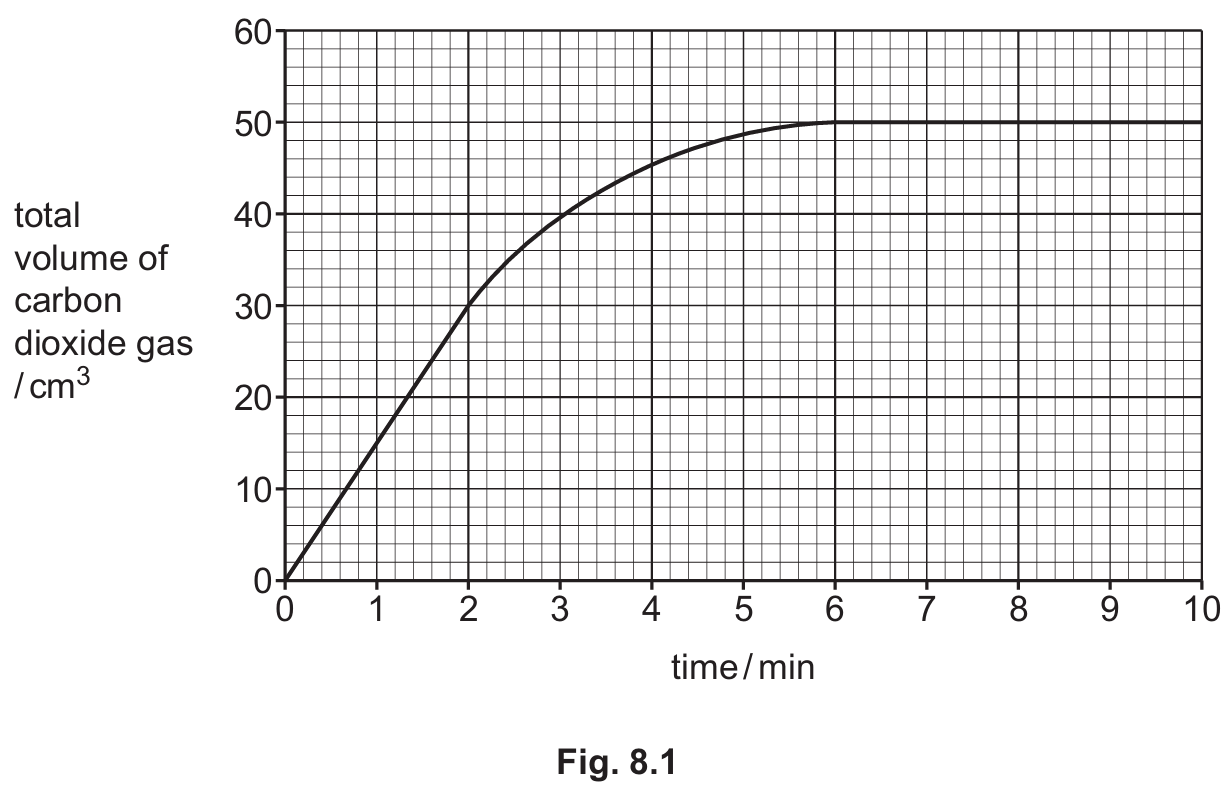
(b)(i) Any value in the inclusive range 5.6–6 minutes.
The reaction stops when no more carbon dioxide is produced. On the graph, this is when the curve becomes horizontal (plateaus). Looking at Fig. 8.1, the volume of gas stops increasing between approximately 5.6 and 6 minutes, so any value in this range is acceptable. At this point, at least one of the reactants (the acid or the calcium carbonate) has been completely used up.
(b)(ii) Average rate = 30 ÷ 2 = 15 cm³/minute.
Average rate of reaction is calculated using:
\( \text{Average rate} = \frac{\text{Total volume of gas produced}}{\text{Time taken}} \)
From the graph, at 0 minutes the volume is 0 cm³ and at 2 minutes the volume is 30 cm³. Therefore:
\( \text{Average rate} = \frac{30 – 0}{2 – 0} = \frac{30}{2} = 15 \text{ cm}^3/\text{minute} \)
(b)(iii) Moles = volume ÷ 24 = 0.050 ÷ 24 = 0.0021 mol.
To calculate the amount in moles, use the relationship:
\( \text{Moles} = \frac{\text{Volume (dm}^3\text{)}}{24} \)
First, convert 50 cm³ to dm³: 50 cm³ = 50 ÷ 1000 = 0.050 dm³.
Then: \( \text{Moles of CO}_2 = \frac{0.050}{24} = 0.002083… \approx 0.0021 \text{ mol (to 2 significant figures)} \).
(c) When the concentration of acid is increased, there are more particles per unit volume / more acid particles in the same volume. This leads to a higher frequency of collisions between the acid particles and the calcium carbonate particles, so the rate of reaction increases.
Collision theory states that for a reaction to occur, particles must collide with sufficient energy (activation energy) and in the correct orientation. When the concentration of hydrochloric acid is increased, there are more HCl particles in the same volume of solution. This means the particles are closer together, leading to:
- A greater number of particles per unit volume.
- A higher frequency of collisions between the acid particles and the calcium carbonate surface.
- More successful collisions that result in a reaction, therefore increasing the rate of reaction.
Question
Most-appropriate topic codes (Cambridge IGCSE Co-ordinated Sciences 0654):
• Topic C11.3 — Fuels
• Topic C11.4 — Alkanes
• Topic C11.5 — Alkenes
• Topic C3.3 — The mole and Avogadro constant
▶️ Answer/Explanation
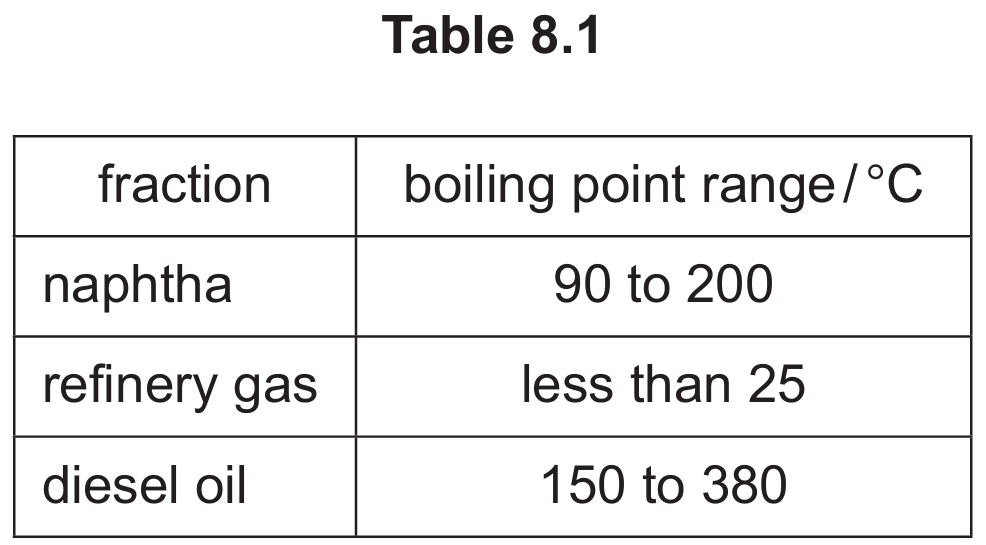
(a) refinery gas
In fractional distillation, the fraction with the lowest boiling point condenses at the top of the column where it is coolest. Refinery gas has the lowest boiling point range (< 25°C).
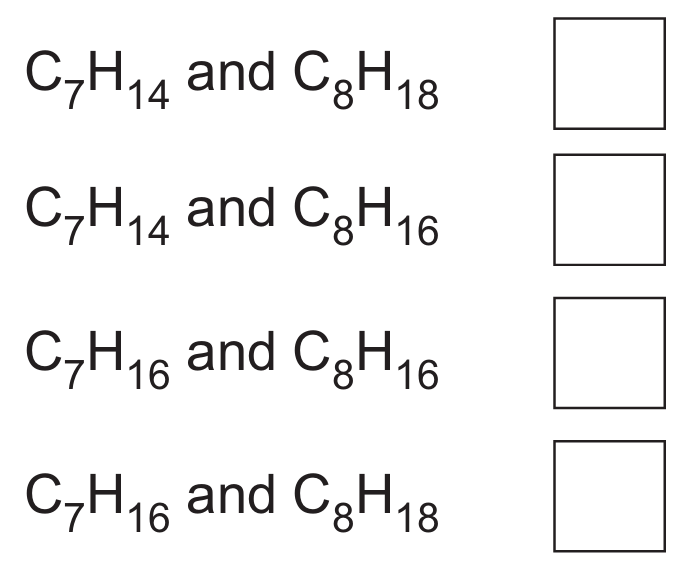
(b) C₇H₁₄ and C₈H₁₆
Alkenes are unsaturated hydrocarbons containing a C=C double bond. They turn aqueous bromine colourless through addition reactions. C₇H₁₄ and C₈H₁₆ have the general formula CₙH₂ₙ, characteristic of alkenes.
(c)(i) single ; saturated
Alkanes contain only single C–C bonds, making them saturated hydrocarbons. This means they can hold the maximum number of hydrogen atoms.
(c)(ii) 10,800 dm³
Molar mass of C₉H₂₀ = (9 × 12) + (20 × 1) = 128 g/mol
Moles of C₉H₂₀ = 6400 ÷ 128 = 50 mol
From the equation, 1 mol C₉H₂₀ produces 9 mol CO₂
Moles of CO₂ = 50 × 9 = 450 mol
Volume of CO₂ = 450 × 24 = 10,800 dm³
(d)
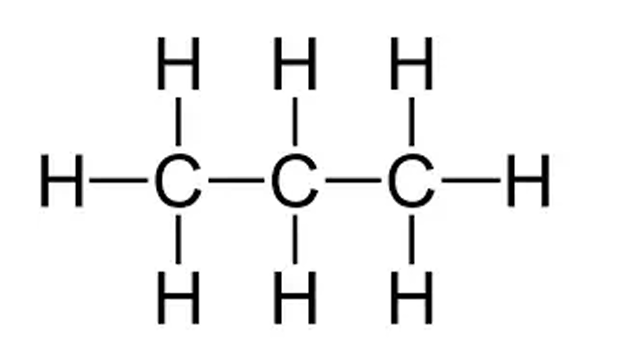
Propane has three carbon atoms connected by single bonds, with each carbon bonded to enough hydrogen atoms to complete its valence of four. Each line represents a covalent bond.