CIE iGCSE Co-Ordinated Science C4.1 Electrolysis Exam Style Questions Paper 2
Question
Which gas is formed at the cathode during electrolysis?
A. carbon dioxide
B. chlorine
C. hydrogen
D. oxygen
▶️ Answer/Explanation
✅ Answer: (C)
Question
Concentrated aqueous sodium chloride is electrolysed using inert electrodes.
What is the ionic half-equation for the reaction at the cathode?
A. \( 2\mathrm{Cl}^- \rightarrow \mathrm{Cl}_2 + 2e^- \)
B. \( 2\mathrm{H}^+ + 2e^- \rightarrow \mathrm{H}_2 \)
C. \( \mathrm{Na}^+ + e^- \rightarrow \mathrm{Na} \)
D. \( \mathrm{NaCl} \rightarrow \mathrm{Na}^+ + \mathrm{Cl}^- \)
▶️ Answer/Explanation
✅ Answer: (B)
Question
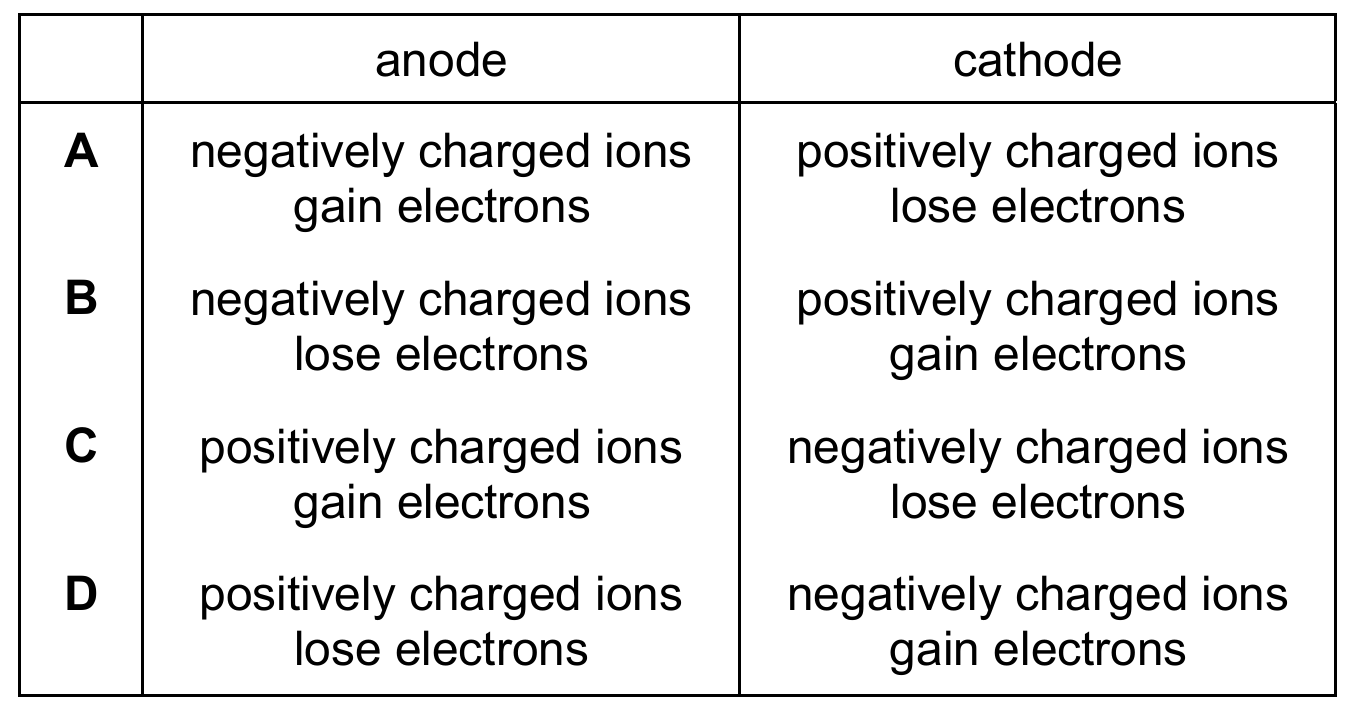
Which changes take place at the electrodes during electrolysis?

▶️ Answer/Explanation
✅ Answer: (B)
Question
Which statement describes what happens during electrolysis?
A. Covalent compounds produce more complex substances.
B. Covalent compounds produce simpler substances.
C. Ionic compounds produce more complex substances.
D. Ionic compounds produce simpler substances.
▶️ Answer/Explanation
Covalent compounds generally do not conduct electricity and cannot be electrolysed; only ionic compounds undergo electrolysis, and the products are always simpler than the starting compound.
✅ Answer: (D)
Question
During electrolysis, reactions occur at the cathode and anode. Which statements about the electrode reactions are correct?
- At the anode, anions gain electrons and are reduced.
- At the anode, anions lose electrons and are oxidised.
- At the cathode, cations gain electrons and are reduced.
- At the cathode, cations lose electrons and are oxidised.
A. 1 and 2
B. 1 and 4
C. 2 and 3
D. 3 and 4
▶️ Answer/Explanation
✅ Answer: (C)
