
CIE iGCSE Co-Ordinated Science C4.1 Electrolysis Exam Style Questions Paper 4
Question
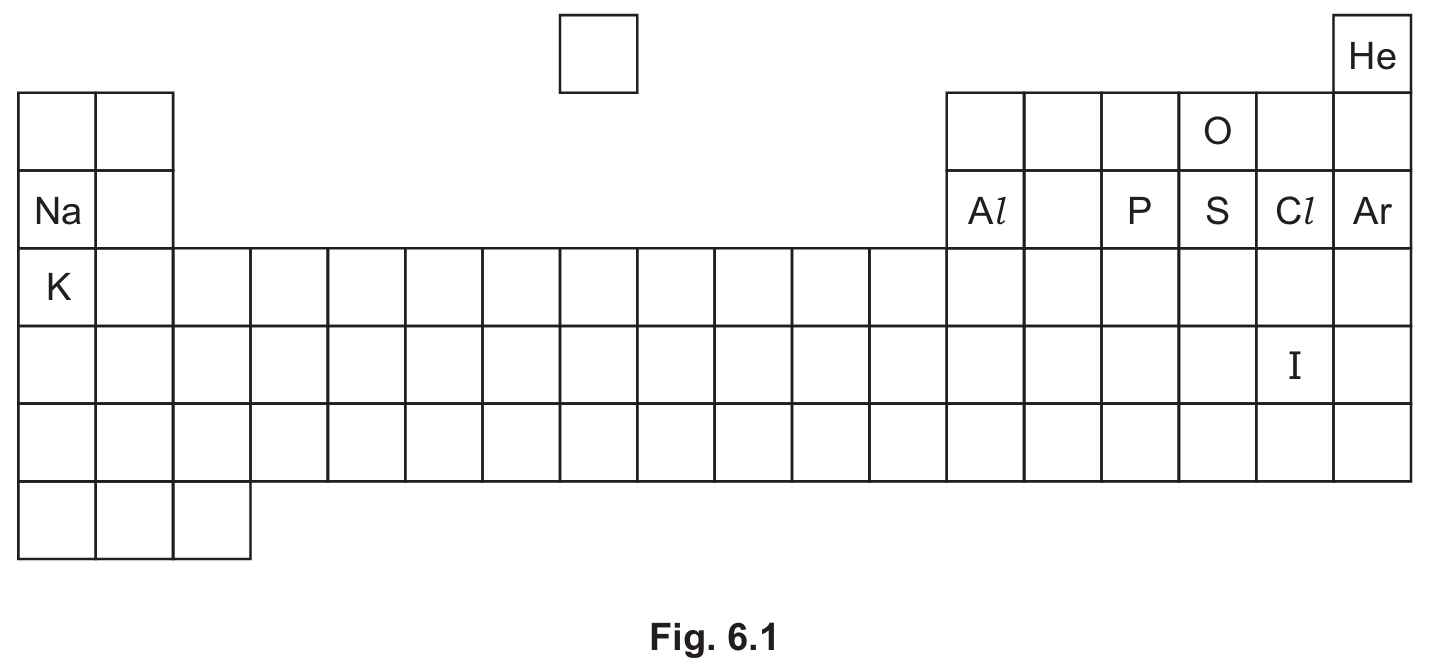
Most-appropriate topic codes (Cambridge IGCSE Co-ordinated Sciences 0654):
• Topic C2.2 — Atomic structure and the Periodic Table (Part (a)(i), (a)(ii), (a)(iii), (c)(i), (c)(ii))
• Topic C2.4 — Ions and ionic bonds (Part (b))
• Topic C2.6 — Giant covalent structures (Part (c)(iii))
• Topic C4.1 — Electrolysis (Part (c)(iv))
▶️ Answer/Explanation
(a)(i) Ar (argon).
Argon (Ar) is a noble gas with the electronic configuration 2,8,8. It has 8 electrons in its outer shell (a full outer shell), making it chemically stable and unreactive.
(a)(ii) Na, K, or Al (sodium, potassium, or aluminium).
Sodium (Na), potassium (K), and aluminium (Al) are metals. Metals tend to lose electrons from their outer shells to form positive ions (cations). Sodium loses 1 electron to form Na+, potassium loses 1 to form K+, and aluminium loses 3 to form Al3+.
(a)(iii) Al (aluminium).
The electronic configuration 2,8,3 means there are 13 electrons in total. The element with 13 electrons is aluminium (Al), which has the atomic number 13.
(b)
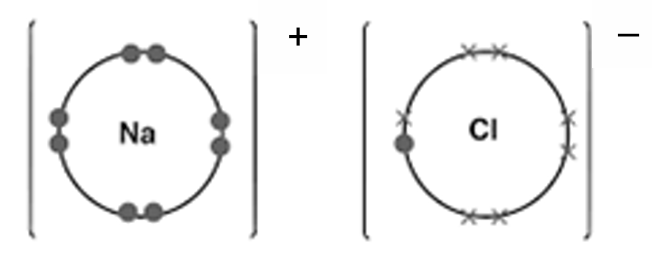
Sodium chloride is an ionic compound. Sodium (Na) has 1 electron in its outer shell and chlorine (Cl) has 7 electrons in its outer shell. Sodium transfers its single outer electron to chlorine. Sodium becomes a positive ion (Na+) with a full outer shell (2,8), and chlorine becomes a negative ion (Cl−) with a full outer shell (2,8,8). The dot-and-cross diagram shows the electron transfer with crosses representing sodium’s electron and dots representing chlorine’s electrons.
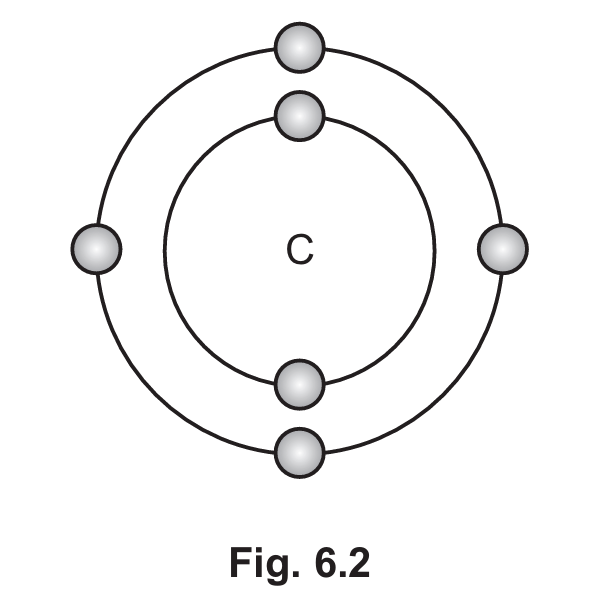
(c)(i) Carbon has 2 occupied electron shells.
The period number of an element in the Periodic Table corresponds to the number of occupied electron shells. Fig. 6.2 shows a carbon atom with 2 electron shells (the inner shell and the outer shell). Therefore, carbon is in Period 2.
(c)(ii) Both isotopes have the same electronic configuration.
Isotopes are atoms of the same element with the same number of protons but different numbers of neutrons. Carbon-12 has 6 protons and 6 neutrons, while carbon-13 has 6 protons and 7 neutrons. Chemical properties are determined by the number and arrangement of electrons in the atom. Since both isotopes have the same number of electrons (6) and the same electronic configuration (2,4), they have identical chemical properties.
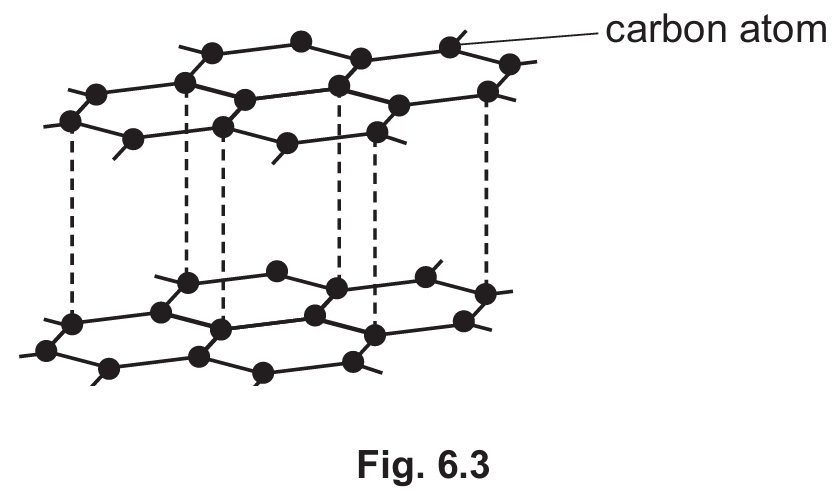
(c)(iii) Graphite has electrons that can move.
Graphite has a giant covalent structure where each carbon atom is bonded to three other carbon atoms in a hexagonal ring structure. This leaves one delocalised electron per carbon atom that is not used in bonding. These delocalised electrons are free to move throughout the structure, allowing graphite to conduct electricity.
(c)(iv) Anode: oxygen.
Cathode: copper.
During the electrolysis of aqueous copper(II) sulfate using graphite (inert) electrodes:
• At the anode (positive electrode), hydroxide ions (OH−) from the water are discharged. They lose electrons and form oxygen gas: 4OH− → O2 + 2H2O + 4e−.
• At the cathode (negative electrode), copper(II) ions (Cu2+) are discharged. They gain electrons and form copper metal: Cu2+ + 2e− → Cu.
Question
Most-appropriate topic codes (Cambridge IGCSE Co-ordinated Sciences 0654):
• Topic C3.1 — Formulas (Part (a))
• Topic C4.1 — Electrolysis (Part (b), (c))
• Topic C9.4 — Reactivity series (Part (d))
• Topic C9.3 — Alloys and their properties (Part (e))
▶️ Answer/Explanation
(a) Formula of sodium sulfate = Na₂SO₄
Two Na⁺ ions (each +1) balance one SO₄²⁻ ion (-2).
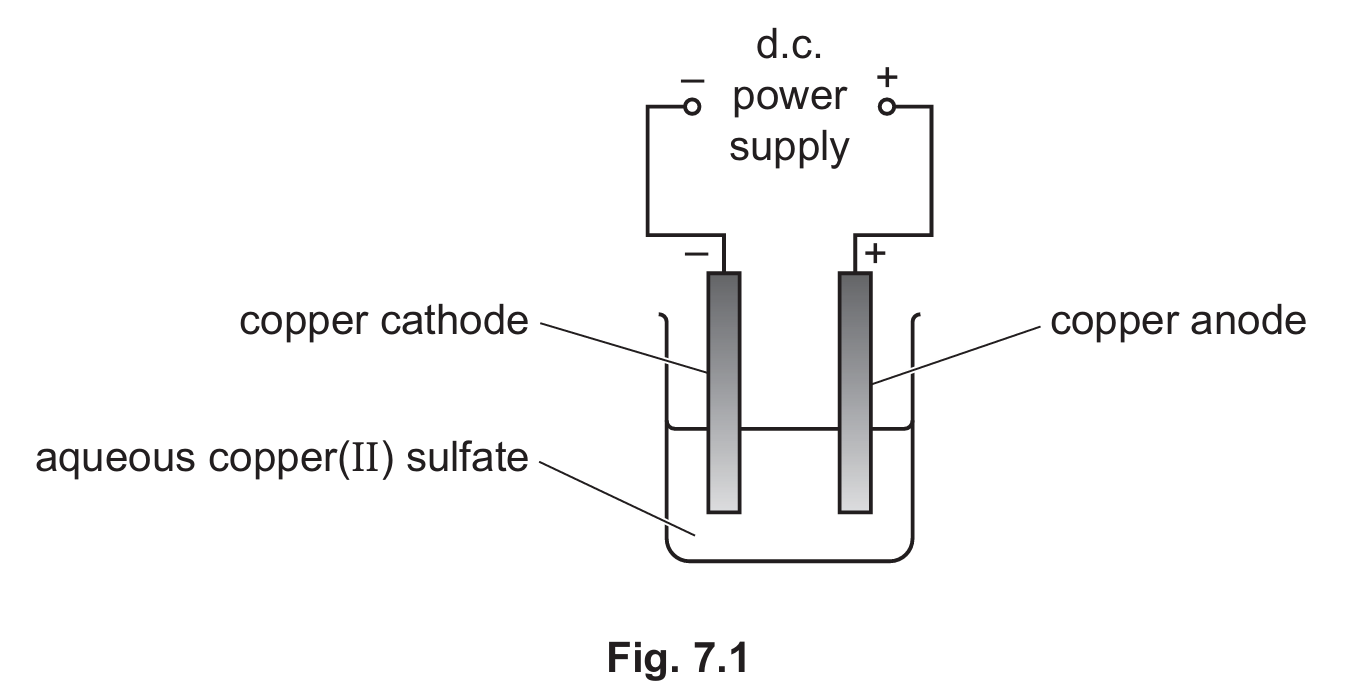
(b) Observation at the anode:
The copper anode dissolves/gets smaller. Cu atoms at the anode lose electrons to form Cu²⁺ ions, which go into the solution: Cu → Cu²⁺ + 2e⁻.
(c)(i) Ionic half-equation: Cu²⁺ + 2e⁻ → Cu
Copper ions gain two electrons to form copper atoms.
(c)(ii) The reaction at the anode is oxidation.
Oxidation is the loss of electrons. At the anode, copper atoms lose electrons to form Cu²⁺ ions.
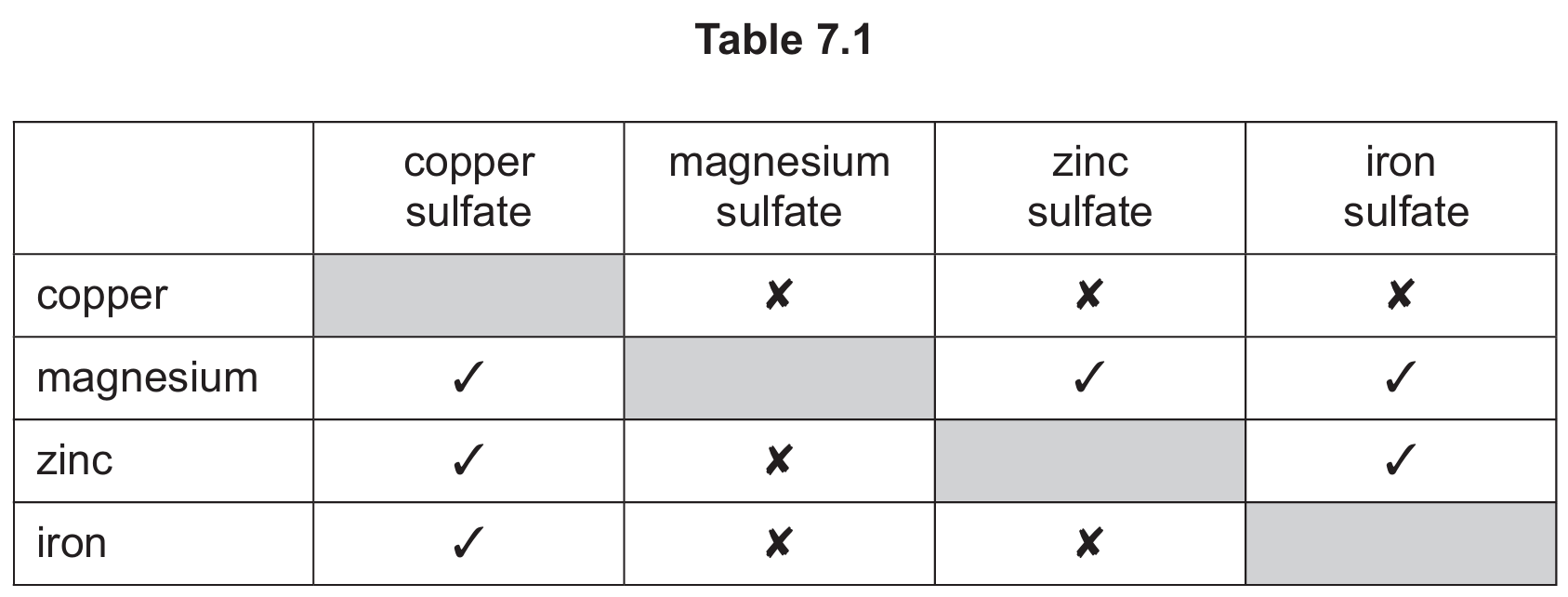
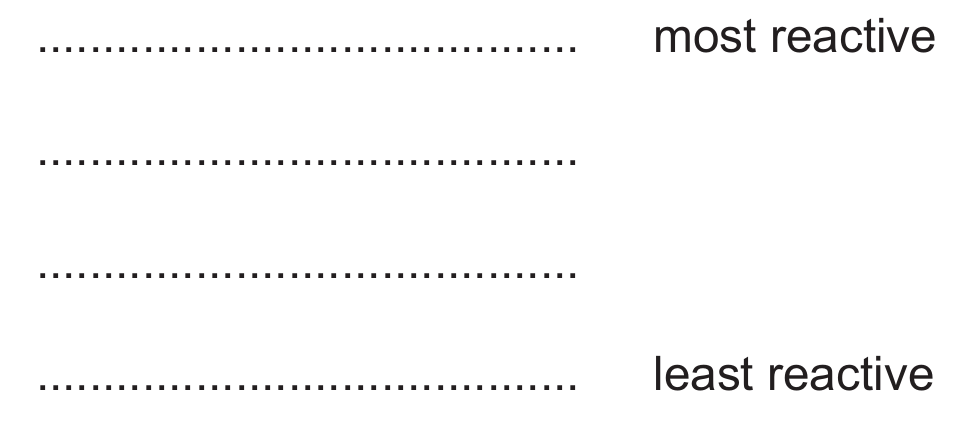
(d)(i) Order of reactivity:
Most reactive → Least reactive: magnesium > zinc > iron > copper
(d)(ii) Balanced equation: Mg + ZnSO₄ → Zn + MgSO₄
Magnesium is more reactive than zinc, so it displaces zinc from zinc sulfate solution.
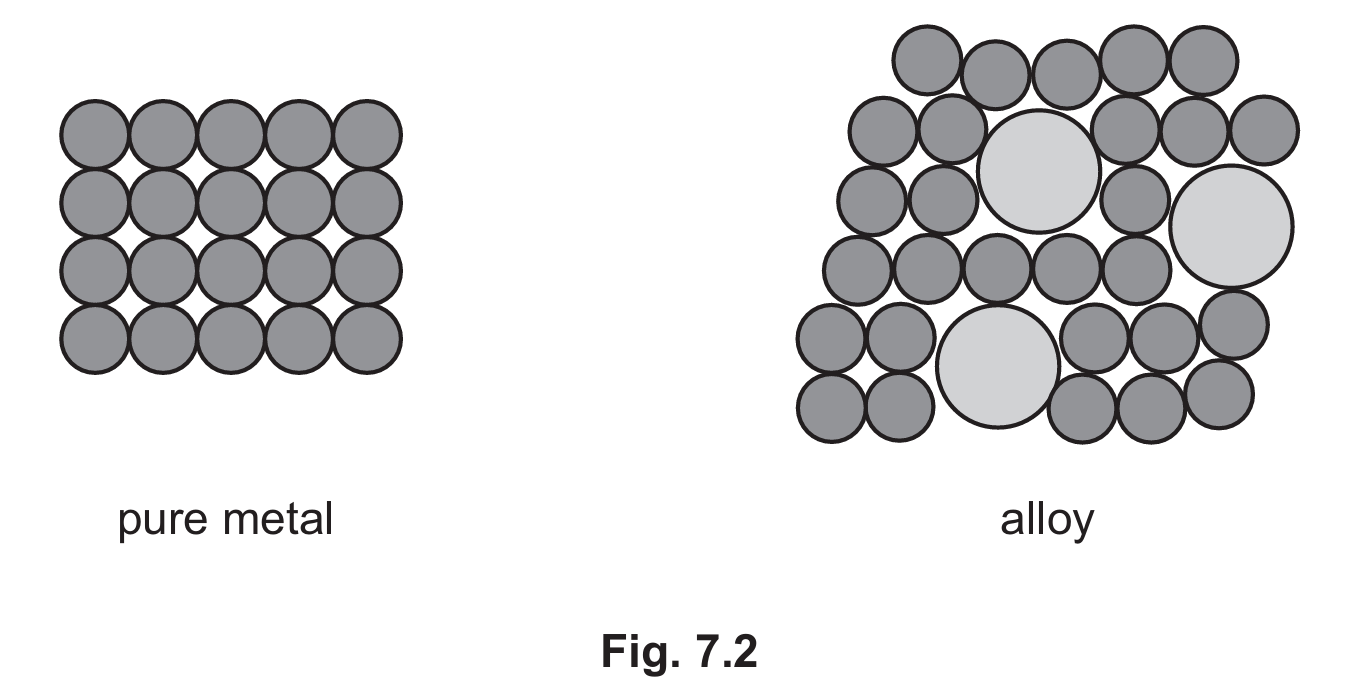
(e) Why brass is harder and stronger:
In pure metals, atoms are arranged in regular layers that can slide over each other. In an alloy like brass, the zinc atoms are different sizes from the copper atoms. This disrupts the regular arrangement of the layers, preventing them from sliding easily, making the alloy harder and stronger.