
CIE iGCSE Co-Ordinated Science C4.2 Hydrogen–oxygen fuel cells Exam Style Questions Paper 3
Question
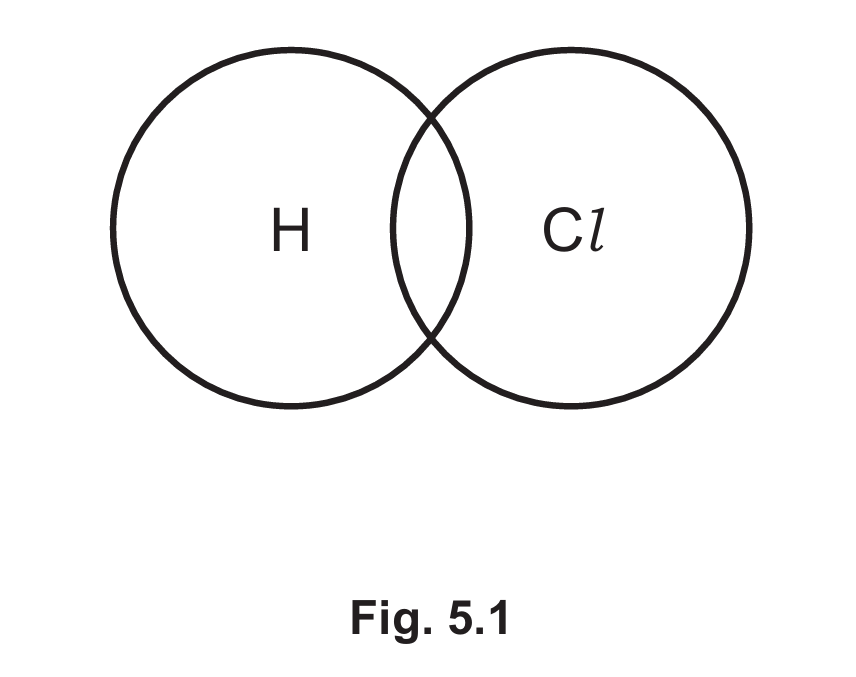
Most-appropriate topic codes (Cambridge IGCSE Coordinated Sciences 0654):
• Topic C10.2 — Air quality and climate (Part (a)(i)-(iv))
• Topic C9.5 — Corrosion of metals (Part (a)(v))
• Topic C2.5 — Simple molecules and covalent bonds (Part (b))
• Topic C7.1 — Characteristic properties of acids (Part (c))
• Topic C4.2 — Hydrogen-oxygen fuel cells (Part (d))
▶️ Answer/Explanation
(a)(i) He
Helium (He) is a monatomic gas because it consists of single atoms rather than molecules. It is a noble gas with a full outer electron shell.
(a)(ii) CO
Carbon monoxide (CO) is a toxic gas produced by incomplete combustion. It binds to haemoglobin in red blood cells, preventing oxygen transport.
(a)(iii) N₂
Nitrogen (N₂) makes up approximately 78% of clean, dry air. It is an inert gas at normal temperatures.
(a)(iv) He or N₂ or O₂
Elements are substances that contain only one type of atom. He, N₂, and O₂ are all elements, while CO, CO₂, and H₂O are compounds.
(a)(v) O₂ and H₂O
Rusting of iron requires both oxygen (O₂) and water (H₂O). These react with iron to form hydrated iron(III) oxide.
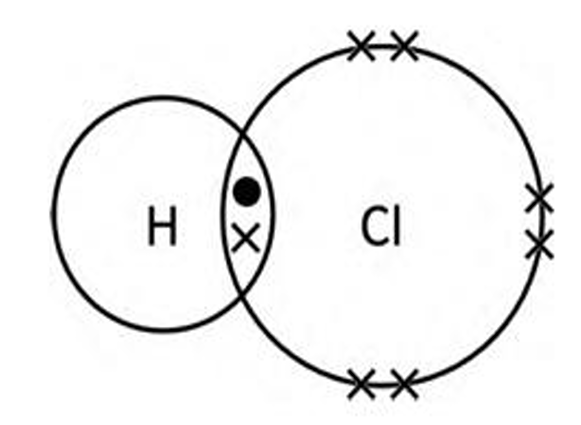
(b) Shared pair correct; all else correct
In HCl, hydrogen shares one electron with chlorine to complete both their outer shells. The dot-and-cross diagram should show one shared pair of electrons.
(c) turns red
Dilute hydrochloric acid is acidic. Acids turn blue litmus paper red, indicating a pH below 7.
(d) hydrogen; oxygen
A hydrogen-oxygen fuel cell uses hydrogen and oxygen as reactants. The chemical energy is converted directly into electrical energy with water as the only product.
Question
A potassium atom has a total of ………………… electrons.
A potassium ion has a positive charge of ………………… .
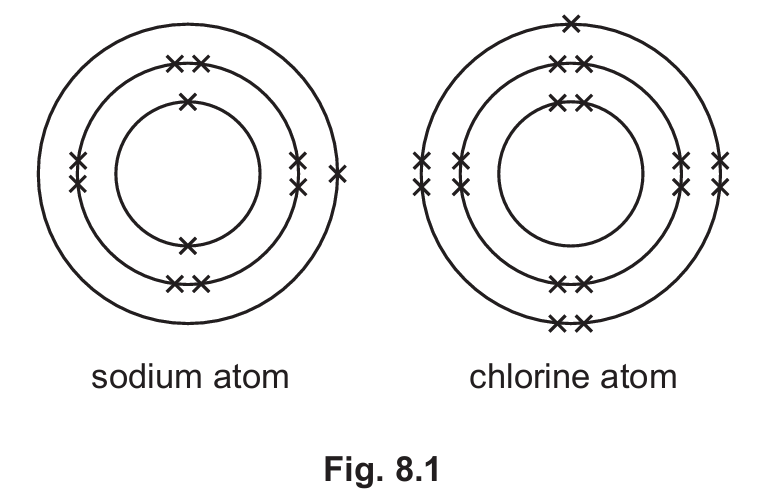
Fig. 8.1 shows the electronic structure of a sodium atom and a chlorine atom.
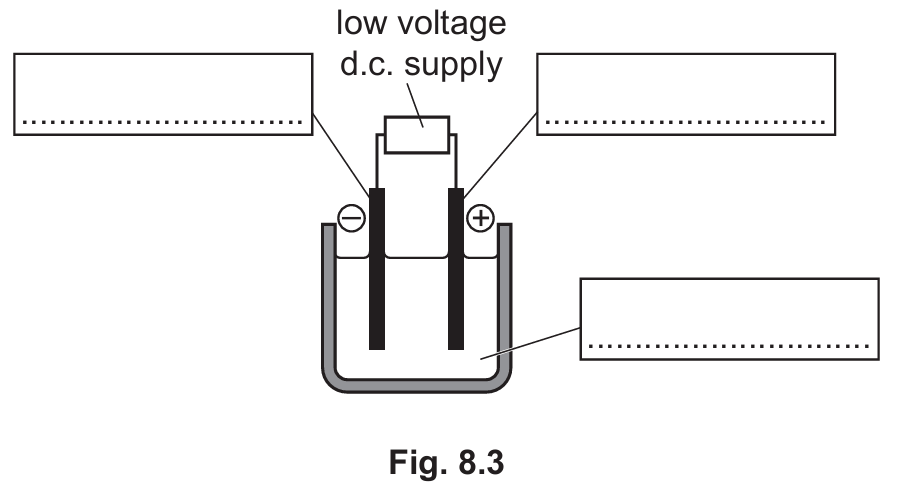
- anode
- cathode
- electrolyte
State the name of the other electrode product.
Most-appropriate topic codes (Cambridge IGCSE Co-ordinated Sciences 0654):
• Topic C8.1 — Arrangement of elements (Part (a))
• Topic C2.4 — Ions and ionic bonds (Part (b))
• Topic C4.2 — Electrolysis (Part (c)(i), (ii), (iii))
▶️ Answer/Explanation
(a) Group 1; 19 electrons; charge of 1
Potassium is an alkali metal, placed in Group 1.
Its atomic number is 19, so it has 19 electrons, and it loses one to form \( K^+ \).
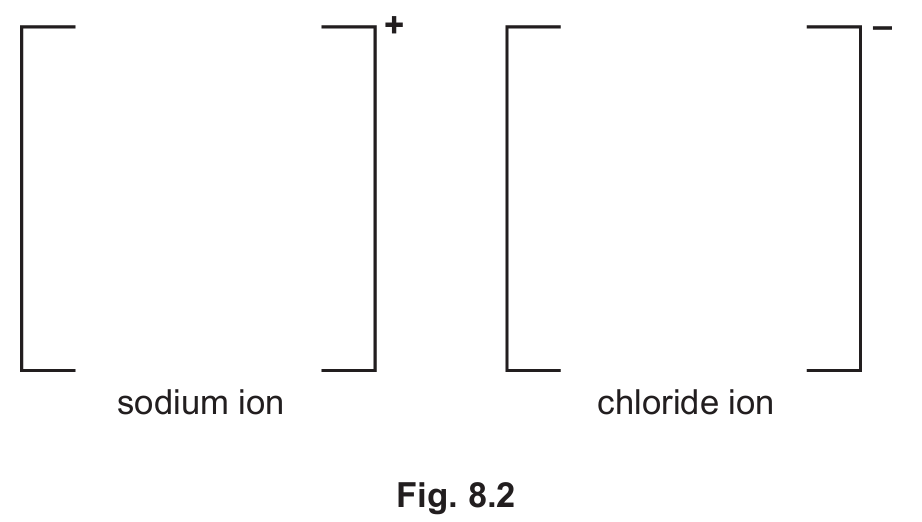
(b) 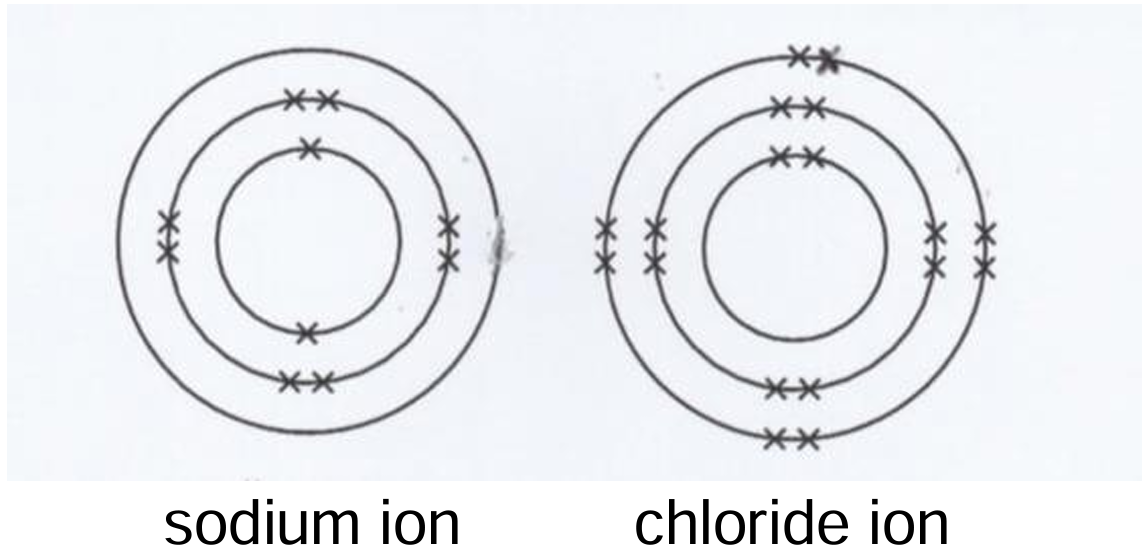
Sodium loses its outer electron, leaving an electron arrangement of 2,8.
Chlorine gains that electron, giving an arrangement of 2,8,8, forming an ionic bond.
(c)(i) Anode is positive; cathode is negative; electrolyte is the NaCl solution
The anode is the positive electrode where oxidation occurs.
The cathode is the negative electrode where reduction occurs, and the electrolyte is the concentrated aqueous sodium chloride.
(c)(ii) Chlorine
Hydrogen gas is produced at the cathode from reduction of hydrogen ions.
Chlorine gas is produced at the anode from oxidation of chloride ions.
(c)(iii) Lighted splint test; gives a pop sound
A lighted splint is held near the gas being tested.
If hydrogen is present, it burns rapidly with a characteristic “pop” sound.